The Elephant spiritual meaning is associated with memory, family, emotional intelligence, protection and strength that does not need to be constantly displayed. Elephants are the largest living land animals, but their symbolic importance comes from more than size. They live in socially complex groups, communicate over distance, maintain long-term relationships, care for calves cooperatively and show strong responses to the deaths and distress of other elephants. Those traits make the Elephant a more precise symbol of social memory and protective power than the vague idea of “being strong.”
This guide separates the Elephant’s real biology from documented cultural associations and from modern spiritual interpretation. That distinction matters: animal symbolism is more useful when it grows from accurate observation instead of repeating a stereotype as if it were zoology or claiming that a recent interpretation is an ancient universal belief.
Elephant spiritual meaning: quick guide
| Core meanings | Memory, family bonds, wisdom, emotional intelligence, strength, protection and long-term continuity |
| Shadow meanings | Carrying old grief too long, family pressure, domination, emotional heaviness and confusing strength with control |
| Spirit animal lesson | Use strength to protect relationships and memory to guide the future, not to remain trapped in the past |
| Best interpretive method | Start with species, behavior and context; use symbolism as reflection, not prediction |
What does a Elephant symbolize?
Elephant biology gives several layers to the symbolism. In many African elephant populations, related females and their young form stable social units led by experienced females. Knowledge about water, movement, risk and social relationships can be especially valuable in older individuals. The popular phrase “an elephant never forgets” is an exaggeration, but elephants do have impressive spatial and social memory. Spiritually, memory here means continuity: experience becomes useful when it helps the group navigate what comes next.
The trunk adds another symbolic contrast. It is powerful enough to move heavy objects and precise enough to manipulate small ones, smell, drink, touch and communicate. That combination makes the Elephant a useful image of controlled power. Strength becomes most effective when it can change scale—from force to tenderness without losing competence.
Elephants also communicate through sound, touch, scent and low-frequency calls that can travel over long distances. Symbolically, this supports themes of connection beyond immediate proximity and the importance of signals that are not obvious to everyone. The lesson is not mystical telepathy; it is that relationships are maintained through many channels, some subtle and some explicit.
The shadow meaning appears when memory becomes burden. Remembering danger is adaptive, but a person can use memory to keep an old injury permanently present. Elephant symbolism therefore asks whether the past is functioning as knowledge or as weight.
Elephant as spirit animal, totem and power animal
As a modern spirit animal, Elephant can become relevant during periods involving family responsibility, grief, leadership or long-term decision-making. It favors the perspective of the matriarch rather than the impulse of the moment: what information has accumulated, who depends on the decision, and what path preserves the group over time?
As a power-animal image, Elephant represents grounded authority. The animal does not need to prove its size. This makes it a useful symbol when you need to hold a boundary calmly, carry responsibility without theatrical aggression, or use influence in a way that protects rather than intimidates.
People drawn to Elephant symbolism may identify with loyalty, family memory, patience and the tendency to carry other people’s needs. The shadow is over-responsibility: becoming the emotional archive, protector and problem-solver for everyone. Healthy Elephant symbolism includes support within the group. Even a powerful social animal does not live as if it must do everything alone.
Elephant can also symbolize grief without reducing elephant behavior to human emotion. Researchers have documented unusual attention to bones, bodies and remains of other elephants. For a spiritual reader, this can become an image of acknowledging loss and maintaining continuity with the past while still moving through the landscape.
Modern spirituality often uses spirit animal, totem and power animal as if the terms were interchangeable. They are not. “Totem” belongs to specific Indigenous cultural systems and should not be detached from those traditions and presented as a generic personal label. The interpretation here is therefore framed primarily as contemporary animal symbolism. For the terminology, see Spirit Animals, Totems & Power Animals.
What does it mean when you see a Elephant?
A wild Elephant encounter should first be treated as an encounter with a very large, potentially dangerous animal. Distance, local guidance and animal welfare take priority over symbolic interpretation. If the moment remains personally meaningful afterward, the specific behavior matters.
A herd moving together can emphasize family systems, coordinated movement and the protective value of experience. A mother with a calf naturally brings themes of care and responsibility. A solitary bull may shift the symbolism toward independence, maturity and power outside the family unit. Elephants at water can symbolize memory of resources, renewal and the knowledge required to survive dry periods.
Seeing repeated Elephant imagery during a family decision may invite you to think in generations rather than hours. During grief, the symbol may suggest honoring memory without confusing remembrance with refusal to move forward. During leadership, it may ask whether your strength makes the group safer or merely more obedient.
In dreams, an Elephant can represent something too large to ignore, a family history, responsibility or a long memory. A calm Elephant may symbolize stable power; a charging Elephant can reflect pressure, fear or a boundary that has been pushed too far. A lost calf may point toward vulnerability within a family system. A herd crossing a difficult landscape can symbolize collective endurance.
Repeated encounters do not automatically prove that a supernatural message has been sent. First ask what the animal is doing and why it may be present. Then ask whether that pattern mirrors a real issue in your life. This method keeps symbolism specific and prevents ordinary wildlife behavior from being turned into a prediction.
Elephant in folklore, religion and cultural symbolism
Elephant symbolism differs sharply across cultures, so it should not be compressed into one “ancient meaning.” In Hindu traditions, Ganesha is a major deity with an elephant head, associated in different contexts with beginnings, wisdom and the removal of obstacles. This is a specific religious tradition, not evidence that all Elephants everywhere mean the same thing.
In Buddhist art and literature, elephants can appear in different symbolic roles, including royal power, mental discipline and important narrative episodes. Again, meanings depend on the text, school and context. African cultures also contain many distinct elephant traditions, but “African Elephant meaning” is too broad to be responsible without identifying a specific people and source.
In modern Western symbolism, elephants have also become conservation icons and family symbols. These contemporary meanings are influenced by wildlife research, documentaries and public awareness of poaching and habitat loss. They are legitimate modern associations, but they should not be mislabeled as ancient doctrine.
Species and behaviors: how the meaning changes
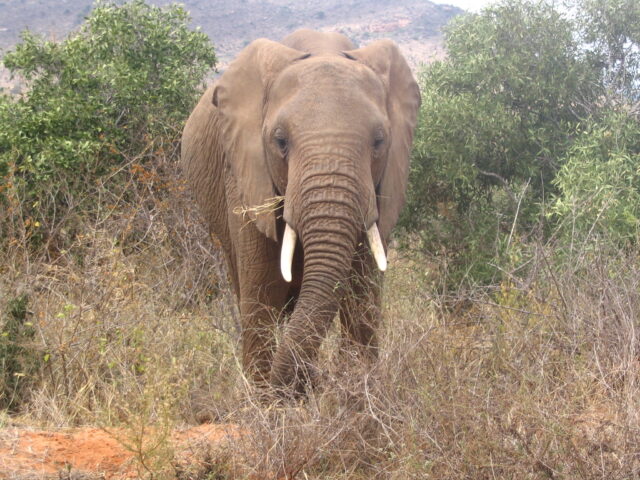
There are living African savanna elephants, African forest elephants and Asian elephants, each with different habitats, body forms and social/ecological contexts. The animal in this article’s image is an African savanna elephant. A symbolic reading should not treat every species as ecologically identical.
Behavior is even more informative than species. Herd travel emphasizes community; dust bathing can emphasize body care and protection from the environment; trunk touching emphasizes social contact; a threat display emphasizes boundaries; long-distance travel emphasizes memory and persistence. Calves introduce learning and dependency, while older females can symbolize accumulated knowledge.
Male and female life histories also differ. Adult males may spend substantial time apart from female family groups while maintaining their own social relationships. This complicates the simplistic idea that “Elephant always means family.” Sometimes the animal also represents maturation into a different social role.
The practical spiritual lesson of the Elephant
The Elephant asks how you are using memory and power. Are they protecting continuity, or are they keeping you bound to old patterns?
- Use accumulated experience to make the next decision better rather than to replay the last injury.
- Protect vulnerable people without making them permanently dependent on you.
- Let authority become calmer as competence increases.
- Think in longer cycles when a decision will affect a family, community or future self.
- Make room for grief without making grief the permanent center of the group.
The deepest Elephant symbolism is not simply “strength.” It is strength integrated with relationship, memory and restraint. The animal’s scale becomes spiritually meaningful precisely because so much of its life is social: enormous power is embedded inside networks of care, communication and learned experience.
For the wider context, continue with Mammal Symbolism. The strongest animal symbolism keeps the living animal visible: biology provides the pattern, documented history provides cultural context, and spiritual interpretation turns those patterns into questions for reflection rather than fixed omens.
References
Web References
- https://animaldiversity.org/accounts/Elephantidae/
- https://www.elephantsforafrica.org/elephant-facts/
- https://nationalzoo.si.edu/animals/asian-elephant
Image Reference
https://commons.wikimedia.org/wiki/File:Loxodonta_africana_in_Tsavo_East_National_Park.jpg