NASA researchers studying 37 nearby dwarf galaxies have found a surprisingly large shortfall in the oxygen these galaxies should have produced. The Galaxies Losing Oxygen via Winds, or GLOW, project used Hubble observations to reconstruct star-formation histories and calculate how much oxygen stellar generations ought to have left behind. The results, reported by NASA on November 2 and published in The Astrophysical Journal, suggest that small galaxies have been especially effective at losing the heavier elements forged by their stars.
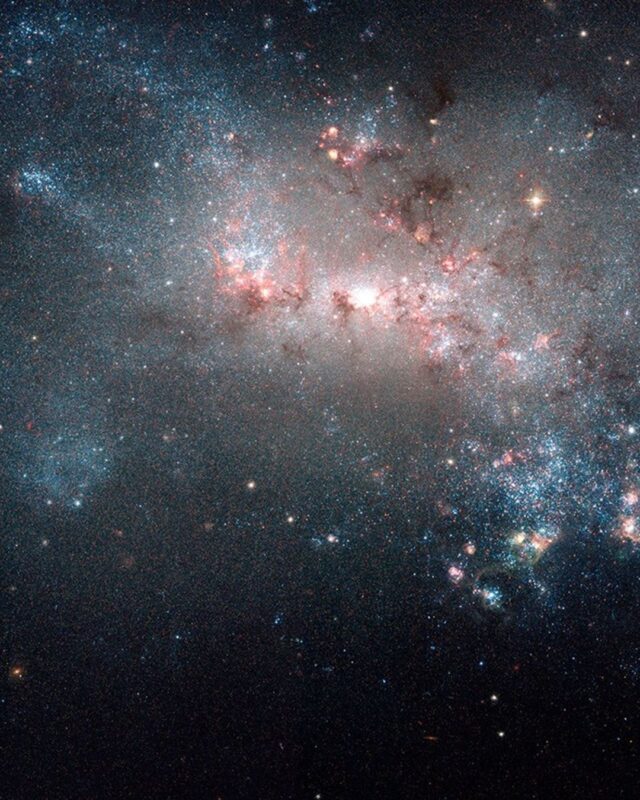
Oxygen is made inside stars and released through stellar evolution and explosions. In a galaxy with relatively little mass, energy from massive stars and supernovae can push enriched gas outward. Researchers already expected this process, but the new comparison indicates that a much smaller fraction of the oxygen remains within the studied galaxies than current models would predict. The missing material has not been directly traced to a single destination: some could surround the galaxies in diffuse gas, while some may have escaped farther into the space between galaxies.
The team combined Hubble’s resolved-star observations with information from other telescopes, including Spitzer and radio facilities. Oxygen was chosen because scientists can measure it comparatively well and use it as a signpost for other heavy elements. This is not evidence that oxygen has ceased to exist or been destroyed. It is a problem of cosmic accounting: astronomers need to learn where the material travels and whether their models correctly describe those flows.
The result has consequences far beyond a single chemical element. Elements assembled in stars circulate through galaxies and eventually become part of later stars, planets and, in suitable circumstances, living systems. A philosophical reflection on the shared material origins of distant worlds is reasonable; a claim that the measurement proves a spiritual force is not. The study instead demonstrates how much remains unknown about the routes by which the universe recycles matter.
The proposed next step involves faint, even smaller galaxies that the Nancy Grace Roman Space Telescope may help identify. Until their gas reservoirs are better mapped, the missing oxygen remains an open observational question. Readers following the wider story of stellar transformation can also explore our earlier coverage of the Cat’s Head Nebula seen by Hubble and Webb.
References