A new study of cave paintings in China’s Altai Mountains suggests that the same rocky spaces attracted artists and communities across dramatically different historical periods. Investigators have used advanced imaging to document visible and previously obscured figures, building a picture of religious and artistic change rather than a single unbroken tradition.
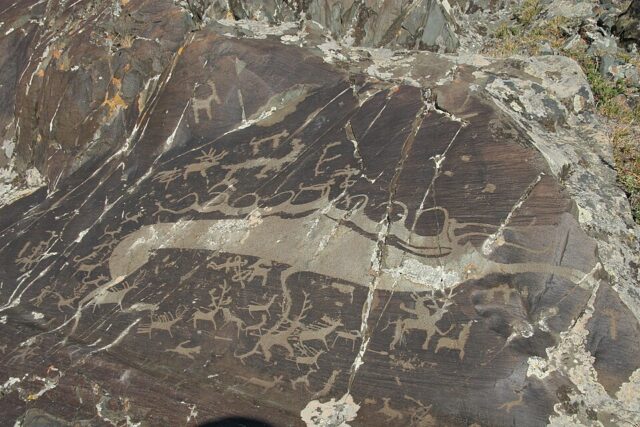
The research, reported in October 2026, focused on the Tangbaletasi painted caves in Xinjiang. Researchers examined two cave interiors and compared paintings, materials and motifs using an approach that included hyperspectral imaging. That method detects differences in reflected light outside the range of ordinary photography, helping bring faded details back into analytical view without touching the art.
The paintings appear to represent multiple phases of activity, including early figures associated with prehistoric traditions and later imagery connected with Tibetan Buddhism. The long time span is important: the evidence does not imply that one community practiced the same religion unchanged for millennia. Different groups may have returned to a significant landscape and left their own traces.
Rock art can illuminate how a place was remembered, revisited and reinterpreted, but images do not arrive with labels explaining their meaning. Animals, human forms and religious figures might have different significance depending on who made them. Dating, pigment analysis and comparisons with better-documented material are necessary before identifying a particular rite, deity or ceremony.
Hyperspectral imaging is especially useful when pigments have faded or overlapped. It can separate visual information that the unaided eye perceives as one indistinct surface. This does not produce a complete reconstruction automatically; researchers still need to distinguish original paint, later additions, deterioration and natural marks.
The appearance of Tibetan Buddhist elements in some phases points to a wider history of religious interaction across Inner Asia. The Altai region has long connected routes, communities and landscapes. Images found within one cave may therefore preserve evidence of repeated cultural contact rather than the development of a single isolated artistic school.
The discovery invites reflection on sacred space without requiring supernatural explanations. A cave can acquire meaning because of its physical form, location, inherited stories or a community’s decision to return. When different groups reuse a location, its walls may become a visible record of successive understandings of the world.
The careful conclusion is that the paintings preserve multiple artistic and religious horizons and that new imaging is improving their documentation. Claims that individual prehistoric scenes depict specific shamanic journeys or ceremonies remain interpretations unless supported by additional evidence.
References
- Research article, Heritage Science, DOI: https://doi.org/10.1038/s40494-026-02433-7
- HeritageDaily, October 11, 2026: https://www.heritagedaily.com/2026/10/ancient-cave-paintings-reveal-thousands-of-years-of-religious-activity-in-china/159543