Archaeological evidence from the Maya city of Aké in Mexico’s Yucatán Peninsula shows that people continued to live, work and conduct ritual activities there centuries after the center’s earlier political importance had diminished. A newly discussed study identifies small domestic structures and shrine-like spaces belonging to a later period of occupation, offering a different picture from the familiar story of a city that simply vanished after its peak.
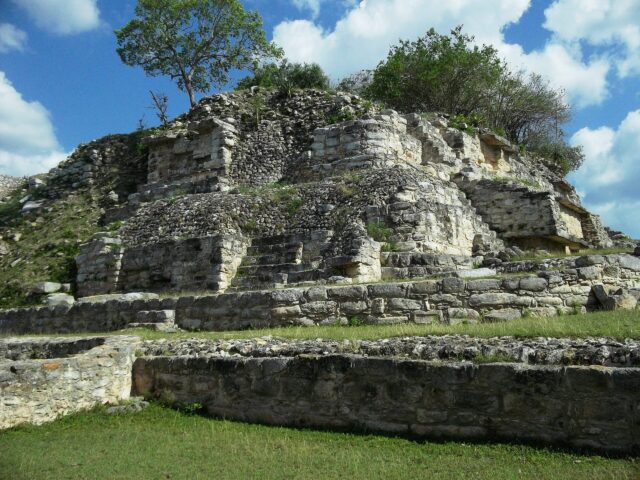
The results were highlighted by Archaeology magazine on October 22, 2026, drawing on research published in Latin American Antiquity. Ceramic finds from household mounds and a refuse pit point to occupation extending approximately from AD 1100 to 1550. Those dates are significant because they place daily life at Aké well beyond a period often described in broad histories as the collapse of Classic Maya political centers.
Researchers recovered objects associated with recognizable routines: grinding stones, stone tools, spindle whorls and animal remains. Together, the artifacts suggest food preparation, cooking, textile production and other domestic activities. Instead of presenting Aké only as a set of monumental ruins, the evidence encourages attention to the people who occupied its smaller residential spaces.
Five small structures interpreted as shrines contained ceramic incense burners, animal figurines and vessels. Incense burners are especially relevant to the study of ancient religion because they can provide material traces of ceremonies that otherwise leave no written record. Their presence does not, however, reveal a complete liturgy, the names of the deities honored or the beliefs of each household.
The distinction between household practice and state religion matters. Monumental temples and royal inscriptions are more likely to survive and attract public attention, but religious activity also took place in ordinary neighborhoods. A small shrine may represent kinship, local identity, a domestic tradition or a combination of these. Archaeologists must use architectural placement, object deposits and chronology to investigate those possibilities.
These finds also complicate the language of ‘collapse.’ A decline in elite institutions, public construction or regional influence is not identical to the sudden disappearance of residents. Political systems can unravel while communities continue farming, trading, raising children and maintaining ritual obligations. The new study at Aké adds a specific archaeological case to a larger debate about the uneven consequences of historical change.
That does not mean the later occupation was unchanged or secure. The number, size and placement of dwellings suggest a different settlement pattern from the city’s earlier phases. Researchers are still reconstructing how the community’s population, resources and external relationships evolved across those centuries. Neither the shrines nor the recovered household tools provide a complete demographic record.
The reported chronology extends toward the era of Spanish colonial intervention. The magazine notes the possibility that inhabitants were later moved during the sixteenth century. Such historical transitions would require evidence from both archaeological contexts and documentary sources; the end of a particular pottery sequence is not itself proof of a precise political episode.
For readers interested in spirituality, the findings offer a reminder that ancient religions were lived practices rather than only mythologies recorded in books. An incense burner in a household setting shows that rituals could be woven into ordinary social life. It does not justify recreating a specific Maya ceremony today or claiming that archaeologists have recovered all of its meanings.
The result is a quieter but important discovery: resilience and adaptation remain visible after the end of a city’s best-known political age. Aké’s later residents were not merely survivors in the background of monumental history. Their tools, dwellings and small shrines are now evidence in their own right, allowing the archaeological story to continue beyond a simplistic ending.
Related reading: our report on Maya frog pendants and ancient exchange networks examines another form of material evidence that requires interpretation in its cultural context.
References
Latin American Antiquity research highlighted by Archaeology, October 22, 2026 — https://archaeology.org/news/2026/10/22/people-continued-to-live-in-maya-city-after-its-collapse/
Journal of Latin American Antiquity, Cambridge University Press — https://www.cambridge.org/core/journals/latin-american-antiquity