Australian scientists have independently recovered the ring-like structure surrounding the supermassive black hole in galaxy M87 using a new way of processing observations from the Event Horizon Telescope. In a news release on November 12, 2026, CSIRO said the method corroborates the structure shown in the image first unveiled in 2019. This is a fresh test of existing astronomical data, not the discovery of another black hole.
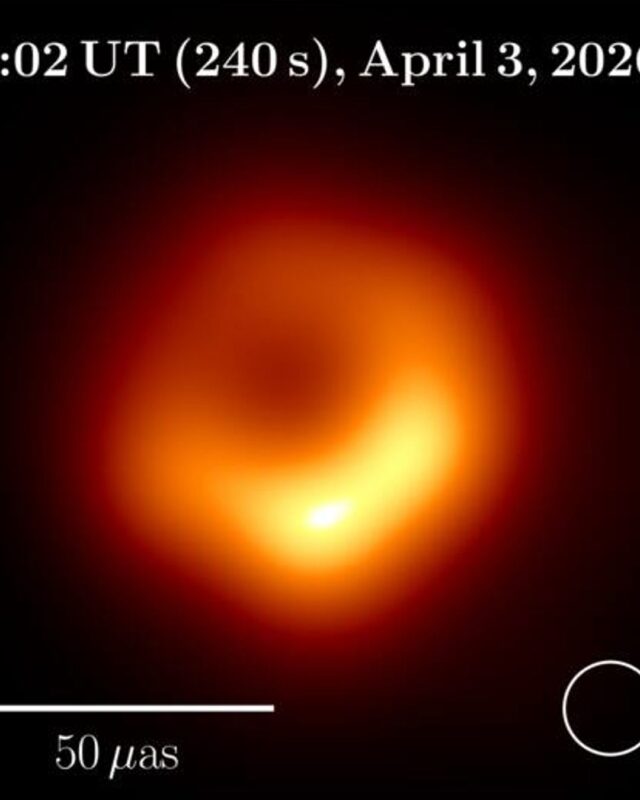
The first M87 image came from a network of radio telescopes acting together as an Earth-sized observatory. Its data were difficult to turn into a picture: the telescopes recorded only limited portions of the information needed to reconstruct the source, while weather and calibration effects introduced additional complications. The now-familiar glowing ring was the result of careful reconstruction and cross-checking rather than an ordinary optical photograph.
The Australian team’s technique, called GenDIReCT, combines machine learning with constraints from telescope measurements. In work published in Nature, the investigators used this alternative route to examine what structures could reliably be recovered from the observations. Obtaining a similar ring through a different processing approach matters because it reduces dependence on the choices made by any single imaging pipeline.
The ring is understood as emission from hot material near a black hole whose intense gravity bends light. Its dark central region is often called the black hole’s shadow. A reconstruction is not a literal picture of the event horizon, which cannot be directly illuminated from within. It is a physically informed image of radiation and gravitational effects near that boundary.
Strong confirmation does not imply that every detail in either image is beyond dispute. The precise brightness distribution and fine structure depend on sensitivity, coverage and modeling assumptions. Researchers still need observations taken at other epochs and continued comparisons with theoretical models to understand how the region changes over time.
The discovery raises a philosophical question about what it means to see something that cannot itself emit escaping light. Scientists can infer properties of distant objects from signals shaped by gravity and plasma; those inferences are testable, even when the subject lies far beyond direct human experience. That distinction leaves metaphysical interpretations open to discussion but does not turn black-hole physics into evidence for a spiritual claim.
Templum Dianae recently covered the question of missing oxygen in dwarf galaxies, another case in which a new analysis changes how astronomers understand an established observation. The M87 result likewise shows the value of revisiting extraordinary data with independent methods.
References