A small bronze ring brought up from the submerged royal quarter of ancient Alexandria bears a remarkable image: the Lighthouse of Alexandria, one of antiquity’s celebrated architectural wonders. The object was recovered from the underwater site of the palace on Antirhodos, a royal island now beneath the waters of Alexandria’s eastern harbour. Its importance lies not in its size but in its combination of imagery, location and the questions it raises about how power was administered in the ancient city.
The European Institute for Underwater Archaeology, directed by Franck Goddio, announced the find on October 7, 2026. The team described it as the first known bronze ring-signet depicting the famous lighthouse. It was discovered during ongoing underwater excavations in the area once occupied by Alexandria’s royal palace complex, where researchers are documenting remains that once formed part of the ancient Portus Magnus.
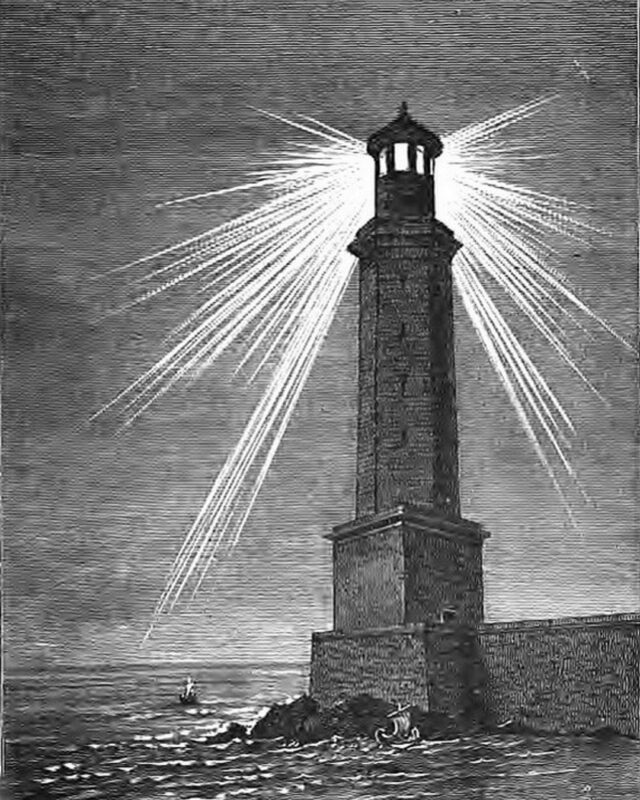
The lighthouse itself, traditionally associated with the island of Pharos, became a defining landmark of the Ptolemaic city. Erected in the centuries after Alexander the Great’s conquest of Egypt, it was both an aid to navigation and a monumental statement of Alexandria’s role as a Mediterranean harbour and centre of learning, exchange and royal power.
A lighthouse image on a ring may appear to be simple civic decoration. Yet ring-signets in ancient societies often served as recognizable personal or administrative marks. Their impressions could be used to seal and authenticate objects or communications. Without evidence of the ring’s specific owner and use, however, the newly recovered object cannot simply be assigned to a named official or reconstructed into an exact administrative procedure.
The relief on the ring resembles some representations of the lighthouse known from coins of the second century CE, according to the excavation announcement. That resemblance gives scholars an important comparative point, but it does not automatically establish a precise date for the ring itself. Archaeological chronology depends on the material context, the object’s manufacture and its relationship to deposits encountered during excavation.
The island of Antirhodos makes the discovery particularly intriguing. The area was part of the royal quarters of ancient Alexandria and had a history extending across successive political periods. Classical author Strabo visited Alexandria in the late first century BCE and referred to royal structures in the harbour. The newly recovered ring offers one more material connection between the submerged palace landscape and the city’s celebrated public monuments.
Goddio has suggested that the find is consistent with administrative functions in the palace complex, potentially including activities connected to the lighthouse. That is a significant interpretation from the excavating team, but it should be presented as an archaeological hypothesis rather than a demonstrated institutional chart. One artifact can point toward a network of activities without proving the full organization of government.
Alexandria’s underwater remains also reveal how cities can disappear from ordinary view without vanishing from history. Natural processes, including changes in coastal terrain, submerged structures and long-term harbour transformation, helped obscure portions of the ancient royal quarter. Underwater archaeology makes it possible to investigate those spaces in situ rather than relying solely on scattered sculptures, written testimonies or objects with uncertain provenances.
The ring illustrates an important methodological point. Artifacts do not speak in complete narratives; their meaning grows from the relationships investigators can establish among location, associated objects, historical texts, material characteristics and comparable images. A symbol recognized immediately by a modern observer may have fulfilled several functions for the person who owned or used it.
The lighthouse itself was both a practical structure and an unusually powerful civic emblem. Its image linked the city to safe passage, royal patronage and international exchange. Those associations can be explored historically without claiming that every ancient depiction carried a single religious or spiritual message. For a city whose harbour was central to its identity, a recognizable tower could serve as an especially effective image of belonging and authority.
The larger excavation programme is therefore central to the story. As archaeologists record the submerged architecture and recover additional material, they can better understand the palace’s changing uses. The ring is valuable not only as an attractive image of a lost wonder but also as a clue whose significance depends on the continued study of its context.
The discovery invites readers to imagine a city in which monumental architecture, maritime movement and administrative life were deeply interconnected. The familiar outline of the lighthouse survived in a portable object, while the palace where it was found remained hidden underwater. The challenge for researchers now is to discover precisely what brought the two together.
References
https://www.franckgoddio.org/cn/service/newsletter/detail/new-find-in-the-eastern-port-of-alexandria/ — Franck Goddio / IEASM field announcement, October 7, 2026.