Astrology meaning begins with the idea that the sky can be read as a symbolic language of timing, character, pressure, desire, and direction, through the positions of the Sun, Moon, planets, and zodiac signs at a given moment.
When you understand astrology with precision, relationships stop feeling casual and random. You start recognizing why some people pull you into confusion, why others activate desire, why certain periods sharpen your ambition, and why money flows more easily in one season of life than in another. A chart gives structure to what you already feel but cannot always name. That structure changes standards, choices, boundaries, timing, and the way you direct your energy toward attraction, stability, and material results.
- Astrology meaning in plain language, from the core definition to the real function of a birth chart
- Astrology symbols meaning, including zodiac glyphs, planetary glyphs, houses, and aspect patterns
- How to apply astrology meaning to love, personal power, money, career direction, and daily decisions
- … and much, much more!
Keep reading to make your chart easier to decode and your choices easier to direct.
“…in the vision of Templum Dianae, astrology meaning becomes the moment you stop treating your love life and abundance as chaos, and begin reading them as patterns that can be recognized, interpreted, and directed with more clarity…”
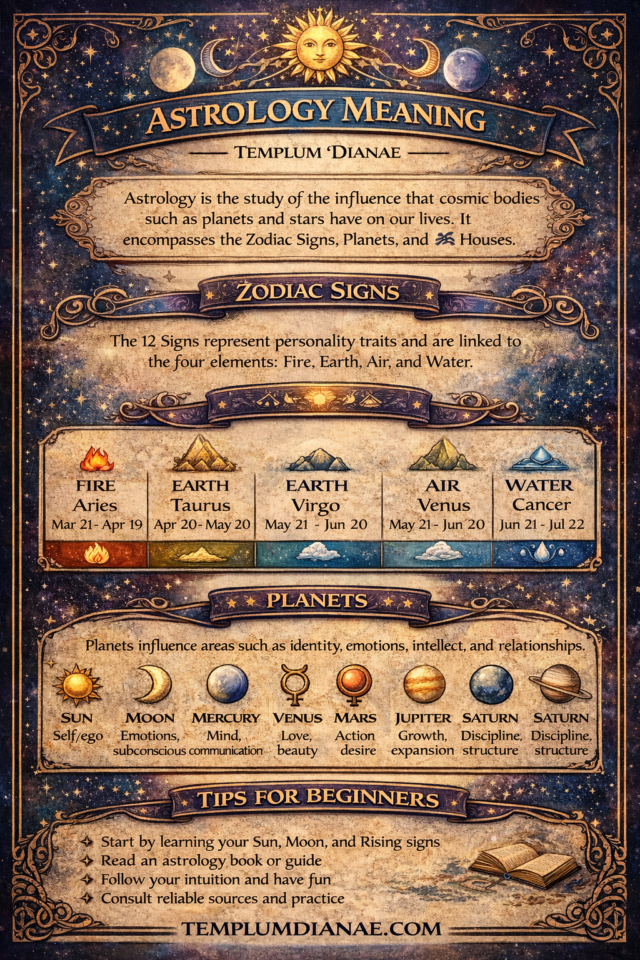
What is astrology?
Astrology is traditionally understood as a system that interprets the positions and apparent movements of celestial bodies as meaningful signs connected with earthly life, temperament, and timing. In practical use, astrology reads a moment in time through a horoscope or chart. The most common example is the natal chart, built from the date, exact time, and place of birth.
What astrology studies
Astrology studies relationships between celestial cycles and symbolic patterns in human life. In classical and modern Western practice, interpretation usually depends on four main factors: planets, zodiac signs, houses, and aspects. Planets describe functions. Signs describe style. Houses describe life areas. Aspects describe the dynamic tension or harmony between different parts of the chart.
What astrologers do
An astrologer works with a chart as a map. That map is used to interpret temperament, recurring themes, relational habits, timing cycles, and areas of strength or difficulty. Some branches focus on the birth chart. Others focus on questions, elections of favorable timing, nations, or public events.
Astrology meaning in simple terms
In simple terms, astrology means reading the sky as a symbolic code. A chart does not replace judgment. It gives structure to judgment. A strong Venus placement can show how you love, receive, attract, and assign value. A stressed Saturn can show where fear, delay, scarcity, or discipline shape your life. A loaded seventh house can turn relationships into the main stage on which your growth unfolds.
People return to astrology because it names patterns they feel before they can explain them. A chart can help a woman recognize why she repeats the same emotional contract, why money feels easier in one period and blocked in another, or why confidence rises when a specific transit activates her natal Sun, Venus, or Midheaven.
| Core term | Plain meaning | Why it matters in real life |
|---|---|---|
| Planet | A function or drive | Shows what part of you is acting |
| Sign | A style of expression | Shows how that energy behaves |
| House | A life area | Shows where the energy lands |
| Aspect | A relationship between chart factors | Shows ease, tension, attraction, or friction |
| Birth chart | A map of the sky at birth | Shows your core pattern |
Astrology vs astronomy
Key differences
Astronomy is a scientific discipline that studies celestial objects and phenomena through observation, mathematics, and physics. Astrology is a symbolic and divinatory tradition that interprets celestial positions as meaningful for human life. In older periods the two were treated more closely, but they gradually separated as astronomy developed into a modern natural science.
Why people confuse them
People confuse them because both use the same sky. Both talk about planets, stars, constellations, and cycles. The difference lies in purpose. Astronomy asks what celestial bodies are and how they move. Astrology asks what those movements mean inside a symbolic system.
| Topic | Astronomy | Astrology |
|---|---|---|
| Main aim | Explain celestial phenomena | Interpret symbolic meaning |
| Method | Observation, measurement, physics | Chart construction and interpretation |
| Output | Scientific models and data | Horoscopes and readings |
| Status today | Science | Divinatory and symbolic system |
History of astrology
Mesopotamia and Egypt
The roots of astrology reach back to the ancient world, especially Mesopotamia, where celestial observation was linked to omen traditions, calendars, rulership, and timing. Egyptian and Babylonian currents later fed into more formal astrological systems.
Hellenistic astrology and Ptolemy
A major turning point came in the Hellenistic period, when techniques involving zodiac signs, houses, aspects, and horoscopic charts became more systematized. Claudius Ptolemy’s Tetrabiblos became one of the most influential texts in the Western tradition.
Later developments
Astrology developed into multiple traditions and branches over time. Western astrology, natal astrology, horary astrology, electional astrology, Hindu astrology, and Chinese astrology preserve distinct methods and symbolic systems.
| Period | What developed | Why it matters now |
|---|---|---|
| Ancient Mesopotamia | Celestial omens and early sky interpretation | Foundation of later symbolic reading |
| Hellenistic era | Zodiac, houses, aspects, horoscope methods | Core structure of Western chart reading |
| Medieval and early modern periods | Transmission and technical expansion | Branches and methods spread widely |
| Modern era | Popular horoscopes and psychological readings | Astrology enters mass culture |
Basics of astrology
Planets
Planets represent functions, drives, and forces. In chart reading they answer the question: what is acting here?
Signs
Signs describe style, quality, and mode of expression. They answer the question: how is that energy acting?
Houses
Houses show the field of life in which the energy operates. They answer the question: where is it happening?
Aspects
Aspects show the angular relationships between planets and points in the chart. They answer the question: how do these forces interact?
| Building block | Main question | Example |
|---|---|---|
| Planet | What? | Venus, Mars, Saturn |
| Sign | How? | Venus in Taurus, Mars in Scorpio |
| House | Where? | Venus in the 2nd house, Mars in the 7th |
| Aspect | How do they interact? | Venus trine Jupiter, Mars square Saturn |
What planets mean in astrology
The lights and the personal planets
The Sun is linked with identity, vitality, and the core will. The Moon is linked with instinct, need, emotion, and habit. Mercury deals with speech, thought, analysis, and exchange. Venus deals with attraction, pleasure, value, affection, aesthetics, and money logic. Mars deals with desire, conflict, pursuit, and force.
The social and outer planets
Jupiter expands, amplifies, protects, and seeks meaning. Saturn limits, structures, matures, and tests. Uranus is associated in modern astrology with disruption and liberation. Neptune is linked with vision, diffusion, and longing. Pluto is linked with intensity, power, and deep transformation.
| Planet | Main meaning | Relationship theme | Abundance theme |
|---|---|---|---|
| Sun | Identity and will | Self-respect and presence | Confidence in leadership |
| Moon | Needs and instincts | Attachment and emotional safety | Security habits |
| Mercury | Mind and communication | Conversation and miscommunication | Negotiation and trade |
| Venus | Attraction and value | Love, magnetism, pleasure | Money taste, pricing, receptivity |
| Mars | Action and desire | Pursuit and tension | Ambition and execution |
| Jupiter | Growth and expansion | Faith and generosity | Opportunity and increase |
| Saturn | Discipline and pressure | Fear, commitment, limits | Structure, delay, long-term gain |
What zodiac signs mean
The 12 signs
The zodiac in Western astrology consists of twelve signs, each occupying thirty degrees of the ecliptic in the astrological scheme. The signs are Aries, Taurus, Gemini, Cancer, Leo, Virgo, Libra, Scorpio, Sagittarius, Capricorn, Aquarius, and Pisces.
Elements and modalities
Each sign belongs to an element and a modality. The four elements are fire, earth, air, and water. The three modalities are cardinal, fixed, and mutable. This matters because sign meaning is not random. Fire pushes outward. Earth stabilizes and materializes. Air connects, thinks, and exchanges. Water absorbs and feels. Cardinal signs initiate. Fixed signs preserve. Mutable signs adapt.
| Sign | Element | Modality | Core style |
|---|---|---|---|
| Aries | Fire | Cardinal | Direct, initiating, fast |
| Taurus | Earth | Fixed | Steady, sensual, resistant |
| Gemini | Air | Mutable | Curious, verbal, mobile |
| Cancer | Water | Cardinal | Protective, responsive, inward |
| Leo | Fire | Fixed | Expressive, proud, radiant |
| Virgo | Earth | Mutable | Precise, useful, analytical |
| Libra | Air | Cardinal | Relational, balancing, refined |
| Scorpio | Water | Fixed | Intense, private, penetrating |
| Sagittarius | Fire | Mutable | Expansive, frank, searching |
| Capricorn | Earth | Cardinal | Strategic, contained, ambitious |
| Aquarius | Air | Fixed | Detached, conceptual, reforming |
| Pisces | Water | Mutable | Porous, imaginative, fluid |
What houses mean in astrology
The 12 houses
Houses are divisions of the chart linked to areas of life such as identity, money, communication, home, romance, work, partnership, shared resources, belief, career, community, and the hidden inner world. The same planet changes expression according to house placement. Venus in the second house speaks differently from Venus in the eighth. Mars in the first behaves differently from Mars in the tenth.
Angles and house rulers
The Ascendant marks the eastern horizon and is tied to the first house. The Descendant opposes it. The Midheaven is associated with visibility and public direction. The Imum Coeli points toward roots and foundations. House rulers add another layer by linking each house cusp sign to its planetary ruler.
| House | Main field | Useful relationship reading | Useful abundance reading |
|---|---|---|---|
| 1st | Identity and presentation | How you arrive and affect others | Personal initiative |
| 2nd | Money, possessions, value | Self-worth and standards | Earning and resource style |
| 5th | Romance, pleasure, creativity | Dating style and attraction | Creative output and speculation |
| 7th | Partnership and contracts | Marriage, projection, open opponents | Business alliances |
| 8th | Shared assets, crisis, depth | Bonding, jealousy, intimacy | Debt, investments, other people’s money |
| 10th | Career, status, reputation | Public role and visible standards | Success, recognition, authority |
What aspects mean
Major aspects
Aspects are angular relationships between planets or points in the chart. The most commonly used major aspects are conjunction, sextile, square, trine, and opposition. They shape tension, ease, chemistry, friction, repetition, and internal conflict.
How aspects change interpretation
A chart with soft Venus-Jupiter contact often reads with ease in attraction, pleasure, or generosity. A chart with hard Mars-Saturn contact often reads with frustration, discipline, delayed action, or pressure. The aspect does not erase the planet. It changes the way the planet behaves in context.
| Aspect | Angle | General tone | Simple reading clue |
|---|---|---|---|
| Conjunction | 0° | Merging, concentration | Two functions act as one |
| Sextile | 60° | Opportunity, cooperation | Useful support if activated |
| Square | 90° | Friction, pressure | Stress that demands action |
| Trine | 120° | Ease, flow | Talent or natural alignment |
| Opposition | 180° | Polarity, confrontation | Projection and balancing forces |
What is a birth chart?
Natal chart meaning
A birth chart, also called a natal chart, is a map of the sky for the exact date, time, and location of birth. It records the positions of the Sun, Moon, planets, angles, and houses at that moment. In natal astrology, this chart is used as the primary symbolic pattern for understanding a person’s temperament, life themes, and timing cycles.
Why birth time matters
The birth time determines the Ascendant and the house structure. Even small time changes can shift house cusps and angular placements. That is why a chart built without an accurate time can still be useful, but usually loses precision in house-based interpretation.
| Birth data | Why it matters |
|---|---|
| Date | Sets the broad planetary positions |
| Exact time | Sets the Ascendant, angles, and houses |
| Place | Adjusts chart orientation for location |
How to read a birth chart step by step
Start with Sun, Moon, and Rising
The cleanest entry is Sun, Moon, and Rising. The Sun gives the conscious identity pattern. The Moon shows emotional needs and instinctive reactions. The Rising sign, or Ascendant, shows your immediate style, social skin, and how life meets you first.
Then read planets, signs, houses, and aspects
Once the three main anchors are clear, read the rest in this order: first identify the strongest planets by angle, sign dignity, repetition, or house emphasis; then note the sign each planet occupies; then the house; then the major aspects; then the repeated themes, especially around Venus, Mars, Saturn, and the 2nd, 7th, 8th, and 10th houses if your focus is love and abundance.
A simple practical reading method
If Venus is in Capricorn in the 10th house square Saturn, you would read attraction, value, and relational style through reserve, standards, public image, long-term seriousness, and pressure. In relationships this can give caution, high thresholds, and fear of vulnerability. In abundance it can favor disciplined earning, prestige focus, and slow but durable results.
| Reading order | What to look for |
|---|---|
| 1 | Sun, Moon, Rising |
| 2 | Chart ruler and angular planets |
| 3 | Planet by sign |
| 4 | Planet by house |
| 5 | Major aspects and repeated patterns |
Astrology symbols and glyphs
Zodiac glyphs
Astrological symbols, often called glyphs, are shorthand signs used for zodiac signs, planets, and aspects. Once you know them, a chart stops looking like a wall of abstract marks and starts reading like a compressed language.
| Sign | Glyph | Short meaning |
|---|---|---|
| Aries | ♈ | Initiation, force |
| Taurus | ♉ | Stability, value |
| Gemini | ♊ | Exchange, duality |
| Cancer | ♋ | Protection, feeling |
| Leo | ♌ | Radiance, self-expression |
| Virgo | ♍ | Refinement, service |
| Libra | ♎ | Balance, relation |
| Scorpio | ♏ | Depth, intensity |
| Sagittarius | ♐ | Expansion, search |
| Capricorn | ♑ | Structure, mastery |
| Aquarius | ♒ | Distance, reform |
| Pisces | ♓ | Merge, imagination |
Planetary glyphs
| Planet | Glyph | Short meaning |
|---|---|---|
| Sun | ☉ | Core self |
| Moon | ☽ | Need and mood |
| Mercury | ☿ | Speech and thought |
| Venus | ♀ | Attraction and value |
| Mars | ♂ | Drive and action |
| Jupiter | ♃ | Growth and expansion |
| Saturn | ♄ | Discipline and limit |
| Uranus | ♅ | Disruption and freedom |
| Neptune | ♆ | Vision and diffusion |
| Pluto | ♇ | Power and transformation |
Types of astrology
Natal astrology
Natal astrology studies the chart of a birth moment to interpret personality, themes, and life patterns.
Horary astrology
Horary astrology answers a specific question by casting a chart for the moment the question is received and understood.
Electional astrology
Electional astrology chooses a favorable time for an action such as marriage, travel, launch, or contract.
Mundane astrology
Mundane astrology applies astrological methods to collective events, states, rulers, and public affairs.
Western, Hindu, and Chinese astrology
Western astrology usually works with horoscope structure, signs, planets, houses, and aspects in a framework historically tied to Hellenistic developments. Hindu astrology has its own technical tradition and terminology. Chinese astrology is based on traditional Chinese astronomy and calendar logic, with its own symbolic cycles, including the twelve-animal zodiac.
Tropical vs sidereal astrology
Two different zodiac frameworks
Tropical and sidereal astrology use different ways of dividing the zodiac. Tropical astrology anchors the zodiac to the equinox cycle. Sidereal astrology aligns signs more closely with the observable stellar background, taking precession into account.
Why charts can differ
This is one reason why different apps, readers, or traditions can produce different sign placements, especially if they follow different zodiac systems or house systems.
| Framework | Anchor point | Common use |
|---|---|---|
| Tropical | Equinox-based zodiac | Common in Western astrology |
| Sidereal | Star-based zodiac | Used in sidereal systems and much of Hindu astrology |
House systems explained simply
Why house systems exist
House systems are different methods for dividing the chart into twelve houses. The house topics stay broadly familiar, but the exact cusps and house boundaries can change according to the system used.
Whole Sign, Placidus, and Equal House
Whole Sign houses assign one full sign to each house. Placidus is one of the most widely used modern systems in Western astrology and is mathematically sensitive to time and latitude. Equal House divides houses into equal thirty-degree segments from the Ascendant.
| House system | Basic logic | Why beginners notice it |
|---|---|---|
| Whole Sign | Each sign becomes one whole house | Clean, easy to follow |
| Placidus | Time-based division | Common in modern Western practice |
| Equal House | Thirty degrees per house from Ascendant | Balanced and simple layout |
FAQ
What does astrology mean?
Astrology means interpreting celestial positions as symbolic signs connected with human life, temperament, and timing.
What is astrology in simple words?
It is a system that reads the sky as a symbolic map and uses charts to interpret patterns in personality, relationships, and life cycles.
How does astrology work?
It works through chart interpretation. The astrologer reads planets, signs, houses, and aspects inside a symbolic framework.
What is the difference between astrology and astronomy?
Astronomy is a science of celestial objects. Astrology is a symbolic interpretive tradition.
What is a birth chart?
A birth chart is a map of the sky at the exact moment and place of birth.
What do zodiac signs mean?
They describe styles of expression shaped by element and modality.
What do planets mean in astrology?
Planets represent functions such as will, emotion, speech, attraction, action, expansion, and structure.
What do houses mean in astrology?
Houses represent areas of life such as money, relationships, career, home, and inner life.
What do aspects mean in astrology?
Aspects show how chart factors interact through harmony, friction, polarity, or concentration.
What are astrology symbols and glyphs?
They are shorthand visual signs used for planets, zodiac signs, and aspects.
Why is birth time important in astrology?
It sets the Ascendant and the house structure, which strongly affects chart interpretation.
What if I do not know my birth time?
You can still read planetary signs and broad themes, but house precision usually drops.
What is the difference between a horoscope and a birth chart?
A birth chart is the actual map for a specific moment. A horoscope is often the interpretation built from that map, or a general forecast based on astrological principles.
What is the difference between Sun sign, Moon sign, and Rising sign?
The Sun shows identity and conscious style. The Moon shows emotional need and instinct. The Rising sign shows the outward approach and how life meets you first.
What is natal astrology?
Natal astrology is the branch that interprets the chart of birth.
What is tropical astrology?
It is a zodiac framework tied to the equinox cycle and is widely used in Western astrology.
What is sidereal astrology?
It is a zodiac framework aligned more closely with the stellar background and used in sidereal traditions.
Why do different astrology apps show different charts?
They may use different zodiac systems, house systems, or settings for time and location.
Is astrology scientific?
No. In modern science it is generally classified as a pseudoscience.
Can astrology predict personality or future events?
Astrology is commonly used to interpret personality, themes, and timing. Claims about prediction vary by tradition and practitioner, and they are not accepted as scientifically validated.
External references