chinese astrology meaning becomes useful the moment you stop looking at your sign as a cute animal label and start reading it as a timing system. Your animal, your element, and the balance of yin and yang in astrology show how you move through conflict, desire, patience, and opportunity. That matters in relationships because harmony in this tradition is rarely about forcing emotion. It is about recognizing cycles, compatibilities, clashes, and the right moment to advance, pause, or repair. Chinese astrology is rooted in traditional Chinese astronomy and the Chinese lunisolar calendar, and it developed through the interplay of yin-yang, the Five Phases, the Heavenly Stems, and the Earthly Branches.
The same logic applies to financial luck. In Chinese metaphysics, prosperity is not just a matter of effort. It is also a matter of rhythm, season, and alignment. A strong chart is not one that “wins” all the time; it is one that knows when to push, when to consolidate, and when to avoid waste. The Chinese zodiac assigns an animal to each year in a repeating 12-year cycle, but the deeper system expands into a 60-term stem-and-branch cycle and, in Bazi basics, into four pillars built from year, month, day, and hour. That is why chinese birth year meaning is only the beginning of the real reading.
- meaning of chinese zodiac symbols and why the 12 animals still shape traditional ideas of character and fortune
- how to read chinese astrology through the shengxiao guide, the lunisolar calendar, and Bazi basics
- applying animal signs to wealth and love through harmony, timing, and chinese horoscope compatibility
- … and much, much more!
Keep reading if you want a beginner guide that explains the chinese zodiac animals, the five elements chinese zodiac, and the deeper logic of timing without reducing the system to superstition.
“…in the vision of Templum Dianae, Chinese Astrology is the ancient map that teaches you when to move, when to yield, how to protect harmony in love, and how to align your spirit with the current that nourishes abundance…”
Chinese Astrology keywords
Auspicious: harmony, timing, reciprocity, steadiness, prosperity
Inauspicious / clashing: friction, haste, excess, rigidity, depletion
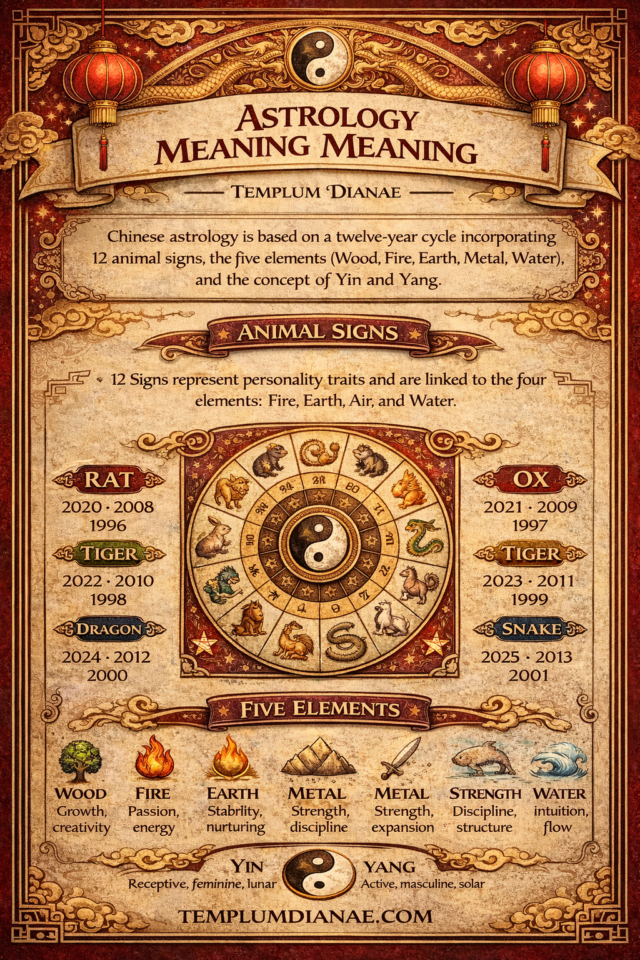
Chinese Astrology Description and symbolism
Chinese astrology is built around a 12-year cycle in which each year is associated with an animal sign. Britannica describes the Chinese zodiac as an annual classification system in which each year in a 12-year cycle is assigned an animal, and it notes that this system follows the traditional Chinese calendar. That calendar is more accurately lunisolar than purely lunar: Britannica explains that the Chinese calendar uses 12 months of 29 or 30 days, with intercalary months added to keep the year aligned with the solar cycle.
The symbolism is not limited to animals alone. Chinese astrology also rests on yin and yang polarities and on the five phases, or wuxing. Wikipedia notes that Chinese astrology uses yin-yang, the five phases, the Heavenly Stems, the Earthly Branches, and the lunisolar calendar. In practice, that means every year-sign is not just Rat or Tiger, but also carries a yin or yang polarity and an elemental quality within the sexagenary cycle.
The familiar legend of the 12 animals comes from folklore rather than strict historical origin. Britannica states that a legendary race between animals is said to have founded the zodiac, often with the Jade Emperor or Buddha calling the contest, while Wikipedia’s Chinese folklore page identifies the Great Race as a folk story explaining the 12-animal calendar. Historically, however, the 12 animals were attached to the 12 Earthly Branches of the timekeeping system, and that calendrical structure is older than the popular race legend.
Chinese Astrology meaning and the 12 Zodiac Animals
Chinese astrology meaning begins with the 12 animals, but each animal is really a symbolic shorthand for timing, temperament, and the way a person meets life’s cycles. Britannica notes that each year in the zodiac is associated with an animal and a personality said to typify the year and those born during it, while Wikipedia adds that the zodiac became formalized as part of a 12-year cycle linked to the Earthly Branches and later expanded through the 60-year stem-and-branch system. The meanings below are best read as traditional symbolic tendencies, not fixed destiny.
- Rat: initiative, cleverness, adaptability. Traditionally read as quick-minded, resource-sensitive, and skilled at spotting openings.
- Ox: endurance, order, persistence. The Ox is commonly read as steady, dutiful, and slow to change, but powerful once committed.
- Tiger: courage, force, volatility. Tiger energy is bold, competitive, and harder to restrain once it decides to move.
- Rabbit: tact, sensitivity, refinement. Rabbit symbolism is often linked with diplomacy, caution, and graceful self-protection.
- Dragon: charisma, authority, expansion. The Dragon is the most overtly mythic sign, often read as ambitious, magnetic, and hard to ignore.
- Snake: intuition, strategy, secrecy. Snake energy is often associated with depth, patience, calculation, and subtle persuasion.
- Horse: freedom, movement, drive. Horse symbolism tends toward speed, independence, and resistance to confinement.
- Goat / Sheep: gentleness, artistry, care. Traditionally linked with softness, empathy, beauty, and a more indirect form of strength.
- Monkey: ingenuity, wit, improvisation. Monkey energy is clever, playful, opportunistic, and often skilled at reading social angles.
- Rooster: precision, visibility, discernment. Rooster symbolism leans toward standards, self-presentation, and exactness.
- Dog: loyalty, conscience, vigilance. Dog energy is commonly read as protective, principled, and alert to fairness or betrayal.
- Pig: abundance, ease, generosity. Pig symbolism often points to enjoyment, sociability, and the capacity to gather comfort and goodwill.
Chinese Astrology love and relationships compatibility
affinity, tension, reciprocity
Chinese horoscope compatibility is usually explained through patterned relationships between signs rather than romance alone. Wikipedia’s compatibility section points to the Four Trines, the Six Harmonies, and the Six Offending Groups as common compatibility frameworks. In popular reading language, people also talk about “secret friends” for quieter supportive pairings, but the more clearly documented logic is the Liu He harmony pairings and Liu Chong clash groups. For beginners, that means compatibility is less “perfect soulmate fate” and more a question of whether two rhythms support, challenge, or exhaust one another.
Chinese Astrology careers and wealth meaning
timing, discipline, momentum
Every sign navigates professional luck differently because animal signs characteristics are filtered through element, polarity, and cycle. Rat and Monkey styles often thrive through agility, Ox and Rooster through structure, Tiger and Dragon through drive, Rabbit and Goat through soft influence, Snake through strategy, Horse through speed, Dog through reliability, and Pig through relationship-building. The deeper rule is not “which sign is richest,” but how each sign handles timing and resource flow. In stricter systems such as Bazi, wealth and career are read through the full Four Pillars rather than the birth year alone.
Chinese Astrology and the Five Elements
The five elements chinese zodiac system is better described as the Five Phases, or wuxing: Wood, Fire, Earth, Metal, and Water. Britannica explains that wuxing is a model of five basic phases used to explain change in the cosmos, and Wikipedia notes that Chinese astrology incorporates wuxing together with yin-yang, the Heavenly Stems, and the Earthly Branches. This is why the same animal sign does not always express itself identically every 12 years. A Wood Rat and a Fire Rat belong to different positions within the larger 60-year cycle.
In practical reading, Wood expands, Fire intensifies, Earth stabilizes, Metal sharpens, and Water adapts. These are not literal substances inside the personality. They are energetic patterns. In Bazi basics, every pillar carries one Heavenly Stem and one Earthly Branch, and those are assigned elemental and yin-yang qualities. That means the five phases do not sit on top of the zodiac as decoration; they are part of the machinery of the chart itself.
Chinese Astrology and tarot
Chinese astrology and tarot come from different worlds, but beginners often compare them because both systems organize human experience into symbolic patterns. Tarot compresses meaning into cards and images. Chinese astrology compresses it into animal signs, stems, branches, phases, and seasonal timing. The similarity is structural rather than historical. Chinese astrology grew out of traditional Chinese astronomy and calendrics, while tarot belongs to a later Western symbolic tradition.
The comparison becomes useful only when you respect the difference. Tarot is often immediate and situational. Chinese astrology is more cyclical and calendar-based. A tarot spread might show the emotional state of a relationship now; a Bazi reading asks how a person’s underlying timing and energetic pattern is built across year, month, day, and hour. That makes Chinese astrology broader and slower, but also more structural.
Chinese Astrology and dreaming interpretation
Dream interpretation is not the core of Chinese astrology in the way the calendar and the stem-and-branch system are, but animal symbolism makes dream language especially rich. Because the zodiac animals already carry layered associations in folk culture, dreaming of your sign, its opposite, or a dominant element can feel charged even before formal interpretation begins. The deeper point is that Chinese astrology already treats time and symbol as linked, so dream images often get read through the same symbolic lens.
For beginners, the sane approach is not to force every animal dream into a prophecy. A Tiger dream can reflect assertion, fear, competition, or the pressure to take action. A Pig dream can reflect comfort, indulgence, or material ease. If the dream repeats around your zodiac year, a major life transition, or a period of clashing signs, it becomes more useful as a symbolic prompt. Read it alongside your timing, not in isolation.
Chinese Astrology and the law of attraction
The law of attraction enters Chinese astrology through timing more than through slogans. This tradition is fundamentally calendar-conscious. The Chinese calendar is lunisolar, it uses intercalary months to stay aligned with the seasons, and it includes 24 solar terms that divide the solar year into meaningful seasonal thresholds. In that framework, manifestation is not merely about desire. It is about choosing the right day, the right phase, the right seasonal gate, and the right balance of action and receptivity.
That is why favorable days matter so much in Chinese metaphysical culture. The traditional calendar is still used to choose auspicious timings for weddings, moving, and major life actions. Attraction work becomes sharper when it respects rhythm. Instead of demanding immediate results, you align your intention with a calendar already designed to track change, climate, and cyclical openings.
Chinese Astrology and historical references
Chinese astrology is old, but not all parts of it emerged at once. Wikipedia states that Chinese astrology is based on traditional Chinese astronomy and the Chinese calendar, that it was elaborated during the Zhou dynasty, and that it flourished during the Han dynasty. Britannica likewise notes that the Chinese zodiac’s exact beginning is unclear but that it was firmly established by the latter half of the Han dynasty. That means the popular system of animal years sits on top of a deeper history of calendrics, astronomy, and correlative cosmology.
The same historical caution applies to Bazi basics. The conceptual foundations of the Four Pillars are tied to Han-dynasty cosmology, but Wikipedia’s Four Pillars page says the formal systematization of destiny reading by year, month, day, and hour was shaped later, with major development in the Tang and Song periods. So when modern guides talk about “ancient Chinese astrology,” they often compress several layers of history into one phrase.
Chinese Astrology and the Four Pillars of Destiny
The Four Pillars of Destiny, or Bazi, is the part of Chinese astrology that goes beyond the birth year. Wikipedia defines it as a Chinese astrological and calendrical system used to analyze destiny or life path based on four pillars, each made of a Heavenly Stem and an Earthly Branch for the year, month, day, and hour of birth. Since each pillar contains two characters, the system is also called “eight characters,” or Bazi.
This is why a simple animal-sign reading is incomplete. The year pillar may speak more to ancestry, family background, and social environment, while the day pillar becomes central because its Heavenly Stem is the Day Master, the reference point for the rest of the chart. For beginners, the clean lesson is simple: the zodiac animal is the doorway, not the whole house. If you want a real reading of harmony, career flow, and elemental balance, the Four Pillars matter much more than the yearly animal alone.
Chinese Astrology and the Yin Yang balance in your chart
Yin and yang in astrology are not moral labels. Britannica defines yinyang as two complementary forces that together make up the phenomena of life, with yin linked to earth, darkness, passivity, and receptivity, and yang linked to heaven, light, activity, and penetration. Wikipedia notes that Chinese astrology uses yin-yang together with wuxing, stems, branches, and the lunisolar calendar.
In chart work, this means balance matters more than raw strength. Too much yang can produce haste, aggression, and burnout. Too much yin can become hesitation, withdrawal, and stagnation. The point is not to become half of one and none of the other. It is to see whether your chart knows when to receive and when to act. Harmony in Chinese astrology is never passive. It is dynamic equilibrium.
Chinese Astrology and the meaning of the 24 Solar Terms
The 24 Solar Terms are one of the clearest examples of how Chinese astrology links symbolism to real seasonal observation. Britannica explains that the Chinese calendar developed a 24-part meteorological cycle, and Wikipedia adds that each solar term marks a 15-degree portion of the ecliptic and helps define the seasons. These terms include Beginning of Spring, Rain Water, Qingming, Grain Rain, Summer Solstice, White Dew, Winter Solstice, and Great Cold.
For beginners, the Solar Terms matter because they teach that timing is not generic. The year is not one flat flow of luck. It has gates. Some phases favor germination, some refinement, some harvest, some storage, some rest. This is one reason lunar calendar astrology in East Asia feels different from Western pop-astrology. It ties psychological and ritual timing to observable climate and solar movement, not only to personality description.
Chinese Astrology and your birth day number connection
A lot of modern content talks about a “birth day number connection,” but the classical Chinese system is more specific than that. In Bazi, the critical unit is the day pillar, especially the Day Master, which is the Heavenly Stem of the day. Wikipedia’s Four Pillars page states that the Day Master is considered the most important element in the chart because it represents the person themselves and serves as the reference point for interpreting the rest of the chart.
So if you want the Chinese equivalent of a personal core code, look there first, not at a simplified birth-date number. The sexagenary cycle also runs through days continuously, which is why dating and timing in Chinese metaphysics is much more granular than just animal-year identity. A modern number overlay can be fun, but the stronger classical method is the day stem and branch inside the Four Pillars.
Chinese Astrology and karmic lessons for your sign
Chinese astrology does not usually use the term “karma” in the same way later Buddhist or modern New Age systems do, but it absolutely carries the idea of consequence, repetition, and cyclical lessons. The zodiac works through recurring 12-year and 60-year cycles, and the Four Pillars system maps how those cycles interact with the individual life pattern. A lesson returns because timing returns. That is one reason people take their zodiac year, or Ben Ming Nian, so seriously.
The lesson of each sign is usually the shadow of its strength. Rat must learn honesty around strategy. Ox must learn flexibility. Tiger must learn restraint. Rabbit must learn directness. Dragon must learn humility. Snake must learn transparency. Horse must learn steadiness. Goat must learn firmness. Monkey must learn seriousness. Rooster must learn softness. Dog must learn trust. Pig must learn boundaries. These are interpretive shorthand, but they become most useful when read through the larger timing cycles rather than as fixed moral labels.
Chinese Astrology shadows and weaknesses
The shadow side of Chinese astrology begins when people treat the birth year as the whole truth. That is the biggest beginner error. Wikipedia makes clear that Chinese astrology uses far more than the yearly animal: it includes yin-yang, the five phases, the Heavenly Stems, the Earthly Branches, the lunisolar calendar, and the year-month-day-hour structure used in the Four Pillars. A sign-only reading is quick, but it is thin.
Another problem is fear-based reading around clashing years. Britannica notes that the return of one’s birth-year sign, called Ben Ming Nian, is traditionally considered unlucky rather than automatically celebratory, and it also notes that each year in the 60-year cycle is guarded by a Tai Sui deity. Wikipedia’s Tai Sui page adds that Tai Sui is linked to the star opposite Jupiter in its 12-year cycle and that people whose signs clash with the Tai Sui of the year are believed to face misfortune or disturbance. That tradition is culturally important, but it can easily become fatalism if treated as a doom sentence.
There is also the issue of sign shadows. Every animal has a strength that can become a flaw: Rat becomes manipulative, Ox rigid, Tiger reckless, Rabbit avoidant, Dragon inflated, Snake secretive, Horse unstable, Goat passive, Monkey slippery, Rooster critical, Dog suspicious, Pig indulgent. The point is not shame. It is mitigation. In Chinese metaphysics, bad luck is often managed through timing, restraint, ritual caution, and better alignment rather than panic.
The clean beginner approach is this: read the sign, then the element, then the full chart if possible. Use Tai Sui and clashing cycles as warnings to slow down and correct course, not as excuses to surrender your judgment. Chinese astrology is strongest when it sharpens timing and self-command, not when it turns a person into a hostage of the calendar.
Chinese Astrology FAQ
Chinese Astrology what is the true chinese astrology meaning for beginners?
For beginners, chinese astrology meaning is the interpretation of time through a system that combines the lunisolar calendar, the 12 animal signs, yin-yang, the five phases, and the stem-and-branch cycle. Your birth year gives a first symbolic layer, but the deeper reading comes from the full calendrical structure.
Chinese Astrology how do I find my chinese zodiac animal and element?
Find your birth year within the traditional Chinese calendar, not just the Gregorian year, because the zodiac year changes at Chinese New Year and, in some astrological schools, at the start of spring. Then identify the corresponding animal and the stem-branch combination that determines the yin-yang polarity and element.
Chinese Astrology what does it mean when it is my zodiac year (Ben Ming Nian)?
Traditionally, Ben Ming Nian is the return of your birth-year sign every 12 years, and Britannica notes that it is often treated as unlucky rather than lucky. It is commonly understood as a year demanding caution, humility, and better timing, not a year of guaranteed disaster.
Chinese Astrology which chinese zodiac signs are most compatible in love?
The better-documented compatibility logic uses the Four Trines, Six Harmonies, and Six Offending Groups. That means compatibility is not random: some pairings are traditionally read as supportive, while others are considered clashing or harmful.
Chinese Astrology what does chinese astrology mean for soulmates?
In practice, it means looking for rhythm, complementarity, and whether two people intensify each other constructively or destructively. A soulmate reading in this tradition is stronger when it considers the broader compatibility patterns and, ideally, the full Four Pillars, not just the animal year.
Chinese Astrology how do the five elements change my animal sign’s personality?
The five phases modify the basic animal pattern by changing how it expresses itself. A Wood sign expands differently from a Metal sign, and a yin version behaves differently from a yang one. That is why the same animal repeats every 12 years but in different elemental forms within the 60-year cycle.
Chinese Astrology is chinese astrology more accurate than western astrology?
They are different systems built on different cosmologies. Chinese astrology is more calendar-based, cyclical, and structured through stems, branches, elements, and lunar-solar timing. Western astrology is more focused on signs, planets, houses, and aspects. “More accurate” usually depends on what question you are asking and how seriously the system is practiced.
Chinese Astrology what is a “secret friend” in the chinese zodiac?
In popular compatibility language, a “secret friend” is usually described as a quieter supportive counterpart. The more clearly documented compatibility frameworks, however, are the Six Harmonies, Four Trines, Six Offending Groups, and related clash or harm patterns. For a beginner, those are the better place to start.
Chinese Astrology how can I use chinese astrology to attract abundance?
Use it first for timing. The traditional calendar is still used to choose auspicious days, and the broader metaphysical system ties prosperity to harmony between action, season, and elemental balance. The strongest abundance work in this tradition comes from choosing the right moment and reducing conflict, not from forcing luck.
Chinese Astrology what are the lucky numbers and colors for my sign?
Popular guides often assign lucky numbers and colors to each sign, but those lists vary. In stricter Chinese metaphysics, a stronger reading comes from your full chart, especially the balance of elements, the Day Master, and the timing cycles affecting you now. Generic sign lists can be fun, but they are weaker than real Bazi analysis.