
At first glance, actinolite may look quite different from the smooth green stones usually shown in crystal guides. It often forms slender, blade-like crystals, with shades that range from soft green to almost black. In contemporary crystal practice, those features have inspired associations with resilience, steady progress and staying grounded through change.
Its mineralogy matters just as much as its symbolism. Actinolite belongs to the amphibole group, and some asbestiform varieties are regulated asbestos. This guide explains what actinolite is, how people interpret its spiritual meaning and how to approach specimens safely. The spiritual correspondences discussed here are symbolic, not scientifically established effects. For a broader introduction, see Crystal Healing.
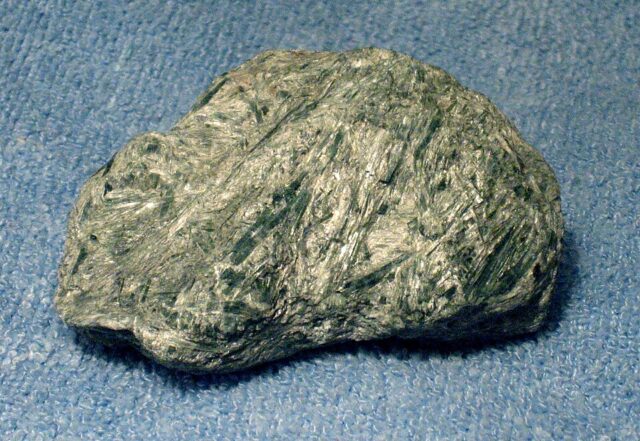
Actinolite Meaning: Quick Guide
| Material | a calcium-magnesium-iron amphibole mineral in the actinolite–tremolite series |
| Color | green, gray-green to nearly black |
| Mohs hardness | about 5–6 |
| Core spiritual themes | grounding, resilience, patient growth and personal boundaries |
| Common chakra associations | heart and root |
| Common zodiac associations | Scorpio and Capricorn in some modern interpretations |
| Main modern uses | mineral study, collection, display and non-contact symbolic practices |
| Care | avoid abrasion, dust and disturbance of fibrous or unidentified material |
What Is Actinolite?
Actinolite is a calcium-, magnesium- and iron-bearing amphibole mineral. Its crystals can be long and prismatic, flattened like blades, or occur in aggregates. The color often becomes darker as iron content increases, although appearance alone is not enough to identify a particular specimen.
The mineral commonly develops in metamorphic rocks, including rocks changed by heat and pressure at low to medium metamorphic grades. It forms a compositional series with Tremolite, which is relatively richer in magnesium. This is why the two minerals can look similar and are sometimes difficult to distinguish without mineralogical testing.
There is also a useful connection with Jade: nephrite jade is made mainly of tightly interlocking amphibole minerals from the tremolite–actinolite series. That does not mean an unidentified, fibrous actinolite specimen should be handled like a polished piece of jade; crystal habit and condition make a significant difference.
Actinolite Meaning and Symbolism
As with many green crystals and stones, actinolite’s color is often associated with renewal, nature and balance. Its elongated crystals add another layer of symbolism, suggesting perseverance and forward movement. In modern spiritual interpretations, the stone is therefore used as a symbol of continuing to grow without expecting everything to change at once.
Consider a period when you are rebuilding a routine after a setback. Rather than treating resilience as the ability to push through every difficulty, you might interpret actinolite as a reminder to start with a manageable step, repeat it and allow progress to accumulate. The meaning comes from the intention you give to the symbol, not from a proven influence of the mineral itself.
Metaphysical Properties
In contemporary metaphysical writing, actinolite is associated with grounding, emotional steadiness and personal boundaries. These words can feel vague until they are connected to ordinary experiences. Grounding, for example, might mean returning your attention to what you can do today instead of worrying about every possible outcome. A boundary might simply be the decision to protect time for rest when you have taken on too much.
Some practitioners also connect actinolite with persistence during periods of recovery or transition. In this context, recovery is a personal or symbolic theme, not a claim that a crystal treats illness or restores physical health. You can explore the symbolism through writing, reflection or an image of the mineral; owning or touching a specimen is not necessary.
Actinolite Chakra Associations
Green actinolite is commonly associated with the heart chakra, traditionally linked in modern chakra practice with compassion, connection and emotional openness. Darker specimens are sometimes connected with the root chakra, which symbolizes stability and a sense of security.
These two ideas can work together. If you are trying to support someone without exhausting yourself, the heart chakra might represent care for the other person, while the root chakra represents the need to maintain your own limits. This is one way to interpret the pairing, not a fixed rule or a measurable property of actinolite.
Actinolite Zodiac Associations
Scorpio and Capricorn appear in some contemporary crystal-correspondence lists. Scorpio is associated with transformation and moving through change; Capricorn emphasizes patience, responsibility and the work involved in reaching long-term goals. Both themes fit the modern symbolism given to actinolite, though there is no single universally accepted zodiac correspondence for the mineral.
For example, someone drawn to Scorpio symbolism might focus on letting go of an old habit. Someone drawn to Capricorn symbolism might use the same stone’s image as a reminder to stay consistent with a new one. The association is a reflective choice, not something determined by a person’s birth sign.
How to Use Actinolite
Because actinolite may occur in hazardous fibrous forms, the simplest spiritual practices are also the most appropriate: use a photograph, a drawing or a securely enclosed display rather than handling an unidentified specimen. This gives your attention a focus without requiring physical contact. If you are exploring this kind of practice for the first time, our guide to using crystals explains the wider approach; with actinolite, always keep the additional safety precautions described here in mind.
Meditation
Choose an image that clearly shows actinolite’s green color or blade-like crystal structure. Spend a moment observing it, then select a single intention, such as patience during a difficult change. Ask yourself: What is one realistic action I can take today to feel more settled? You might write down the answer and return to it later.
This approach makes the exercise personal and practical. It also avoids rubbing, holding or otherwise disturbing material whose fiber habit has not been professionally assessed.
Ritual and altar work
For an altar dedicated to persistence or personal boundaries, a photograph of actinolite can serve as a visual symbol beside a written intention. For instance, you could write a short reminder to set aside time for an important task and place it near the image. A physical specimen should only be displayed in a manner appropriate to its professionally assessed condition; unknown or visibly fibrous material should remain sealed and undisturbed.
Jewelry and carrying stones
Raw actinolite is not an appropriate default choice for a pocket stone or handmade jewelry. Fibrous or splintery material should never be drilled, sanded, tumbled or worn in ways that could release particles. If you simply want a daily reminder of the symbolism, carrying a written intention or a small photograph is a safer alternative.
How to Identify Actinolite
Actinolite is often green to dark green, with elongated prismatic or bladed crystals. Some specimens appear compact, while others have a fibrous habit. Those visual clues can help you understand a label, but they cannot establish a reliable identification or show whether a specimen poses a respirable-fiber hazard.
Actinolite may be confused with related amphiboles and other green metamorphic minerals. For example, serpentine and epidote can both be green and occur in metamorphic settings, but they are different minerals. Names such as byssolite can also appear in descriptions of fibrous amphibole material. If you need a reliable identification, consult a qualified mineralogist or laboratory rather than trying a scratch, breakage or polishing test at home.
Cleansing, Charging and Physical Care
It helps to separate spiritual cleansing from physical cleaning. If you work with actinolite symbolically, methods such as visualization, quiet reflection or sound do not require you to touch the mineral. There is no need to wash a specimen to give a ritual meaning to the practice.
For physical care, avoid brushing, scrubbing, polishing, ultrasonic cleaning or other methods that could disturb fibers or create dust. Do not soak or rinse a visibly fibrous or unidentified specimen. If its condition is uncertain, leave it enclosed and seek appropriate specialist advice instead of attempting to clean it yourself.
Safety
Asbestiform actinolite is one of the regulated asbestos minerals. The principal concern is inhalation of airborne fibers released when hazardous material is disturbed. Not every actinolite specimen has the same crystal habit, but a photograph, a seller’s description or a simple visual check cannot reliably establish that a particular specimen is safe to handle.
Do not cut, grind, drill, crush or intentionally break fibrous or uncertain material. Avoid using such specimens for body layouts, jewelry making or crystal-infused water. If you have a visibly fibrous specimen, keep it sealed and undisturbed, and consult a qualified mineral or occupational-safety professional before making any handling or disposal decisions.
Actinolite FAQ
What is Actinolite used for spiritually?
In modern crystal practice, actinolite is mainly a symbol of steady growth, resilience and personal boundaries. You might use its image during a short reflection on a difficult decision or as a reminder to take one practical step toward a goal. These are personal interpretations rather than therapeutic effects.
What chakra is Actinolite associated with?
Green actinolite is commonly linked with the heart chakra, while darker varieties may be associated with the root chakra. Together, these correspondences are often interpreted as balancing compassion with stability and healthy limits. They vary between modern spiritual systems.
Can Actinolite go in water?
For an unidentified or fibrous specimen, avoid putting it in water. The concern is not simply whether the mineral tolerates moisture, but whether cleaning, movement or later handling could disturb hazardous fibers. Non-contact symbolic practices are the better choice when the specimen’s condition is unknown.
How can you tell if Actinolite is real?
A reliable mineral identification may require optical, chemical or diffraction testing. Color and crystal shape can provide clues, but they are not definitive, and they do not establish asbestos-related safety. Ask a qualified specialist if identification or safe handling matters.
References
- https://www.mindat.org/search.php?search=Actinolite
- https://www.atsdr.cdc.gov/csem/asbestos/what_is_asbestos.html
- https://commons.wikimedia.org/wiki/File:Actinolite.jpg


