dream interpretation becomes powerful when you stop treating dreams as random static and start treating them as a working language. In that language, fear rarely appears as a lecture. It appears as a chase, a collapse, a locked room, a missing train, a face from the past. Once you learn that pattern, relationship anxiety stops feeling shapeless. You begin to see what your mind is rehearsing at night: abandonment, mistrust, desire, unfinished grief, or the need for clearer boundaries. Dreams have been interpreted in religious, divinatory, and psychological ways for thousands of years, and in modern psychology Freud and Jung made dream analysis central to their very different models of the unconscious.
That same dream state can become a laboratory for abundance. A dream will often show you where you are leaking energy before waking life becomes obvious enough to force the lesson. You may dream of losing money, missing an exam, driving without control, or finding gold in the ground. None of that should be read mechanically, but all of it can reveal how your subconscious is organizing pressure, desire, risk, and opportunity. REM sleep, the phase in which vivid dream reports are most frequent, is marked by elevated brain activity, irregular eye movements, and reduced muscle tone, which is one reason dreaming feels so vivid and emotionally convincing.
- common dream meanings and why the same few images keep returning across very different lives
- significance of dream symbols through metaphor, archetype, and personal context
- contextualizing dreams for money and love without falling into rigid dream dictionary thinking
- … and much, much more!
Keep reading if you want a dream meanings guide that helps you read common dreams with more psychological precision, stronger spiritual discernment, and better practical judgment.
“…in the vision of Templum Dianae, Dream Interpretation is the bridge between your hidden desires and your waking power, teaching you to read the symbols that restore harmony in love and open the inner path to abundance…”
Dream Interpretation keywords
Upright: clarity, revelation, integration, intuition, renewal
Reversed: repression, anxiety, distortion, obsession, dread
Dream Interpretation Description and symbolism
Dreams use metaphor because direct language is often too narrow for what the sleeping mind is trying to stage. Freud argued that dreams disguise latent material through dream-work, including condensation, displacement, and symbolization, so the remembered dream, the manifest content, is not identical to the underlying wish or conflict. Britannica summarizes Freud’s position by noting that he called dreams the “royal road” to the unconscious and treated the manifest dream as a veil over latent meaning.
The physiology matters too. REM sleep is one of the two main phases of the sleep cycle and is the stage most strongly associated with vivid dreaming. Britannica notes that a typical sleep cycle lasts about 90 to 110 minutes and that adults usually complete four to six cycles per night. It also states that dream reports are much more frequent and vivid when people are awakened from REM than from non-REM sleep.
Jung widened the frame. He did not reduce dreams to disguised wish-fulfillment. Britannica notes that Jung saw dreams as compensatory, balancing what waking life underrepresents, and connected them to archetypes and the collective unconscious, a layer of inherited primordial images shared across humanity. In that model, symbols in dreams are not only private codes; they can also be archetypal patterns that recur across myth, religion, and inner life. This is why dream interpretation sits at the meeting point of neuroscience, psychology of dreaming, and the older spiritual meaning of dreams.
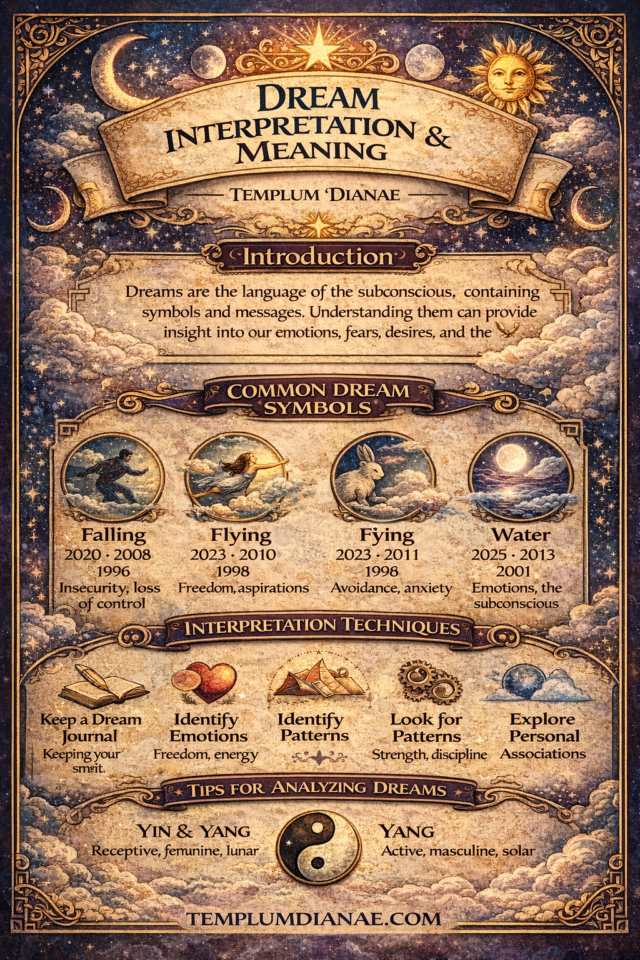
Dream Interpretation Meanings: the 20 most common symbols
No serious dream meanings guide should claim that one symbol has one universal answer. Freud emphasized latent content and dream-work, Jung emphasized compensatory and archetypal meaning, and modern dream dictionaries can be useful prompts but are not generally treated as scientifically reliable within psychology. The best method is to read symbols in dreams through context, emotional tone, repetition, and the dreamer’s personal life.
- Teeth falling out
Often read as anxiety about image, power, aging, speech, or loss of control. It can also reflect a period where your identity feels unstable or exposed. - Flying
Commonly linked with freedom, release, confidence, or expanded perspective. If the flight is unstable, it may show inflated ambition or fear of losing grip. - Being chased
Usually points to avoidance. The pursuer matters less than the pattern: something in waking life wants attention and you keep running. - Naked in public
Often tied to vulnerability, shame, exposure, or the fear of being seen without the social mask that protects you. - Falling
Commonly signals insecurity, loss of support, failure anxiety, or a transition where the old structure no longer holds. - Pregnancy
Frequently reflects incubation, creativity, inner growth, or a life change that is developing but not ready to emerge yet. - Death
Rarely needs a literal reading. More often it points to endings, identity shifts, grief, release, or the death of an old role. - Water or drowning
Water often reflects emotion, the unconscious, or psychic depth. Calm water differs from floodwater; drowning suggests overwhelm, saturation, or fear of being consumed by feeling. - Snakes
Snakes can indicate threat, healing, temptation, instinct, sexuality, or renewal. Context changes everything. - Spiders
Often linked to anxiety, entrapment, patience, hidden intelligence, or fear of a subtle force you cannot easily control. - Fire
Fire can purify, destroy, energize, or consume. It may point to anger, passion, crisis, or transformation already underway. - Being late
Commonly reflects pressure, regret, missed opportunity, perfectionism, or fear that life is moving faster than you can manage. - Meeting a celebrity
Often reflects projection onto status, beauty, power, talent, or an unrealized part of yourself that you admire from a distance. - Finding money
Can point to growing confidence, recognized value, hidden talent, or the discovery of an inner resource that can become material progress. - Taking an exam
Often signals judgment anxiety, performance pressure, or the feeling that waking life is testing you in public or moral ways. - Driving a car out of control
Commonly reflects problems with direction, agency, impulsivity, or the fear that your decisions are no longer under conscious command. - Cats
Cats often symbolize intuition, independence, sensuality, mystery, or a need to trust subtler instincts. - Dogs
Dogs frequently suggest loyalty, protection, companionship, instinct, or a relationship issue involving trust and devotion. - Houses or rooms
Houses often represent the self. Different rooms may point to different parts of your inner life, memory, secrecy, identity, or family inheritance. - Birds
Birds are often read as messages, thought, transcendence, aspiration, or the desire to move beyond confinement.
Dream Meaning love and relationships
attachment, betrayal, union
Dreaming of an ex-partner often points less to the person than to the emotional pattern that bond created in you. Dreams of infidelity usually expose insecurity, mistrust, guilt, jealousy, or the fear of emotional replacement rather than proving an external fact. Weddings can symbolize union, vow, identity transition, or anxiety about commitment depending on the emotional tone. In practical dream interpretation, relationship dreams are strongest when read as mirrors of attachment style, unfinished emotional contracts, and the way desire negotiates fear.
Dream Meaning careers and money
value, pressure, ascent
Dreams about gold, cash, or hidden valuables often point to inner resources, emerging confidence, or the question of what you truly value. Elevators rising or falling usually dramatize status, momentum, or the fear of losing ground. Losing a job in a dream can reflect insecurity, identity threat, burnout, or a real transition already building underneath the surface. For abundance work, these dreams matter because they show where your subconscious links worth, performance, and survival.
Dream Interpretation and tarot
Dreams and tarot overlap because both speak in archetypal images rather than abstract arguments. Jungian psychology is especially useful here. Britannica notes that Jung linked dreams to archetypes and the collective unconscious, and that similar symbolic patterns recur across myth, imagination, and inner life. Tarot does something similar by turning conflict, loss, desire, choice, fear, and transformation into repeatable visual scenes.
For a beginner, the practical connection is simple: if a dream feels like a Tower moment, a Moon atmosphere, or a Lovers conflict, you are already reading it symbolically. Tarot can become a companion language that helps amplify a dream image rather than replace it. The danger is forcing the fit. The value is noticing when the same archetypal pattern keeps appearing in both dream life and waking choices.
Dream Interpretation and astrology
Astrology and dream interpretation meet most naturally through symbol, timing, and emotional climate. In traditional and modern astrological language, the Moon is associated with instinct, habit, memory, and inner responsiveness, while Neptune is often linked in modern astrology with dreamlike imagery, altered states, and blurred boundaries. Even when one approaches astrology symbolically rather than literally, those two planetary themes line up well with the psychology of dreaming.
The more grounded lesson is timing. Dreams often intensify around emotional pressure, transition, loss, or longing. An astrological lens can help some people frame those seasons, but the dream itself still needs to be read on its own terms. The image is primary. The symbolism comes first. Astrology, at best, gives the weather around the dream, not its final meaning.
Dream Interpretation and shadow work
Nightmares are often more honest than pleasant dreams because they do not flatter the ego. Jung’s model is useful here because he treated dreams as compensatory, showing what conscious life neglects or suppresses. When a nightmare repeats, it often exposes fear, rage, helplessness, shame, or grief that waking life keeps postponing.
That is why nightmares can become teachers. A chase dream may show avoidance. A locked room may show repression. A monster may show a disowned instinct. The point is not to romanticize suffering. It is to notice that the psyche often stages conflict in symbolic form before the person is ready to admit it directly. Shadow work begins when you stop asking only, “What scared me?” and start asking, “What part of me or my life does this fear belong to?”
Dream Interpretation and law of attraction
If dreams are a laboratory, they can also be a rehearsal space. Before waking life changes, the mind often experiments symbolically. A person who keeps dreaming of new rooms, open roads, or recovered treasure may be psychologically preparing for expansion. A person who keeps dreaming of collapse, loss, or lateness may be revealing conflict between conscious desire and unconscious resistance.
That is where dream interpretation can support manifestation. Not by turning every dream into prophecy, but by showing whether your inner life is aligned with your stated goals. If your waking mind says “success” while your dreams stage panic, scarcity, and sabotage, the deeper work is obvious. Dreams do not replace action. They reveal the emotional architecture underneath it.
Dream Interpretation and historical references
Dream interpretation is ancient. Britannica defines oneiromancy as prophetic divination from dreams and notes that it was considered a divine act in most ancient cultures. It also states that dreams as messages from gods or the dead were taken seriously in ancient traditions. Wikipedia’s dream interpretation page likewise notes that in ancient societies such as Egypt and Greece, dreaming was often treated as supernatural communication or divine intervention.
Later, classical oneirocritic literature gave dream interpretation a more formal structure, most famously in Artemidorus’s Oneirocritica. In the modern era, Freud’s The Interpretation of Dreams turned dream analysis into a cornerstone of psychoanalysis, while Jung reshaped the field through archetypes, compensation, and the collective unconscious. Modern neuroscience then linked vivid dreaming strongly to REM sleep, giving dream research a physiological foundation that older systems did not have.
Dream Interpretation and biblical meaning
Biblical dream interpretation belongs to one of the oldest and most influential streams of dream culture. Britannica notes that ancient and religious literatures express strong confidence in so-called message dreams, and specifically states that frequent examples appear in the Bible. Joseph interpreting Pharaoh’s dreams of famine and abundance is the clearest case most readers know, but the broader biblical pattern is the same: dreams appear as warnings, guidance, or revelation in moments of crisis.
For beginners, the practical lesson is not that every dream is prophetic. It is that the biblical tradition treats dreams as meaningful when they arrive with force, timing, and consequence. In symbolic work today, that remains a useful standard. A dream becomes more important when it repeats, coincides with real decision, or carries a clarity and gravity that ordinary dream noise does not.
Dream Interpretation and lucid dreaming
Lucid dreaming basics begin with one fact: a lucid dream is a dream in which the dreamer knows they are dreaming while the dream is still happening. Wikipedia notes that lucid dreams are strongly associated with REM sleep and that later laboratory work showed dreamers could signal awareness from within REM through prearranged eye movements.
This matters because lucid dreaming changes the relationship between dream and dreamer. Instead of being carried entirely by the narrative, you gain some degree of participation. For some people that means curiosity and exploration. For others it becomes a way to face nightmares, rehearse difficult scenarios, or deepen self-observation. Lucidity does not make every dream profound, but it can turn dream life into a more active field of psychological practice.
Dream Interpretation and animal totems
Animals in dreams often feel more charged than ordinary objects because they arrive with instinct already attached. A dog rarely feels like furniture. A snake rarely feels neutral. Jungian approaches are useful here because they treat dream figures as possible carriers of instinctive and archetypal meaning rather than only literal references. Britannica notes that Jung tied dreams to archetypes and primordial image-patterns that recur across human experience.
Whether you call these animal totems, spirit guides, or instinct-symbols depends on your framework. The careful approach is to begin with the animal’s felt function in the dream. Did it protect, threaten, watch, guide, or ignore you? That usually tells you more than any rigid dictionary meaning. The animal becomes useful when it reveals the force it represents in your own life.
Dream Interpretation challenges and pitfalls
The biggest beginner mistake is literalism. A dream about death does not automatically mean physical death. A dream about infidelity does not automatically prove betrayal. A snake does not automatically mean evil. Freud and Jung both rejected naive one-symbol-one-answer reading, even though they disagreed strongly about what dreams were doing. Modern dream dictionaries may be useful prompts, but Wikipedia’s dream dictionary entry notes that they are generally not considered scientifically viable within psychology.
A second pitfall is ignoring biology. Dreaming is not untouched by the body. REM sleep structure can be altered by medication, especially psychotropic medication. Reviews indexed by PubMed and PMC report that many antidepressants prolong REM latency, reduce REM sleep, and often reduce dream recall frequency, while some medications can intensify vivid dreaming or alter REM muscle tone. If your dream life changes sharply after a medication change, that matters.
A third danger is dismissing recurring dreams because they feel embarrassing or repetitive. A recurring dream usually signals that the same emotional equation is still active. That does not mean prophecy. It means unfinished work. When a chase, lateness, failure, collapse, or lost-voice dream keeps returning, the psyche is usually showing that conscious life has not dealt with the issue cleanly.
The strongest practice is simple. Record the dream. Track emotional tone. Note repetition. Check waking context. Respect both psyche and physiology. Dream interpretation becomes useful when it increases honesty, not superstition.
Dream Interpretation FAQ
Dream Meaning what is the true dream interpretation meaning for beginners?
For beginners, dream interpretation means assigning meaning to dreams by reading images, emotions, narrative patterns, and waking-life context rather than taking dream content at face value. Historically this ranged from oneiromancy and religious revelation to Freud’s psychoanalytic model and Jung’s archetypal model.
Dream Meaning why do I keep having the same recurring dream?
Recurring dreams usually point to repeated emotional pressure, unresolved conflict, or a lesson your waking life keeps postponing. They deserve attention because repetition is often the psyche’s way of saying the issue has not been metabolized yet.
Dream Meaning what does it mean when you dream about someone?
It may reflect that person directly, but often it reflects what they represent in your inner life: longing, guilt, unfinished conflict, admiration, fear, or a trait you project onto them. The emotional tone of the dream matters more than the mere fact that they appeared.
Dream Meaning how can I remember my dreams better?
Start a dream journal immediately on waking, before screens or conversation. Record images, feelings, fragments, colors, and repeated motifs, even if the story is incomplete. Recall improves when the mind learns that dreams will be noticed instead of discarded.
Dream Meaning what does dreaming about money mean for my abundance?
Dreams about money often relate to value, confidence, self-worth, exchange, fear of loss, or hidden potential. Found money and lost money usually point in different directions, but both ask the same question: what do you feel you possess or fail to possess inwardly?
Dream Meaning can dreams predict the future?
Many ancient cultures practiced oneiromancy and treated dreams as divine warnings or prophecies. Modern oneirology studies dreams scientifically in relation to brain function, memory, and mental life rather than accepting prophecy as established fact. The clean answer is that dreams can feel anticipatory, but predictive certainty is not established by modern dream science.
Dream Meaning what does it mean when you die in a dream?
Usually it points to ending, transformation, ego change, grief, or the death of a role rather than literal death. Death dreams are often transition dreams.
Dream Meaning is dreaming about snakes a bad omen?
Not automatically. Snakes can symbolize fear, sexuality, healing, cunning, danger, or renewal. They are powerful symbols, not fixed omens. Context decides whether the dream is warning, transformation, temptation, or instinct.
Dream Meaning how do I start a dream journal?
Keep it beside the bed. Write the date, the first emotion, the strongest image, the people present, the ending, and any waking-life connection you notice. Over time the journal becomes more valuable than a generic dream dictionary because it reveals your own repeating symbolic language.
Dream Meaning what is the difference between a dream and a nightmare?
A nightmare is usually a dream marked by intense fear, distress, or threat, often followed by awakening and a strong emotional residue. Britannica notes that nightmares typically lead to awakening with feelings of helplessness and threatening thoughts, while ordinary dreaming may be vivid without that same level of distress.
Dream Interpretation references and resources