greek mythology becomes useful when you stop treating the gods as distant museum figures and start reading them as living archetypes of power, desire, law, strategy, passion, excess, and consequence. Zeus teaches command, Athena teaches precision, Aphrodite teaches attraction, Hermes teaches movement, and Hera teaches the politics of bond and vow. When you embody those patterns with awareness instead of drifting through them unconsciously, your relationships become less chaotic and more intentional. You stop confusing passion with devotion, dominance with authority, and luck with divine timing. Greek myth is fundamentally a body of stories about gods, heroes, and the world that grew out of ancient Greek oral tradition and was preserved above all in Homeric and Hesiodic poetry.
The same myths also sharpen your path to material abundance because the hero’s journey in greek mythology stories is never passive. Heroes win gifts, kingdoms, knowledge, or immortal fame by passing trial, discipline, temptation, and ordeal. Hermes governs commerce and exchange, Athena governs strategy and craft, Demeter governs grain and fertility, and even the tragic myths teach what destroys prosperity: blindness, arrogance, oath-breaking, and waste. In that sense, the myths are a path to personal sovereignty. They show how human beings rise by mastering appetite, honoring limits, and acting in right proportion under divine law. Homer’s Iliad and Odyssey are foundational for the traits of the Olympians and heroes, while Hesiod’s Theogony is the fullest classical source for the origins and genealogies of the gods.
- meaning of greek gods and goddesses through their powers, symbols, and sacred roles
- significance of greek mythology symbols such as the lightning bolt, owl, trident, and laurel
- contextualizing myths for money and love through Olympian archetypes, heroic trial, and divine order
- … and much, much more!
Keep reading if you want a beginner’s guide that explains the gods of Olympus, the Titans, the heroes, the spirits, and the deepest symbolic structure of greek mythology without flattening it into trivia.
“…in the vision of Templum Dianae, Greek Mythology is the primordial blueprint that teaches you how to win in love without losing your center, and how to build divine abundance by mastering power, desire, strategy, and fate…”
Greek Mythology keywords
Upright: sovereignty, wisdom, courage, reciprocity, glory
Reversed: hubris, obsession, excess, vengeance, blindness
Greek Mythology Description and symbolism
Greek mythology begins not with a polished divine court but with primordial emergence. In Hesiod’s Theogony, Chaos comes first, followed by Gaia, Tartarus, and Eros, and from that first opening the world unfolds through genealogies of sky, earth, sea, night, and generation. Britannica identifies Hesiod’s Theogony as the fullest and most important source for myths about the origin of the gods, while Wikipedia describes it as a major source for early Greek cosmology and divine genealogy. That is why Chaos in Greek myth is not simply “mess.” In the earliest cosmogonic sense, it is the first gap, opening, or abyss from which ordered reality emerges.
The gods themselves are instantly recognizable through iconography. Zeus is marked by the thunderbolt, Poseidon by the trident, Athena by the owl, olive, and aegis, Apollo by the lyre and laurel, Artemis by the bow, Demeter by grain, Hermes by the caduceus and winged sandals, and Hades by the underworld scepter or cap of invisibility in later tradition. Britannica notes Athena’s association with the owl and olive tree, and Greek divine imagery across classical art makes these emblems part of the mythology’s visual language.
Sacred geography is just as important. The Olympians dwell on Mount Olympus, the Titans are earlier powers overthrown in the Titanomachy, and the Underworld holds its own rulers, judges, rivers, and punitive spirits. Wikipedia notes that the Twelve Olympians were called Olympians because they were believed to reside on Mount Olympus, and Hesiodic tradition distinguishes the older divine generations from the younger Olympian order. Greek mythology symbols therefore do more than identify gods. They locate them within a sacred map of heaven, earth, sea, mountain, and underworld.
Greek Mythology Meaning
Greek mythology is not one single book or creed. It is a network of greek mythology stories preserved in epic, hymn, lyric, tragedy, cult practice, and later retelling. Britannica states that the best-known sources are Homer’s Iliad and Odyssey and Hesiod’s Theogony and Works and Days, while later dramatists and authors preserved additional mythic traditions. That means the myths are both literary and religious: they explain origins, power, ritual, conflict, justice, and human limitation.
Greek Mythology the Twelve Olympians
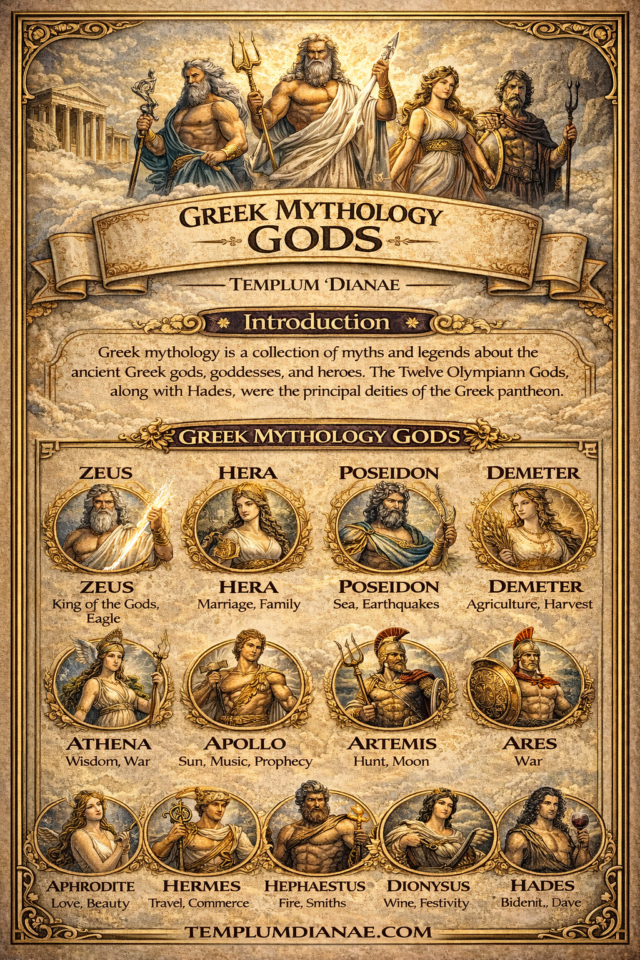
The Twelve Olympians are the major mount olympus deities of the Greek pantheon. Wikipedia lists Zeus, Poseidon, Hera, Demeter, Aphrodite, Athena, Artemis, Apollo, Ares, Hephaestus, Hermes, and either Hestia or Dionysus as the standard grouping. Zeus rules sky, oath, and kingship; Hera governs marriage and queenship; Poseidon governs sea and earthquake; Demeter grain and fertility; Athena strategy and wisdom; Apollo prophecy, healing, music, and light; Artemis the wild and the hunt; Ares violent war; Aphrodite erotic attraction; Hephaestus craft and fire; Hermes trade, travel, and mediation; and either Hestia the hearth or Dionysus ecstatic release completes the cycle.
Greek Mythology the Titans
The Titans in titans greek mythology are the divine generation before the Olympians. According to Hesiod, they are the children of Uranus and Gaia, including Cronus and Rhea among the best known. Their overthrow in the Titanomachy establishes Olympian rule and marks the transition from primordial and older divine orders to the more familiar family of Olympus. Cronus becomes the devourer-father anxious to prevent succession, while Rhea is the mother who preserves Zeus and enables the next divine order to emerge.
Greek Mythology minor deities and spirits
Greek spirits and daemons include nymphs, daemons, personifications, local divinities, and mediating beings that do not sit at the center of Olympus but fill out the world. Wikipedia’s daimon entry explains that in ancient Greek religion a daimon could mean a lesser deity or the experience of divine power, and that Plato later emphasized beings between gods and mortals. Nymphs, meanwhile, are nature divinities tied to places such as springs, trees, caves, rivers, and mountains. This is why Greek myth feels spiritually crowded: the world is full of presences, not just major gods.
Greek Mythology heroes and demigods
Greek heroes and myths turn on figures who are more than ordinary but still mortal enough to suffer consequence. Heracles is the clearest example of heroic labor, purification through ordeal, and strength yoked to suffering. Achilles embodies glory, wrath, beauty, and the tragic economy of immortal fame versus long life. Odysseus stands for cunning, endurance, and the painful return home through trial. These heroes matter because Greek myth does not imagine sovereignty without struggle. Heroism is forged through limit, not through comfort. Homer’s epics are primary for Achilles and Odysseus, while later mythographers and dramatists elaborate the wider heroic cycle.
Greek Mythology the underworld spirits
The underworld is ruled primarily by Hades and Persephone, but it is populated by many other powers: Hypnos, Thanatos, the Oneiroi, the Erinyes, judges of the dead, shades, and punitive beings. Wikipedia describes the Erinyes as chthonic deities of vengeance who punish crimes such as oath-breaking and familial violation, while Oneiros and the dream-spirits connect the underworld to sleep and symbolic vision. This underworld is not simply a place of horror. It is the realm of memory, justice, retribution, and the truths that surface when daylight control falls away.
Greek Mythology love and relationships
eros, magnetism, reciprocity
Aphrodite and Eros are the clearest Greek archetypes of attraction, desire, beauty, and the power that draws beings toward each other. Hesiod places Eros among the earliest powers of creation, and later tradition makes Aphrodite the goddess whose force can bend gods and mortals alike. In relationship terms, these archetypes teach that passion is creative but destabilizing when it loses proportion. Aphrodite gives allure and receptivity; Eros pierces, compels, and exposes what the heart cannot govern by reason alone. Greek myth therefore treats love as both blessing and risk, never as harmless sentiment.
Greek Mythology careers and abundance
strategy, commerce, intelligence
For work and prosperity, Hermes and Athena are central. Britannica describes Athena as goddess of practical reason, war strategy, and handicraft, while Hermes in Greek tradition governs exchange, messaging, movement, and mediation. Together they form a powerful professional pair: Athena plans, structures, and sees the right pattern; Hermes negotiates, trades, and opens roads. In modern symbolic reading, abundance grows when these two powers cooperate. Cunning without wisdom becomes fraud. Wisdom without movement becomes sterility. Prosperity in Greek terms often comes from aligned intelligence, not brute force alone.
Greek Mythology and tarot
Greek mythology and tarot overlap through planetary, symbolic, and archetypal correspondences rather than through direct historical identity. The Olympians are not tarot cards, but both systems use a compact language of figures that dramatize forces such as wisdom, desire, law, death, fate, and transformation. Apollo, Athena, Aphrodite, Hermes, and Hades all map easily onto card-level archetypes because Greek myth already personifies these powers as active intelligences in the world. The same is true of the Greek heroes and myths: they move through ordeals, reversals, triumphs, blind spots, and divine interventions that feel structurally similar to tarot sequences.
For a beginner, the value is interpretive. Tarot helps you read a moment. Greek mythology helps you read the larger archetype underneath it. If a spread feels saturated with Athena, Hermes, or Dionysus energy, what you are really seeing is strategy, exchange, or ecstatic dissolution rendered in two different symbolic languages. The myths give tarot a deeper pantheon of meanings. Tarot gives the myths an immediate diagnostic use.
Greek Mythology and dreaming interpretation
Greek mythology contains one of the oldest and most elegant dream images in Western literature: the gates of horn and ivory. In Homer’s Odyssey, true dreams come through horn and false ones through ivory, and Britannica explicitly notes this distinction in its discussion of dream symbolism and divination. Wikipedia’s entry on the gates of horn and ivory traces the image to the Odyssey and explains the ancient wordplay behind “fulfilling” horn and “deceiving” ivory.
Dreams are not marginal in Greek myth. Wikipedia’s Oneiros entry notes that the “tribe of Dreams” is treated in Hesiod as offspring of Night, while Homer also places a land of dreams near the borderlands of the underworld. That means dreaming in Greek mythology is not merely private psychology. It is a liminal event between mortal and chthonic realms, where truth, deception, omen, and image all meet.
This makes Greek oneirology symbolically sharp. Not every dream deserves belief. Some visions clarify, some mislead, and the soul must learn to distinguish them. That remains one of the oldest lessons of mythic discernment.
Greek Mythology and shadow work
Greek mythology is one of the richest traditions for shadow work because it never flatters the human being as naturally balanced. The Minotaur, Medusa, the Erinyes, and even divine figures like Ares or Eris reveal that violence, appetite, revenge, shame, and frenzy belong to the human field of experience. To “face the Minotaur within” is a modern metaphor, but it captures something authentically Greek: monsters are rarely just external threats. They are distorted powers demanding confrontation.
Jungian readers have long found Greek myth especially fertile because the gods and monsters behave like concentrated psychic patterns. The underworld descent, the labyrinth, the Gorgon’s gaze, the Furies’ pursuit, and Narcissus’ self-ensnarement all work as images of repressed drives and self-defeating fixation. In practical terms, Greek myth teaches that shadow is not defeated by denial. It is mastered by recognition, ordeal, and right relation. The hero who refuses the monster is usually the one already ruled by it.
Greek Mythology and the great poets
The great literary pillars of Greek mythology are Homer and Hesiod. Britannica states that Homer’s Iliad and Odyssey are among the most important and well-known works preserving Greek myth, especially for the personalities of the Olympians and major heroes. Hesiod’s Theogony is the fullest source for the origin and genealogy of the gods, while Works and Days reframes some myths inside a moral and agrarian vision of justice, labor, and mortality. Together they form the core Homeric and Hesiodic traditions for beginners.
But they are not the whole story. Britannica also notes that the tragedians Aeschylus, Sophocles, and Euripides preserve many mythic traditions, and that later literature continued the mythic stream. Ovid’s Metamorphoses, though Roman rather than Greek, became one of the most influential later sources for the transmission of Greek myth in Western culture. That matters because many myths people think of as purely Greek now come mediated through Roman poetic retelling.
For study, this means two things: start with Homer and Hesiod, but do not ignore the later dramatists and Ovid if you want to understand how the myths survived and evolved.
Greek Mythology and the birth of archetypes
Greek mythology is one of the clearest theaters for archetypal thinking because its figures are both highly individual and larger than individual life. Zeus is not just a character but kingship, command, oath, and storm. Athena is not only a goddess but disciplined intelligence, civic order, and strategy. Aphrodite is not merely a beautiful deity but the force of attraction itself. This is exactly why Greek myth has remained so productive for later psychology, literature, and symbolic analysis.
A Jungian perspective does not need to claim that the Greeks “invented” archetypes. It is enough to see that the myths preserve enduring psychic patterns in unusually concentrated form. The hero, the tyrant, the trickster, the devouring parent, the rejected beloved, the avenger, the wise maiden, the king, the underworld guide: Greek mythology offers them all. This makes it a training ground for self-reading. The myths become useful when you ask not only, “What happened in the story?” but “What pattern does this story keep repeating in human life?”
Greek Mythology and the meaning of sacred animals
Sacred animals in Greek myth are rarely decorative. They condense the field of a god into living form. Athena’s owl, noted by Britannica, is the clearest example: it suggests watchfulness, night vision, and the intelligence that sees through darkness. Zeus is linked with the eagle, Apollo with the raven or swan in some traditions, Poseidon with horses and bulls, Artemis with deer, Hera with the peacock, and Aphrodite with doves. These animal associations help explain why greek mythology symbols remain so immediately legible. They translate divine function into embodied image.
For beginners, sacred animals matter because they teach how myth thinks. A god’s power is not abstract. It radiates into bird, beast, tree, landscape, weapon, and emblem. To understand Greek myth is to understand that the world is iconographic: the divine announces itself through recurring forms.
Greek Mythology and the life path of the hero
The life path of the hero in Greek mythology is not comfort rewarded with fame. It is ordeal purified into stature. Achilles, Odysseus, Heracles, Perseus, Theseus, and Orpheus each undergo a pattern of summons, danger, temptation, divine aid, and consequence. Some return wiser, some die glorious, some fail through blindness, and some carry the wound of success itself. This is why the hero’s journey remains such a durable lens for reading greek heroes and myths.
For modern beginners, the hero is useful because he or she is never exempt from law. Courage without wisdom becomes ruin. Cunning without loyalty becomes corruption. Desire without proportion becomes madness. The heroic path therefore becomes a path to sovereignty only when strength, discipline, and self-knowledge are forced into relationship. Greek myth respects greatness, but it does not sentimentalize it.
Greek Mythology and karmic lessons from the myths
Greek mythology does not use the Indian term “karma,” but it is full of moral and causal return. Oath-breakers are punished. Arrogant rulers are humbled. Murder stains generations. Desire misused becomes destruction. The Erinyes exist precisely to make certain crimes return upon the offender, especially blood guilt and broken foundational bonds. That makes Greek myth a powerful source of karmic-style lessons even without the same philosophical vocabulary.
This causal logic is one reason Greek myths remain psychologically sharp. Every gift has a shadow, every transgression a cost, every refusal of limit a correction waiting somewhere ahead. The myths do not promise easy justice in every moment, but they insist that disorder compounds. Modern readers can use this without superstition: every repeated pattern has a price, and every avoided truth eventually demands payment.
Greek Mythology challenges and hubris
The great danger in Greek mythology is hubris. Not pride in the healthy sense, but overreaching arrogance that refuses proportion, limit, warning, or divine order. Greek stories punish this relentlessly. Icarus flies too high and falls. Niobe boasts over Leto and loses her children. Pentheus refuses Dionysian power and is torn apart by the madness he denied. Arachne challenges Athena and is transformed through the very skill she made into arrogance. These are not random cruelties. They are mythic lessons about what happens when talent loses reverence.
For a modern reader, hubris is still the tragic flaw that matters most. It appears as the belief that rules do not apply to you, that appetite is the same as destiny, that being gifted exempts you from discipline, or that being wounded entitles you to destroy. Greek myth is severe because it insists that excess carries its own punishment. The person who will not listen to measure ends up corrected by reality.
This is why Greek mythology remains useful for self-command. It does not ask you to become smaller. It asks you to become proportionate. The gods do not hate greatness. They hate blindness. The lesson of Icarus is not “never fly.” It is “know the law of your flight.” The lesson of tragic heroes is not “never desire.” It is “master desire before it masters you.” In that sense, Greek mythology is still one of the clearest schools of psychological realism ever created.
Greek Mythology FAQ
Greek Mythology what is the true greek mythology meaning for beginners?
For beginners, greek mythology means the body of myths told by the ancient Greeks about the origin of the world, the gods, heroes, and the ritual significance of divine powers. The main classical literary foundations are Homer for the heroic and Olympian narratives and Hesiod for divine origins and genealogies.
Greek Mythology who are the 12 gods of Olympus and their meanings?
The Twelve Olympians are the major gods of Olympus: Zeus, Hera, Poseidon, Demeter, Athena, Apollo, Artemis, Ares, Aphrodite, Hephaestus, Hermes, and either Hestia or Dionysus. They represent major divine domains such as kingship, marriage, sea, grain, wisdom, prophecy, hunt, war, desire, craft, exchange, and hearth or ecstatic release.
Greek Mythology what does it mean when I see greek symbols in my life?
Symbolically, recurring Greek images often indicate that a certain archetype has become active for you. An owl can point toward Athena-like wisdom or strategy, a trident toward force and instability, a laurel toward Apollo-like inspiration, and a lightning bolt toward Zeus-like command or judgment. Historically these symbols belong to specific gods and their cultic or artistic iconography.
Greek Mythology what is the difference between a god, a titan, and a hero?
A god is a divine being, often part of the Olympian order; a Titan belongs to the older divine generation before the Olympians; and a hero is usually a mortal or semi-divine figure marked by exceptional deeds, suffering, and fame. Hesiod is the key source for the Titans, while Homer is foundational for many heroic figures.
Greek Mythology what are the most common greek spirits (daemons)?
Common greek spirits and daemons include daimones in the broad sense of lesser divine powers, nymphs tied to natural places, Oneiroi linked with dreams, Hypnos with sleep, Thanatos with death, and the Erinyes with vengeance. Greek religion often imagined the world as filled with intermediary presences, not only with the high Olympians.
Greek Mythology who were the most important poets of greek mythology?
The most important poets for beginners are Homer and Hesiod. Homer’s Iliad and Odyssey shape the heroic and Olympian world, while Hesiod’s Theogony and Works and Days establish divine origins and moral cosmology. Later dramatists and Ovid are also essential for the transmission and reshaping of myth.
Greek Mythology how do i start studying greek myths?
Start with Homer’s Iliad and Odyssey, then read Hesiod’s Theogony and Works and Days. After that, move into selected tragedies and later retellings. This order gives you the heroic tradition first, then the genealogical and cosmological framework, then the tragic refinements that deepen the mythic world.