Hecate—also written Hekate—is one of the most complex goddesses of the ancient Greek religious world. She appears at thresholds: between house and street, city and wilderness, life and death, the visible world and the realm of spirits. Ancient sources connect her with crossroads, torches, night, protection, ghosts, magic, childbirth, and the passage between different states of existence.
Modern culture often reduces Hecate to a “goddess of witchcraft.” That description is not entirely wrong, but it is incomplete. In early Greek literature she is already a powerful divine figure, honored by Zeus and associated with authority across land, sea, and sky. Her later relationship with magic, ghosts, the Underworld, and nocturnal rites developed over centuries.
This guide separates ancient evidence, later historical development, and modern Pagan interpretation so that Hecate can be understood without collapsing more than two thousand years of religious history into a single image.
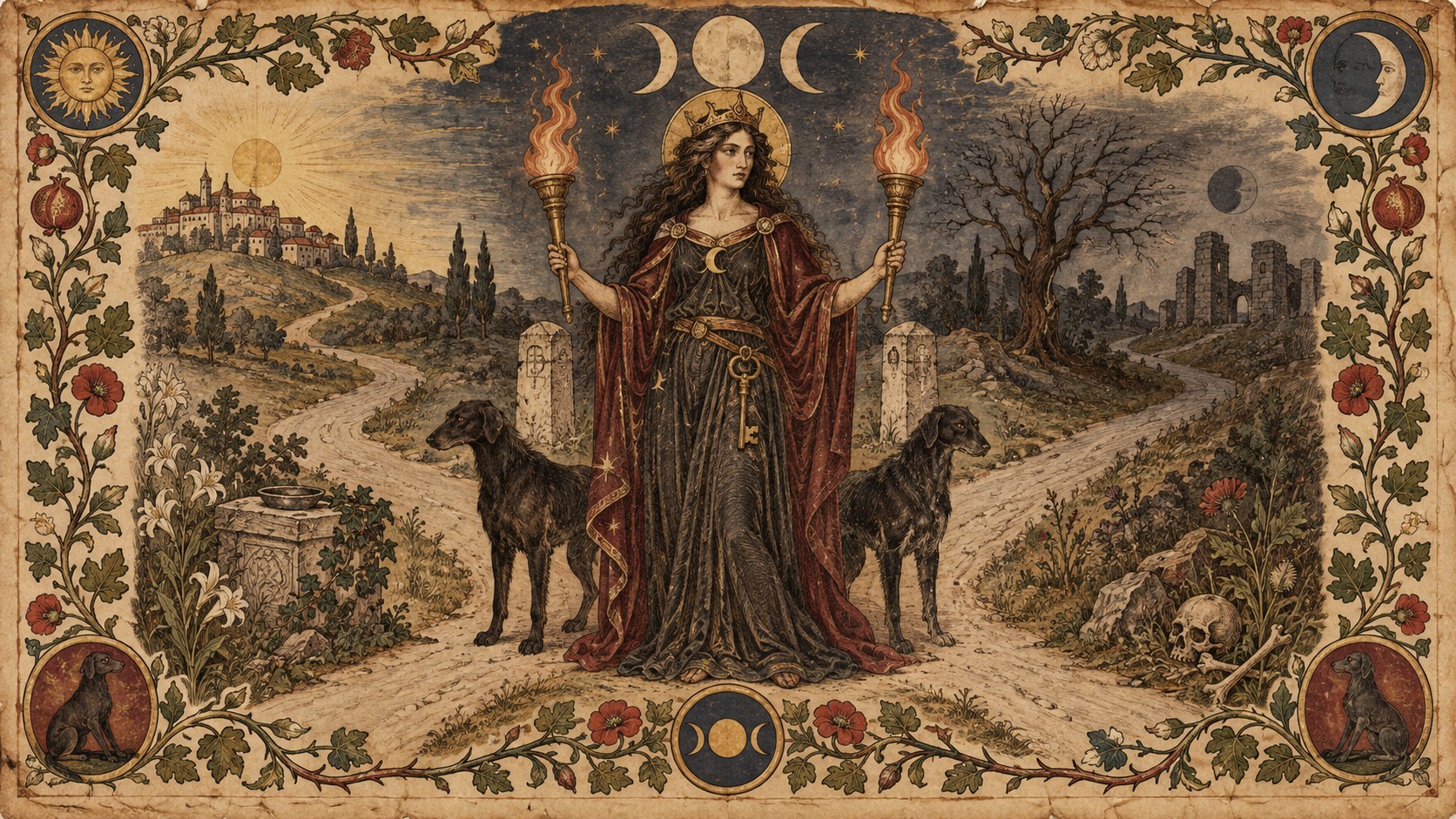
Hecate Quick Facts
| Name | Hecate; Greek Ἑκάτη; commonly transliterated Hekate |
|---|---|
| Culture | Ancient Greek, with important cult connections in Asia Minor |
| Parents | Perses and Asteria in Hesiod’s Theogony |
| Main Domains | Crossroads, thresholds, night, spirits, protection, magic and liminal spaces |
| Important Symbols | Torches, crossroads, keys, dogs and triple-form imagery |
| Major Mythic Connection | Demeter and Persephone |
| Important Ancient Sources | Theogony, Homeric Hymn to Demeter, Argonautica, Orphic Hymns, Description of Greece |
| Modern Associations | Witchcraft, Paganism, Hellenic polytheism, ritual magic and liminal spirituality |
Who Is Hecate?
Hecate is an ancient goddess whose identity cannot be reduced to a single function. In different periods and places she could be invoked as a protective deity, a guardian of entrances, a goddess of crossroads, a companion of Persephone, a power associated with ghosts and the night, and eventually one of the most important divine figures connected with magic.
Her liminal character is the thread that connects these roles. A doorway is neither entirely inside nor outside. A crossroads is the meeting point of different roads. Twilight is neither day nor night. The boundary between the living and the dead is another threshold. Hecate repeatedly appears in precisely these spaces.
This helps explain why later traditions connected her so strongly with magic. Ancient magic was frequently concerned with boundaries: opening and closing paths, contacting spirits, protecting houses, averting harmful forces, binding enemies, calling divine powers, and moving between ordinary and sacred space.
Within the broader Templum Dianae system of Dark Goddesses, Hecate is therefore best understood as a goddess of transition, access and sacred thresholds rather than simply as a personification of darkness.
Hecate or Hekate?
Hecate and Hekate refer to the same goddess. “Hekate” is a closer transliteration of the Greek Ἑκάτη, while “Hecate” is the traditional Latinized spelling that became standard in English.
Both forms are correct in modern writing. Classical studies often use “Hecate,” while contemporary Hellenic and Pagan practitioners frequently prefer “Hekate.” The difference is linguistic, not theological: it does not indicate two separate goddesses or two different traditions.
Origins of Hecate
The origins of Hecate are debated. She is firmly present in early Greek literature, yet some scholars have long suspected connections with Asia Minor, especially Caria, where her cult later became exceptionally important. The monumental sanctuary at Lagina in Caria demonstrates how prominent her worship could become outside mainland Greece.
The earliest major literary portrait appears in Hesiod’s Theogony. Hesiod describes Hecate as the daughter of the Titans Perses and Asteria. Far from presenting her as a marginal or sinister figure, he gives her an unusually elevated position. Zeus honors her, allows her to retain privileges inherited from the earlier divine order, and grants her influence in several areas of human life.
In Hesiod, she can aid kings in judgment, warriors in battle, athletes in competition, horsemen, sailors and herdsmen. She is also connected with prosperity and increase. This portrait is essential because it shows that the earliest surviving Greek image of Hecate is much broader than the later stereotype of an exclusively chthonic witch-goddess.
Hecate in Greek Mythology
Hecate’s most famous mythological appearance is in the Homeric Hymn to Demeter, the story of Persephone’s abduction by Hades and Demeter’s search for her daughter.
When Persephone cries out as she is taken into the Underworld, Hecate hears her voice. Later she approaches Demeter carrying torches and helps her seek information about what happened. After Persephone is restored to the upper world for part of the year, Hecate becomes closely associated with her.
This episode establishes several themes that remain central to Hecate’s identity: torches, night, searching, guidance, thresholds and movement between worlds. She does not rule the Underworld in the manner of Hades or Persephone. Instead, she can accompany movement toward and away from it.
Later literature intensifies her association with magic. In Apollonius of Rhodes’ Argonautica, Hecate becomes particularly important in the magical world surrounding Medea. By the Hellenistic and Roman periods, invocations of Hecate increasingly appear in magical, chthonic and nocturnal contexts.
What Is Hecate the Goddess Of?
There is no single ancient sentence that defines Hecate with the modern formula “goddess of X.” Greek divine functions were overlapping, local and historically changeable. Nevertheless, several domains recur strongly enough to form a coherent picture.
| Domain | Meaning |
|---|---|
| Crossroads | Places where paths divide or meet; sites of transition, choice and ritual activity. |
| Thresholds | Doorways, entrances and boundaries between protected and unprotected space. |
| Night | Nocturnal movement, torchlight and the unseen world. |
| Protection | Guarding houses, entrances and communities against dangerous forces. |
| Spirits and the Dead | Later associations with ghosts, restless dead and chthonic rites. |
| Magic | Especially prominent in Hellenistic and later sources. |
| Liminality | The broader principle connecting crossings, transitions and boundaries. |
These functions explain why Hecate could simultaneously appear as a protective household goddess and as a terrifying nocturnal presence in later magical literature. In ancient religion, protection and danger were often two sides of the same divine power. A deity capable of controlling harmful forces could also be invoked to keep them away.
Hecate Symbols and Their Meanings
Hecate accumulated a rich visual language over centuries. Some symbols are firmly rooted in ancient evidence; others became more important in later religious or esoteric traditions.
Torches
Torches are among Hecate’s clearest ancient attributes. In the Homeric Hymn to Demeter, she approaches Demeter carrying light. The torch therefore represents illumination in darkness, searching, ritual presence and guidance across uncertain terrain.
Crossroads
Crossroads became one of the most characteristic places associated with Hecate. They embody her liminal nature: several possible directions meet at a single unstable point. Offerings connected with Hecate could be placed at such locations, especially where three roads met.
Keys
Keys fit Hecate’s role as a guardian of boundaries and access. They became an important symbol of her capacity to open and close paths, gates and sacred thresholds. Modern practitioners often emphasize the key as a symbol of spiritual access, initiation and authority.
Dogs
Dogs are one of Hecate’s strongest animal associations. Ancient literary and ritual traditions repeatedly connect dogs with her presence. Their ability to guard entrances and detect unseen movement made them especially appropriate companions for a goddess of thresholds and night.
Triple Form
Hecate eventually became famous in three-bodied or three-faced form. Triple imagery was particularly suitable for a goddess connected with crossroads because a central figure could look toward several directions at once. This ancient iconography should not automatically be equated with the modern Maiden–Mother–Crone system, which is a much later interpretative framework.
Hecate’s Sacred Animals and Objects
The dog is the animal most consistently associated with Hecate. Ancient sources describe canine sounds in connection with her arrival, and dogs appear in ritual contexts connected with the goddess. Serpents also occur in some visual and magical representations, reflecting broader ancient associations with chthonic power, renewal and the earth.
Her principal ritual and iconographic objects include torches, keys and sometimes blades or cords in later magical representations. Rather than treating every modern correspondence list as ancient, it is more useful to distinguish securely attested symbols from later devotional additions.
Hecate, Persephone and the Underworld
Hecate’s relationship with Persephone is one of the strongest reasons she became associated with the Underworld. The Homeric Hymn to Demeter places her directly within the drama of Persephone’s disappearance and return. After the reunion between mother and daughter, Hecate becomes a companion to Persephone.
This is an important distinction. Hecate is not simply another ruler of the dead. Her function is more mobile. She accompanies, guides and stands at the points through which passage becomes possible. In this sense her Underworld character remains consistent with her broader role as a goddess of thresholds.
Later magical and literary traditions intensified this chthonic dimension. Hecate could be invoked alongside ghosts, nocturnal powers and Underworld divinities, making her increasingly central to the religious imagination surrounding magic and necromantic practice.
Hecate Triformis and the Triple Goddess
Ancient Hecate was sometimes represented in triple form, particularly in statues associated with crossroads. The triple body allowed the goddess to face multiple directions simultaneously and visually expressed her connection with three-way junctions.
The modern idea that Hecate represents the “Crone” of a universal Maiden–Mother–Crone Triple Goddess should be treated separately. That model belongs primarily to modern Pagan and esoteric interpretation. Ancient Greek sources do not present Hecate as one third of that specific system.
This does not make the modern symbolism meaningless. It simply belongs to a different historical layer. A historically responsible approach can acknowledge contemporary spiritual interpretations without projecting them backward into antiquity.
Hecate and the Moon
Hecate is widely described today as a moon goddess, but the ancient evidence is more complicated. Lunar associations strengthened over time through connections with other goddesses, especially Artemis and Selene, and through the broader tendency of late antique religion and magic to combine divine identities.
Hecate certainly belongs to a nocturnal religious world, but “goddess of the Moon” is too narrow a definition for her ancient identity. Night, torches, crossroads, spirits and magic are historically more characteristic of her than a simple equivalence with the lunar disk.
Hecate, Magic and Witchcraft
Hecate’s modern reputation as the supreme goddess of witches developed from genuine ancient roots, but those roots evolved over a long period.
Early sources such as Hesiod do not define her primarily through witchcraft. By the Hellenistic period, however, her connection with magic becomes much more visible. Medea’s rituals in the Argonautica, later literary portrayals, magical hymns and ritual texts increasingly place Hecate within the world of spells, spirits, nocturnal rites and divine epiphanies.
The word “witchcraft” can therefore be useful as a modern shorthand, provided it does not erase the older and broader goddess. Hecate was not invented by later witches; rather, a powerful ancient goddess of thresholds gradually acquired an increasingly prominent magical identity.
Cult and Ancient Worship of Hecate
Hecate was worshipped in both public and domestic settings. Small images or shrines known as hekataia could stand near doorways and crossroads, where the goddess functioned as a guardian of boundaries.
One well-known practice was the Deipnon, a recurring offering associated with Hecate and the end of the lunar month. Food and other offerings could be placed at crossroads or boundary locations. The practice combined purification, household religion and attention to forces existing outside ordinary domestic order.
Hecate also possessed major cult centers. The sanctuary at Lagina in Caria became one of the most important centers of her worship. Its scale demonstrates that Hecate was not merely a private goddess of magical specialists; she could receive organized civic cult and monumental religious architecture.
Ancient worship varied substantially by period and place. There was no single universal “Hecate ritual” followed across the Greek world.
Hecate in Later Tradition
As Greek and Roman religious traditions developed, Hecate became increasingly intertwined with other nocturnal and liminal goddesses. Roman writers could connect her with Trivia, an epithet evoking the three-way crossroads, while literary and magical sources expanded her chthonic and supernatural character.
Late antique magical texts sometimes present Hecate in highly elaborate cosmic forms, far removed from the relatively restrained portrait in Hesiod. This development illustrates a broader pattern in ancient religion: divine identities were not static. They accumulated epithets, functions, philosophical interpretations and ritual roles over centuries.
Later European literature inherited the image of Hecate as a frightening supernatural goddess. Shakespeare’s Macbeth, for example, contributed to her modern cultural association with witches, even though that literary Hecate belongs to a very different historical environment from archaic Greek religion.
Hecate in Modern Paganism and Witchcraft
Today Hecate is one of the most widely honored ancient goddesses within modern Paganism, Hellenic polytheism and several forms of contemporary witchcraft. Some practitioners attempt to reconstruct ancient Greek rites as closely as possible; others work within eclectic, initiatory, Wiccan, occult or highly personal systems.
Modern devotion commonly emphasizes crossroads, keys, torches, dogs, the dark moon, protection, spirit work, personal transformation and magical practice. Some of these themes have direct ancient precedents, while others are modern developments or reinterpretations.
The distinction matters. Historical reconstruction asks, “What do our sources show ancient worshippers doing?” Modern devotional practice asks, “How can this deity be meaningfully approached today?” They can inform one another without being treated as identical.
Go Deeper with Hekate the Witch Goddess
If you want to move from mythology into structured modern practice, Hekate the Witch Goddess by Templum Dianae Media explores Hekate through symbols, ritual work, invocations, spells and devotional practice.
What Does Hecate Represent?
In contemporary symbolic language, Hecate often represents the moment in which a person stands between an old identity and a new one. The crossroads is powerful precisely because it does not guarantee which path should be taken. It marks the necessity of choosing.
Her torches can therefore symbolize discernment rather than simple “light.” They illuminate enough of the road to make movement possible, but they do not abolish uncertainty. Her keys represent access and restriction: not every door must be opened, and not every threshold should be crossed.
This makes Hecate especially suitable as an archetypal figure for transitions, boundaries and decisions. That psychological reading is modern, but it grows naturally from ancient symbols that already placed her at points of passage.
Frequently Asked Questions About Hecate
What is Hecate the goddess of?
Hecate is associated with crossroads, thresholds, night, protection, spirits and magic. Her functions changed across time, so describing her only as the goddess of witchcraft is an oversimplification.
Is it Hecate or Hekate?
Both are correct. Hekate is a direct transliteration of Greek Ἑκάτη, while Hecate is the traditional Latinized English spelling.
Is Hecate a Greek goddess?
Yes. Hecate is firmly established within ancient Greek religion and mythology, although her deeper origins may include connections with Asia Minor, particularly Caria.
Is Hecate the goddess of witchcraft?
She became strongly associated with magic and witchcraft, especially in Hellenistic, Roman and later traditions. Her earliest surviving Greek portrayal is much broader and includes protection, prosperity, authority and several forms of assistance to human beings.
What are Hecate’s main symbols?
Her best-known symbols include torches, crossroads, dogs, keys and triple-form imagery.
Why is Hecate associated with dogs?
Dogs appear repeatedly in ancient traditions connected with Hecate. As guardians of entrances and animals capable of sensing unseen presences, they fit particularly well with her role as a goddess of boundaries and the night.
Is Hecate a moon goddess?
She has important lunar associations, especially in later religion and modern practice, but reducing her ancient identity to “moon goddess” is historically misleading. Her connections with thresholds, crossroads, spirits and magic are more distinctive.
Is Hecate a triple goddess?
Ancient art did represent Hecate in triple form, especially at crossroads. The modern Maiden–Mother–Crone interpretation, however, is not the same thing and should not be projected directly onto ancient Greek religion.
Is Hecate an Underworld goddess?
Hecate has strong chthonic associations and is closely connected with Persephone, ghosts and later Underworld magic. She is better understood as a goddess who can move across boundaries than as a straightforward ruler of the dead.
Was Hecate considered evil?
No. Ancient Greek religion did not divide its gods into a simple good-versus-evil system. Hecate could protect, guide and grant favor while also being associated with frightening nocturnal and chthonic forces.
Hecate at the Crossroads
The enduring power of Hecate comes from the fact that her ancient symbols remain intelligible even when their religious context changes. The doorway, the road, the torch, the key and the unseen presence beyond the boundary all describe experiences that human beings continue to recognize.
Historically, Hecate moved from the expansive divine figure of Hesiod to the torch-bearing companion of Persephone, the guardian of entrances, the goddess of crossroads and finally one of the great divine names of ancient magic. Modern Paganism inherited all of these layers and added new ones.
Understanding those layers separately does not weaken her mystery. It makes the picture clearer: Hecate is powerful precisely because she has always belonged to the spaces where categories meet and certainty ends.
For a broader map of related traditions, see the Templum Dianae guide to Dark Goddesses Names and Meanings.

Ancient Sources and References
- Theogony — Hesiod
- Homeric Hymn to Demeter
- Argonautica — Apollonius of Rhodes
- Orphic Hymns
- Description of Greece — Pausanias
- Metamorphoses — Ovid
Web References
https://en.wikipedia.org/wiki/Hecate
https://www.britannica.com/topic/Hecate