paganism meaning becomes clearer when you stop living as if every season were the same. Pagan spirituality teaches rhythm. Desire has a season. Rest has a season. Grief has a season. Growth has a season. Once you start living by that logic, your emotional life becomes less chaotic. In relationships, that means fewer reactions driven by panic and more choices grounded in timing, boundary, and self-command. Modern Pagan traditions commonly place strong emphasis on nature, cyclical time, and the sacred character of the natural world, which is one reason many practitioners experience them as stabilizing rather than abstract.
It also changes how you think about abundance. Pagan paths do not teach sterile control detached from life. They teach participation in a living web. You plant, tend, wait, harvest, and give back. That mindset builds sovereignty because it forces you to work with consequence instead of fantasy. Britannica notes that the modern reappropriation of Paganism refers to a family of religions inspired by the pre-Christian traditions of Europe, North Africa, and West Asia, while Wikipedia describes contemporary pagan religions as often polytheistic, pantheistic, panentheistic, or animistic.
- paganism symbols and meanings through signs like the pentacle, sun wheel, and triquetra
- paganism vs wicca and where the two overlap or clearly diverge
- modern paganism for wealth and love through seasonal rhythm, devotion, and grounded manifestation
- … and much, much more!
Keep reading if you want Paganism explained as a real spiritual path with history, symbols, and practical foundations instead of a blur of recycled stereotypes.
“…in the vision of Templum Dianae, Paganism becomes the art of restoring harmony in love, honoring your ancestors without losing yourself, and building abundance by moving in step with the living rhythm of Earth…”
Paganism keywords
Upright: sovereignty, reverence, rhythm, rootedness, reciprocity
Reversed: disconnection, projection, excess, spiritual drift, imbalance
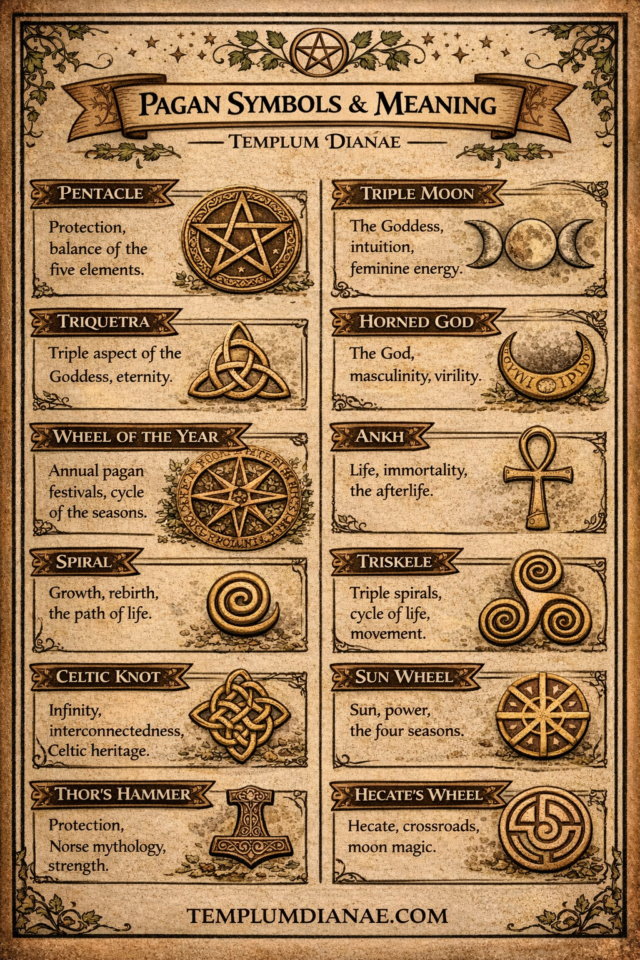
Paganism Description and symbolism
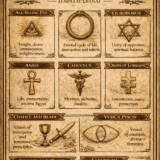
Pagan symbolism is not one single code because Paganism is not one single religion. Even so, some images appear often in modern Pagan visual culture because they express recurring themes: cycle, balance, plurality, and sacred relationship with the world. The pentacle is one of the clearest examples. Britannica notes that in modern Neo-Pagan contexts, especially Wicca, the pentagram enclosed in a circle is often read through the five elements: air, fire, water, earth, and spirit. That makes it a sign not only of protection but of ordered relationship between visible and invisible forces.
The sun wheel, or sun cross, is older and broader. Wikipedia describes it as a circle containing a cross or spokes, frequently found in the symbolism of prehistoric European cultures and often interpreted as a solar sign linked to cyclical movement and seasonal order. The image is powerful because it condenses year, wheel, horizon, and return into one shape.
The triquetra is more complicated. Wikipedia describes it as an interlaced three-cornered figure found in Insular art and later reused in Celtic revival and contemporary symbolic design. In modern Pagan settings it is often read through triplicity: land, sea, sky; life, death, rebirth; maiden, mother, elder. The four elements then complete the picture. Earth stabilizes, air clarifies, fire transforms, water connects. Together they form the grammar through which many Pagans interpret both altar space and inner life.
Paganism meaning and spiritual foundations
At its broadest, Paganism refers to religions that honor a plurality of divine presences, the spiritual significance of nature, or both. Historically, the word was imposed by Christians on non-Abrahamic religions, often with a dismissive tone. Britannica explains that “pagan” was a label Christians used for traditions outside biblical monotheism, while modern Paganism later reclaimed the term as a self-designation for related new religious movements inspired by pre-Christian traditions.
Spiritually, modern Paganism often stands on three foundations: polytheism, animism, and reverence for Earth. Wikipedia states that most modern pagan religions express worldviews that are polytheistic, pantheistic, panentheistic, or animistic. Britannica’s entry on animism defines it as belief in many spiritual beings involved in human life, while Wikipedia’s modern Paganism article notes that many Pagans understand nature as alive, ensouled, or inhabited by specific spirits.
That does not mean every Pagan believes exactly the same thing. Some traditions reconstruct ancient polytheisms with care. Others are more eclectic and symbolic. Britannica explicitly notes that modern Pagan religions range from highly reconstructive approaches to openly eclectic ones using historical and archaeological material in different ways. What unites them is not one creed but one orientation: the world is not spiritually empty. Land, season, ancestry, and embodied life matter. The sacred is not somewhere else waiting to be reached. It is already here, and your task is to learn how to meet it with attention, respect, and reciprocity.
Paganism love and relationships meaning
devotion, reciprocity, sacred regard
In relationships, Paganism trains you to see another person not as property or projection, but as a presence carrying their own dignity, ancestry, and divine depth. A Pagan approach to love is strongest when it treats union as sacred exchange rather than possession. That is why emotional control matters here: you learn to respect timing, vow, fertility, grief, desire, and boundaries as part of a larger order. The spiritual lesson is simple but demanding. Honor the divine in another without abandoning the divine order within yourself.
Paganism careers and abundance meaning
harvest, timing, stewardship
Pagan abundance is less about instant gain and more about right season. You prepare, cultivate, protect, and gather. That makes it a useful spiritual frame for work and money because it rewards patience, consistency, and respect for cycles. Wikipedia notes that common modern Pagan festivals often emphasize agricultural rhythm and seasonal change, while Britannica highlights nature-oriented inspiration as a core feature of modern Pagan religions. In practical terms, Paganism can help you think of prosperity as something grown in relationship with effort, environment, and right timing.
Paganism and tarot and astrology
Tarot and astrology are not universal requirements of Paganism, but they often function as bridges between nature-based spirituality and divinatory interpretation. Modern Paganism emerged partly from a wider Western esoteric environment, and Britannica notes that 19th-century esoteric groups such as the Hermetic Order of the Golden Dawn and the Theosophical Society helped create the cultural ground from which early modern Pagan groups emerged. That helps explain why many contemporary Pagans are comfortable combining ritual, seasonal observance, tarot, and astrology in one living practice.
For a beginner, the logic is straightforward. Tarot reads pattern. Astrology reads timing. Paganism provides the sacred cosmology in which both become meaningful. Nature gives rhythm, divination gives interpretation, and ritual gives response. When kept in balance, these systems can deepen awareness without turning spirituality into passivity or superstition.
Paganism and dreaming interpretation
Dreams sit naturally inside Pagan practice because Pagan worldviews often assume that the boundary between visible and invisible life is porous. In traditions shaped by animism or ancestor reverence, dreaming can become a place where memory, symbol, land, and spirit meet. Wikipedia’s modern Paganism article notes that many Pagans understand the world as spiritually inhabited and interconnected, which gives dream experience a very different status than it has in a purely materialist worldview.
For a beginner, the sane use of dream interpretation is pattern recognition. Not every dream is prophecy. Some are emotional digestion. Some are symbolic rehearsal. Some may feel numinous because they gather grief, ancestry, and intuition into one image. The key is to record recurring motifs, emotional force, and seasonal timing. In a Pagan frame, the dream world is not separate from the sacred ecology of life. It is one more place where the deeper pattern speaks.
Paganism and shadow work
Paganism is often romanticized as pure sunlight, herbs, and festivals, but real Pagan spirituality includes descent. The seasonal year itself teaches that. Growth is only half the story. Decline, composting, grief, and the long inward turn are just as sacred. Wikipedia’s Wheel of the Year page describes modern Pagan seasonal practice as a cycle of growth and retreat tied to solar turning points, which is one reason many Pagans interpret darkness not as failure but as necessary transformation.
Shadow work in a Pagan context means entering the underworld of the self without glamorizing it. You meet jealousy, fear, resentment, vanity, ancestral pain, and the craving to dominate. Then you decide whether you will feed them or transmute them. The point is not endless introspection. It is sovereignty. The dark half of the year becomes a mirror: what must die, what must be mourned, what must be released, and what can return stronger because it was forced underground long enough to become honest.
Paganism and the law of attraction
A Pagan approach to attraction is less about detached wishing and more about alignment with living process. You do not merely “manifest.” You enter a field of reciprocity where intention, season, effort, and consequence remain linked. That fits well with modern Pagan views of interconnection. Wikipedia notes that a key part of many Pagan worldviews is an interconnected universe and, often, the sense that divinity is inseparable from nature.
That changes how attraction is practiced. If you want love, you ask whether your field is stable enough to receive it. If you want abundance, you ask whether your habits match your prayer. If you want change, you ask what must be offered, pruned, or endured first. In this sense, the “flow” you tap into is not an abstract cosmic vending machine. It is Earth’s logic: seed, tending, patience, harvest, gratitude, renewal.
Paganism and historical references
Historically, “paganism” was a Christian category rather than a self-description. Britannica explains that the term was applied to pre-Christian and non-Abrahamic traditions and that modern Pagan groups only later reclaimed it. Wikipedia similarly notes that in early Christianity it referred collectively to polytheistic religious practices and then broadened into a general label for non-Christians.
The modern revival is much later. Britannica places the rise of modern Pagan religions in Europe and North America during the 20th century, drawing inspiration from extinct pre-Christian religions of Europe, North Africa, and West Asia. Wikipedia adds that modern Paganism spans a spectrum from reconstructive forms, which seek close historical revival, to eclectic movements that combine older material with more contemporary spiritual methods. That history matters because it keeps the subject honest. Modern Paganism is real religion, but it is not simply a frozen survival of antiquity. It is revival, reconstruction, reinterpretation, and living invention at once.
Paganism and ethics
Pagan ethics are usually less centralized than the ethics of scriptural monotheisms because Paganism is a family of religions rather than one church with one creed. Still, a common principle appears again and again: relationship carries responsibility. If the world is alive, if land and beings are spiritually significant, and if life unfolds inside a web of reciprocity, then action cannot be ethically neutral. Wikipedia’s modern Paganism article highlights interconnectedness, animism, and reverence for nature as recurring features of Pagan worldviews.
For a beginner, that means ethics begin with attention. How do you speak to the land? How do you use power? How do you treat offerings, promises, sex, grief, animals, and the dead? A Pagan path does not need a single universal commandment to demand seriousness. Personal responsibility becomes heavier, not lighter, when you understand yourself as part of a living web rather than an isolated consumer of spiritual experiences.
Paganism and types of traditions
Modern Paganism includes many distinct traditions, and Britannica explicitly says there is too much variation among them to identify one single unifying feature beyond their shared inspiration in pre-Christian religions. Wikipedia describes this range in similar terms and notes examples that move from reconstructive to eclectic forms.
Among the better-known traditions are Heathenry, which models itself on the pre-Christian religions of Germanic peoples; Druidry, a modern movement inspired by ancient Celtic and British materials; and Hellenism, a modern polytheistic religion derived from the beliefs and rites of ancient Greece. Wikipedia has separate pages for all three and describes each as a modern Pagan or related reconstructionist current rather than a mere aesthetic preference.
This matters for beginners because “Pagan” is an umbrella, not a denominator that erases difference. The best first step is not choosing the most dramatic label. It is learning whether you are drawn to reconstruction, devotion to a specific pantheon, nature-based eclecticism, or a more symbolic path that honors the old gods without claiming strict historical recreation.
Paganism and the wheel of the year
The Wheel of the Year is one of the most visible structures in modern Pagan practice, although it is not universal to every Pagan tradition. Wikipedia defines it as an annual cycle of seasonal festivals observed by a range of modern Pagans, marking solstices, equinoxes, and the midpoints between them. It adds that the version most familiar today was popularized in the mid-20th century, especially in Wiccan and Druid contexts.
For a beginner, the Wheel matters because it teaches sacred timing. Solstices and equinoxes become more than dates. They become inner instructions. Expand, ripen, release, withdraw. That seasonal intelligence can change emotional life because it breaks the illusion that you must feel, want, and produce the same way all year long. A Pagan calendar trains spiritual realism. It returns you to season, and season quietly restores proportion.
Paganism and altar setup for beginners
A Pagan altar is not a display cabinet. It is a point of relationship. For a beginner, that means simplicity is usually stronger than clutter. Since many modern Pagans emphasize nature reverence, sacred place, and seasonal rhythm, a good home altar often begins with a clean surface, a candle, a bowl for water, a stone, seasonal greenery, and one symbol that genuinely anchors devotion. Wikipedia notes that Pagans often treat places of natural beauty as sacred and ideal for ritual, which helps explain why home altars frequently echo land, season, and element rather than fixed dogmatic imagery alone.
The altar becomes useful when it reflects a real relationship: to a deity, an ancestor, a land spirit, a tradition, or the turning year itself. Start with one intention. Add offerings or symbols slowly. Let the altar teach you economy. In Pagan practice, sacred space works best when it is inhabited, tended, and allowed to change with the season instead of remaining frozen as decoration.
Paganism and animistic foundations
Animism is one of the deepest foundations beneath many Pagan worldviews. Britannica defines it as belief in innumerable spiritual beings involved in human affairs, while Wikipedia defines animism more broadly as the view that places, objects, plants, animals, and other beings possess distinct spiritual essence or agency.
Wikipedia’s modern Paganism article states that many contemporary Pagans understand animism in one of two ways: either as a life force running through everything, or as the presence of specific spirits inhabiting features of the natural world. That distinction matters because it shows why Paganism often feels relational rather than merely symbolic. A river can be more than water. A tree can be more than botanical matter. A place can become a presence rather than a backdrop. Once you start from that premise, reverence is no longer sentimental. It becomes the minimum level of intelligence required to live well in an ensouled world.
Paganism challenges and misconceptions
The most common misconception about Paganism is that it means “devil worship.” Historically, that charge came from Christian polemic, not from Pagan self-understanding. Britannica explains that Christians often regarded pre-Christian gods as demons, and Wikipedia notes that “pagan” itself originated as a Christian label applied to others. Modern Pagan traditions do not share a single doctrine, but the family resemblance usually points toward nature reverence, polytheism or animism, reconstruction, and seasonal spirituality, not Satanism.
A second misconception is that all Paganism is invented fantasy with no complexity. That is also false. Britannica describes a spectrum ranging from highly reconstructive traditions to openly eclectic ones, and Wikipedia emphasizes that contemporary Pagan movements differ widely in belief, practice, and relation to historical sources. Some practitioners work carefully with archaeology, texts, and historical ritual logic. Others build more modern spiritual syntheses. The complexity is real, and beginners need to understand that before flattening everything into one “witchy” category.
The third challenge is internal. Reconstructionism can become rigid or romanticized. Eclecticism can become shallow. Some modern Pagan currents have also struggled with questions of nationalism, racial misuse, or pseudohistory, something Wikipedia explicitly notes in its criticism section for modern Paganism. That does not define the whole movement, but it does mean beginners should approach sources carefully, stay historically sober, and refuse simplistic myths of purity or secret unbroken survival.
Paganism FAQ
Paganism what is the true paganism meaning for beginners?
For beginners, Paganism means a family of modern religious paths inspired by pre-Christian traditions and often centered on nature, plurality of divine beings, seasonal rhythm, and spiritual relationship with the living world. It is not one single church or scripture-based system.
Paganism is it a real religion and how does it work?
Yes. Britannica describes modern Paganism as a family of new religions, and Wikipedia classifies contemporary Pagan movements as new religious movements. It works through devotion, ritual, seasonal observance, ethics, worldview, and often relationship to deity, ancestors, or land spirits.
Paganism how do I start practicing at home?
Start small. Learn the seasonal year, keep a journal, build a simple altar, read one tradition carefully, and spend regular time in conscious contact with nature. The strongest beginner practice is not dramatic spellwork. It is consistent relationship and informed study.
Paganism what are the most common pagan symbols and meanings?
Common modern Pagan symbols include the pentacle, often linked to the five elements; the sun wheel, associated with solar and seasonal cycle; and, in some modern Celtic-influenced contexts, the triquetra, used as a sign of sacred triplicity. These do not carry one identical meaning across every tradition.
Paganism can it help with finding a soulmate?
It can help by strengthening self-knowledge, emotional rhythm, discernment, and reverence in relationship. A Pagan frame is most useful when it teaches you to honor sacred union without collapsing into obsession or trying to force destiny. That is more mature than chasing signs while ignoring character.
Paganism what is the difference between Paganism and Wicca?
Paganism is the larger umbrella. Wicca is one specific modern Pagan religion. Wikipedia and Britannica both present Wicca as part of the broader modern Pagan landscape rather than as a synonym for the whole field.
Paganism do pagans believe in God or multiple gods?
There is no single answer for all Pagans. Wikipedia states that most modern pagan religions are polytheistic, pantheistic, panentheistic, or animistic, though some are monotheistic. That diversity is normal within the broader Pagan family.
Paganism is it dangerous or anti-religious?
Paganism is not inherently anti-religious. It is itself religious. The greater risks are poor sources, romantic misinformation, or getting pulled into pseudohistory, extremist misuse, or shallow appropriation of traditions you do not understand.
Paganism what are the main pagan holidays called?
In many modern Pagan traditions, especially Wiccan and Druidic ones, the best-known cycle is the Wheel of the Year: eight seasonal festivals built around solstices, equinoxes, and cross-quarter days. Not every Pagan tradition uses this exact structure, but it is the most widely recognized modern framework.
Paganism do I need to join a group or can I be a solitary pagan?
You can absolutely be solitary. Modern Paganism is decentralized, and Wikipedia notes the sheer diversity and nonuniformity of contemporary Pagan movements. Some people join circles, groves, or kindreds. Others practice privately with no formal membership at all.