rune meanings begin to matter when you stop treating fate as a passive sentence and start treating it as a field you meet with will. In a Germanic frame, Wyrd is not just “what happens to you.” It is what comes to pass, what unfolds, what becomes; the Old English wyrd is cognate with Old Norse urðr, the same family of ideas tied to fate and becoming. When you work with runes in that spirit, your stance changes. In relationships, that means less drift, less emotional leakage, and more conscious exchange. You stop begging life to reveal itself and start reading the pattern with steadier hands.
The same logic applies to money and material flow. The Elder Futhark was originally a writing system used by Germanic peoples, not a fantasy prop, and the runes themselves carried names linked to wealth, need, joy, gift, harvest, day, estate, and humanity. That is why they still feel potent in modern spiritual practice: they compress force into form. Historically, runes were letters first, though some inscriptions and later literary material show magical associations; modern divinatory systems came much later and are extrapolations from sparse historical evidence rather than a fully preserved ancient manual.
- elder futhark rune meanings and how each stave maps a different force of life
- ancient rune symbols meaning through language, myth, and carved form
- applying runes to wealth and love through willpower, reciprocity, and aligned intention
- … and much, much more!
Keep reading if you want a beginner guide that gives you the real historical frame, the full Elder Futhark, and a usable spiritual interpretation without flattening everything into vague Viking aesthetic.
“…in the vision of Templum Dianae, runes are primordial keys, teaching you to cut through confusion in love, read the current of Wyrd with clarity, and open financial flow by bringing will, symbol, and action into one line…”
Runes keywords
Merkstave / aligned: clarity, will, reciprocity, momentum, inheritance
Murkstave / blocked: stagnation, compulsion, rupture, scarcity, misreading
Runes Description and symbolism
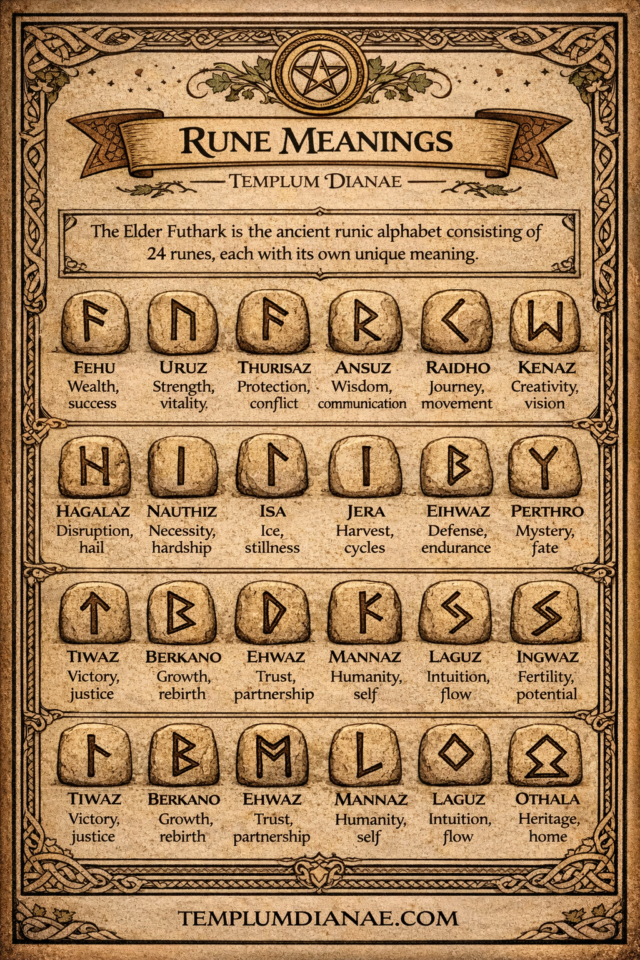
Runes are the letters of the runic alphabets, native to the Germanic peoples. The oldest full runic row is the Elder Futhark, a 24-letter system used from roughly the 2nd to the 8th centuries, and its name comes from the sound values of its first six runes: f, u, th, a, r, k. Britannica also notes that the early Germanic script had 24 letters divided into three groups of eight, the ættir.
Visually, the staves are angular and linear for a practical reason. Britannica points out their angular letter forms, and that feature fits carving on wood, bone, metal, and stone better than rounded scripts do. Historically, runic writing appeared later than the earliest Mediterranean alphabets and is generally understood as deriving from one of those Mediterranean writing traditions, with many scholars favoring some mix of Old Italic or related influence.
Mythically, however, the runes are not presented as mere borrowed signs. In Hávamál, Odin gains the runes through self-sacrifice, hanging for nine nights on the tree, wounded by a spear, then taking up the runes in a scream. That myth is not a historical account of alphabet invention, but it is central to the symbolic life of the runes in Norse tradition because it frames them as wisdom wrested from ordeal rather than received casually. The shapes of the staves therefore carry a double meaning in modern practice: historically they are letters; spiritually they are cuts, branches, crossings, and tensions made visible.
Runes All Elder Futhark rune names and meanings
The names below are the conventional scholarly reconstructions or standardized modern spellings used for the 24 Elder Futhark runes. Wikipedia notes that the names are not directly attested for the Elder Futhark itself; they are reconstructed from later rune poems and related evidence.
- Fehu: wealth, cattle, movable property. In readings, Fehu points to resources that must circulate wisely, not just possessions to be hoarded.
- Uruz: aurochs, wild ox, raw vigor. It often signals untamed strength, endurance, and the force needed to rebuild after strain.
- Thurisaz: thorn, giant-force, disruptive pressure. It marks confrontation, defense, and the dangerous edge that can protect or wound.
- Ansuz: god, divine speech, inspired message. It is commonly read as breath, counsel, language, and the power of rightly timed communication.
- Raido: ride, journey, ordered movement. It suggests travel, rhythm, process, and the need to move in the right direction rather than merely move fast.
- Kaunaz: torch, ulcer, controlled fire; the historical reconstruction on Wikipedia is kaunan, while modern esoteric writing often uses Kaunaz or Kenaz. It points to insight, craft, and illumination that can heal or cauterize.
- Gebo: gift. It is the rune of exchange, reciprocity, alliance, and the truth that every bond changes both giver and receiver.
- Wunjo: joy. In practice it is linked to harmony, emotional relief, right belonging, and the happiness that comes when tension finally resolves.
- Hagalaz: hail. It signals disruption, weather-shock, structural stress, and the kind of destruction that clears false stability.
- Nauthiz: need, constraint, urgency. This rune points to pressure, necessity, survival lessons, and the friction that forces maturity.
- Isa: ice. It is associated with stillness, blockage, concentration, and the hard pause that preserves and delays at once.
- Jera: year, harvest, good season. It marks cycles, timing, earned results, and the slow reward of repeated effort.
- Eihwaz: yew tree. Often treated as a rune of endurance, initiation, axis, and the ability to remain standing through transition.
- Perthro: often glossed as dice-cup, lot, chance, or hidden lot. It is commonly used for mystery, probability, what is cast but not fully controlled.
- Algiz: often reconstructed as elk, with later protective associations also noted on Wikipedia. In practice it is frequently read as defense, alertness, and standing under higher protection.
- Sowilo: sun. It points to radiance, success, clarity, and the life-force that burns through confusion.
- Tiwaz: the god Týr. This is the rune of law, directed courage, duty, honorable struggle, and alignment with principle.
- Berkano: birch. It is linked to growth, birth, recovery, cultivation, and the soft but persistent force of renewal.
- Ehwaz: horse. Historically tied to partnership and movement, it is often read as trust, cooperation, and progress through joined effort.
- Mannaz: man, humanity, the human collective. It points to selfhood, social intelligence, identity, and your place within the human web.
- Laguz: water, lake. It is commonly read as intuition, flow, emotion, and the unconscious currents beneath visible action.
- Ingwaz: associated with Ing, gestation, inner growth. It suggests incubation, stored potency, and power developing below the surface.
- Dagaz: day, breakthrough. It marks turning points, clarity after darkness, and the sudden shift from tension to opening.
- Othala: estate, inheritance, heritage, household. It points to land, lineage, belonging, long-term security, and what you are meant to steward.
Runes general spiritual meaning
Spiritually, runes matter because they sit in two worlds at once. Historically they were letters used to represent sound values, and Wikipedia notes that they could also function ideographically, standing for the concepts after which they were named. That makes them unusually dense signs. A rune is not only a phoneme; it can also point toward a word, a force, a condition, or a mythic field.
This is one reason modern readers experience the runes as more than an alphabet. The names themselves come from daily life and mythology: wealth, need, gift, joy, hail, year, sun, birch, horse, day, estate. Even on the Elder Futhark page, the rune-name table shows how tightly the row is tied to lived realities and divine references. In symbolic practice, the alphabet becomes a map of forces that shape the human path: pressure, exchange, endurance, law, timing, breakthrough, inheritance.
At the same time, serious runology requires restraint. Wikipedia is explicit that there is no direct evidence for a fully preserved ancient rune-divination manual, and that many modern systems were extrapolated later from sparse historical material. So the most honest spiritual reading is this: the cosmic aura of the runes belongs to myth, poetry, magical inscriptions, and later esoteric interpretation, while the historical core remains linguistic and epigraphic. Used well, that tension is a strength. It keeps the runes from becoming either sterile archaeology or empty mysticism. They remain what they have always been at their best: disciplined signs that cut form into fate.
Runes love and relationships meaning
exchange, joy, loyalty
For relationships, Gebo, Wunjo, and Ehwaz form one of the clearest triads in modern rune reading because their historical names point toward gift, joy, and horse or partnership. Gebo emphasizes reciprocity, Wunjo points toward emotional harmony, and Ehwaz suggests trust through shared motion. In practice, these runes are useful because they force one question: is this bond balanced, glad, and capable of moving forward together, or is one person dragging the other through fate without consent.
Runes careers and money meaning
resources, harvest, inheritance
For work and money, Fehu, Jera, and Othala are foundational. Fehu historically points to wealth and movable property, Jera to year and harvest, and Othala to estate and inheritance. Together they sketch a serious prosperity model: acquire, cultivate, consolidate. That is more mature than magical greed. Fehu asks what you actually control, Jera asks whether you have respected timing, and Othala asks whether you are building something that can endure beyond the next impulse.
Runes and tarot and astrology
Runes, tarot, and astrology are often treated together in modern spiritual practice, but historically they are different kinds of systems. Runes began as alphabets used by Germanic peoples; tarot is a much later card system; astrology is a cosmological framework tied to planets, signs, and houses. The overlap is therefore comparative, not original. What unites them is symbolic compression: each system reduces complex life patterns into repeatable signs.
For beginners, this matters because it keeps categories clean. If you compare systems, compare functions. Runes tend to feel sharper and more elemental. Tarot is more narrative. Astrology is more cyclical and structural. None cancels the others. They simply read pattern from different angles. The mistake is to imagine that the Elder Futhark was an ancient version of tarot or a hidden zodiac. It was first a script, then a field of symbolic use, and only much later a modern divinatory system in the form most people now recognize.
Runes and dreaming interpretation
Historically, the sources do not give us a stable manual for “seeing staves in the astral plane.” What we do have are mythic and literary associations in which runes carry power, secrecy, and divine origin, especially through Odin in Hávamál. That gives modern dream-rune work a symbolic base, but not a fixed ancient protocol.
So if a specific rune keeps appearing in dreams, the most honest approach is interpretive rather than dogmatic. Ask what force that rune historically names, and then ask what in your life currently resembles that force. If Nauthiz appears, where is necessity tightening? If Jera appears, what is ripening slowly? If Algiz appears, where are you guarding or needing protection? This method respects both the symbolic richness of the staves and the limits of the historical record.
Runes and shadow work
Shadow work with runes becomes most useful when you stop asking which rune is “good” and start asking which force you resist. Thurisaz and Nauthiz are perfect examples. Historically, Thurisaz is linked with thorn or giant-force, and Nauthiz with need or constraint. In modern introspective reading, these are rarely comfortable runes because they expose pressure, anger, scarcity, friction, and the edge where uncontrolled force meets consequences.
That makes them valuable. Thurisaz shows where you push too hard, defend too harshly, or invite conflict without discipline. Nauthiz shows where deprivation, urgency, or fear has become your hidden teacher. Neither rune is “bad” in any absolute sense. They are difficult because they strip sentimentality away. Shadow work with the runes is strongest when it treats discomfort as diagnosis, not as punishment.
Runes and the law of attraction
The bindrune is one of the clearest places where history and modern manifestation practice intersect, but they are not the same thing. Historically, a bind rune is a ligature of two or more runes. Wikipedia notes that bind runes are extremely rare in Viking Age inscriptions and more common in earlier Proto-Norse and later medieval material. Using them as sigil-like tools for manifestation is a modern esoteric adaptation, not a directly documented Elder Futhark rite.
That does not make bindrunes useless. It just means you should use them honestly. A bindrune can work as a visual anchor for intent, much the way a modern sigil does. If you combine Fehu with Jera, for example, you are not reviving a proven Viking business spell. You are creating a modern symbolic device built from historically attested rune names and forms. That is a valid practice as long as you know what part is ancient and what part is yours.
Runes and historical references
The historical frame begins before the Viking Age. Wikipedia notes that the earliest secure runic inscriptions date no later than AD 150, with possible earlier material and Tacitus’s famous description from around AD 98 of marked lots used in divination. Tacitus does not explicitly describe the Elder Futhark as such, but his account is often discussed as a possible early parallel to later runic culture.
Britannica describes runic writing as a system of uncertain origin used by Germanic peoples from about the 3rd century to the 16th or 17th century, and says it was likely derived from one of the alphabets of the Mediterranean area. By the late 8th century in Scandinavia, the Elder Futhark was simplified into the 16-rune Younger Futhark, which then became the main script of the Viking Age. Wikipedia and Britannica both agree on that broad shift from 24 letters to 16.
Runes and birth day connection
A “runic zodiac” is a modern esoteric overlay, not a historically attested part of Elder Futhark practice. The historical evidence shows runes as alphabets, inscriptions, names, memorials, and sometimes magical or symbolic signs, but not a preserved birth-date horoscope system comparable to later astrology. Wikipedia is explicit that there is no direct evidence for a fully specified ancient rune-divination manual, which is why claims about an ancient runic zodiac should be treated as modern invention or inference rather than settled tradition.
Used carefully, though, a birthday-rune practice can still be meaningful as a reflective tool. You choose a rune by date range or personal method, then meditate on that rune’s historical name and symbolic force. The value is not in pretending the system is ancient. The value is in using a clear symbolic prompt to examine temperament, repeating lessons, and the way your will meets Wyrd across time.
Runes and expression of self
If one rune speaks most directly to self-expression, it is Mannaz. Historically its name points to “man” in the collective sense, humanity rather than isolated ego. That makes it especially useful for questions of identity because it frames the self as relational, social, and accountable rather than merely private.
In modern spiritual work, the Mannaz vibration is strongest when it asks who you become in contact with others. Are you speaking from centered humanity, or from performance? Are you building selfhood, or only reaction? Mannaz does not usually flatter narcissism. It tends to demand sober self-knowledge, because the human path is never walked outside the web of other humans.
Runes and karmic lessons
Historically, the Elder Futhark is arranged in three groups of eight runes, the ættir. Britannica notes the 24-letter structure and the division into three groups of eight, while Wikipedia adds that the original names of those groups are unknown. Modern esoteric readers often treat the three ættir as developmental cycles, but that is an interpretive model rather than a documented ancient doctrine.
As a karmic framework, though, the idea is useful. The first ætt can be read as survival, resources, and relationship to force. The second often feels like pressure, weather, and inner endurance. The third leans toward law, humanity, transformation, and inheritance. Whether you call that karma, fate, or developmental sequence, the lesson is similar: the row moves from acquisition and friction toward maturity and stewardship.
Runes and angel numbers connection
There is no historical Elder Futhark doctrine linking runes to angel numbers. That connection belongs to modern spiritual synthesis, where people combine symbolic systems that originally developed in different cultural and historical settings. Since runes are historically Germanic alphabets and number-sequence spirituality is a much later interpretive culture, the connection should be treated as contemporary symbolism, not ancient runology.
That said, people often experience the two systems together because both rely on repetition and symbolic attention. If a number sequence and a rune keep appearing around the same season of life, the practical move is not to force a grand theory. It is to ask what both symbols are pressing you to notice. One may name timing, the other may name force. Used that way, the overlap becomes reflective rather than superstitious.
Runes and life path alignment
Life-path alignment in rune work means bringing symbol, will, and action into one line. The historical row gives you the names of forces; your task is to decide whether you are moving with them consciously or being dragged by them unconsciously. Wyrd in the older Germanic sense is about what becomes, what comes to pass. Rune practice becomes powerful when it teaches you to participate in that becoming instead of collapsing into passive fatalism.
So alignment is not mystical vagueness. It is concrete. Fehu asks whether your resources are alive. Raido asks whether you are on the right road. Jera asks whether you accept season and delay. Tiwaz asks whether your will answers to honor. Othala asks what you are building that can actually outlast you. If your life path cannot answer those questions, the staves expose the fault line quickly.
Runes pitfalls and negative meanings
One of the biggest beginner mistakes is assuming that “reversed runes” are an unquestioned ancient system. They are not. Wikipedia notes that there is no direct evidence for a preserved historical rune-divination manual, and that modern authors extrapolated whole systems from limited evidence. So Murkstave readings can be useful in modern esoteric practice, but they should be presented honestly as later interpretive conventions, not as fixed Viking doctrine.
A second pitfall is ego-driven magic. Because the rune names are strong and elemental, beginners sometimes treat them like spiritual weapons. They want Thurisaz for domination, Fehu for greed, Algiz for paranoid protection, or bindrunes as shortcuts to control outcomes. Historically, however, the evidence shows a mix of writing, naming, memorial use, and some magical or symbolic use, not a guarantee that the alphabet exists to serve raw appetite.
A third mistake is flattening all rune meaning into “positive” and “negative.” Hagalaz can destroy, but it can also clear. Isa can freeze, but it can also preserve. Nauthiz can feel brutal, but it can also sharpen necessity into skill. Murkstave interpretation works best when it identifies blockage, excess, misapplication, or internal distortion, not when it turns every difficult rune into a doom sentence.
The last misconception is historical romanticism. Not everything labeled “rune magic” online is grounded in runology, and not every modern practice needs false antiquity to have value. The clean approach is better: know the alphabet, know the history, know the myth, and know when you have stepped from scholarship into living symbolic practice.
Runes FAQ
Runes what is the true rune meanings for beginners?
For beginners, rune meanings are the historical names and symbolic associations attached to the letters of the runic alphabets, especially the 24 runes of the Elder Futhark. The names are reconstructed from later evidence rather than directly preserved in one ancient Elder Futhark manual, but they remain the foundation of modern rune reading.
Runes how do I start reading runes at home?
Start with the 24 Elder Futhark runes, learn their historical names and literal meanings first, then practice short readings instead of complex spreads. This works better than memorizing internet clichés because the row was originally an alphabet whose names already carry core symbolic content.
Runes what does it mean when I keep seeing a specific rune?
Historically, there is no fixed ancient manual explaining repeated rune appearances as omens. In modern practice, repeated appearance is usually read as a symbolic emphasis: the force named by that rune is likely active in your life or demanding attention.
Runes where do we find authentic historical runes?
Authentic historical runes are found in inscriptions on objects and stones across northern Europe. Wikipedia notes inscriptions on jewelry, amulets, tools, weapons, and runestones, and Britannica says more than 4,000 runic inscriptions and several runic manuscripts survive, most from Scandinavia.
Runes what does the Fehu rune mean for soulmates?
Historically, Fehu means cattle or wealth, movable property and living resources. In relationship reading, that makes it less a “soulmate rune” than a question of value, exchange, and whether the bond is enriching or draining the life-force of both people.
Runes can runes predict the future accurately?
Runes are better understood as symbolic tools for pattern recognition than as machines for fixed prediction. The historical evidence for formal rune divination is limited, and Wikipedia explicitly notes the lack of direct evidence for a full ancient divination system.
Runes what is a bindrune and how do I make one?
Historically, a bindrune is a ligature of two or more runes joined into one glyph. In modern practice, people often create them by choosing runes whose meanings match an intention and merging their main staves carefully into one coherent sign. The first part is historical; the second is modern esoteric adaptation.
Runes is it dangerous to use runes without training?
The real danger is not mystical punishment for being a beginner. It is confusion, projection, and ego. Without grounding in the historical meanings and limits of the evidence, people often over-interpret, invent false certainty, or treat the staves as excuses for compulsion.
Runes what is the difference between Elder and Younger Futhark?
The Elder Futhark is the older 24-rune system, used roughly from the 2nd to the 8th centuries. The Younger Futhark is the later Scandinavian 16-rune system used for Old Norse from about the 8th to the 12th centuries, after the older row was simplified.
Runes do I need to buy or make my own runes?
Historically, runes were carved on many materials, including wood, bone, metal, and stone. That means making your own set is completely compatible with the tradition’s carved nature, though buying a set is fine if the symbols are accurate and readable.
Runes references and resources