The Rhinoceros spiritual meaning is connected with grounded power, boundaries, endurance and the difference between looking invulnerable and actually being vulnerable. Rhinos are massive herbivores with thick skin, strong bodies and one or two horns depending on species. Yet every living rhinoceros species faces serious conservation pressure, and several are critically endangered. That contrast makes the Rhino a powerful modern symbol: physical strength does not protect a species from habitat loss, organized poaching or small population size.
This guide keeps three different layers visible: the animal’s real behavior, documented cultural material and modern spiritual interpretation. That prevents a symbolic reading from turning folklore into zoology or presenting a recent interpretation as a universal ancient tradition.
Rhinoceros spiritual meaning: quick guide
| Core meanings | Grounded power, boundaries, endurance, presence, protection, ancient continuity and strength without ornament |
| Shadow meanings | Charging without enough information, isolation, rigidity, intimidation and being reduced to one visible trait |
| Spirit animal lesson | Let your presence carry weight, but make sure perception guides power before power becomes momentum |
| Best interpretive method | Begin with species, behavior and context; use symbolism as reflection rather than prediction |
What does a Rhinoceros symbolize?
The Rhinoceros embodies physical presence. A large adult can reshape vegetation simply through feeding, movement and repeated use of paths, wallows and resting areas. Spiritually, this becomes grounded influence: some forms of power alter the environment without constant performance.
Rhino horns are made primarily of keratin, not bone or magical medicinal material. The horn has become culturally and economically overemphasized because illegal demand drives poaching. Symbolically, this creates an important lesson about being reduced to one visible feature. When others value only one part of you, their attention can become destructive rather than admiring.
Rhinos generally have strong senses of smell and hearing, while vision is more limited than in many humans. The cliché that they are “nearly blind” is exaggerated, but the sensory balance is real enough to support a symbolic theme: perception does not have to rely on one channel. Power should be informed by the information system the organism actually possesses.
The shadow meaning is momentum without enough assessment. A large body moving rapidly is difficult to stop. In human terms, Rhino symbolism warns against letting anger, authority or institutional force begin moving before the situation is correctly understood.
Rhinoceros as spirit animal, totem and power animal
As a modern spirit animal, Rhinoceros can become relevant when you need to occupy space without apology. It can symbolize standing your ground, simplifying priorities and refusing to let other people’s urgency dictate every movement.
As a power-animal image, Rhino represents embodied boundaries. The animal’s presence can deter conflict before conflict begins. This makes it a useful symbol for calm authority, especially when the alternative is either passivity or unnecessary aggression.
People drawn to Rhino symbolism may value independence, durability and directness. The shadow can be becoming emotionally armored or assuming that being difficult to move is always a virtue. Stability is useful until the environment changes and flexibility becomes necessary.
Conservation adds a modern ethical layer. Rhino power is not a fantasy of invulnerability. A species can be physically formidable and still require protection. The spiritual lesson is therefore compatible with asking for help: strength and vulnerability can exist at the same time.
The terms spirit animal, totem and power animal are often merged in modern writing, but they are not historically interchangeable. “Totem” belongs to specific Indigenous systems and should not be used as a generic label detached from those cultures. This page therefore treats the Rhinoceros mainly as a contemporary symbolic figure. See Spirit Animals, Totems & Power Animals for the distinction.
What does it mean when you see a Rhinoceros?
A wild Rhinoceros encounter requires distance, trained guidance and respect. These animals are capable of rapid movement and should never be approached for a symbolic experience. If the encounter remains meaningful afterward, the observed behavior matters more than a generic omen list.
A grazing white rhino can symbolize steady nourishment and grounded routine. Wallowing can evoke cooling, skin care and the practical maintenance required by a powerful body. A mother with a calf emphasizes protection and long investment in offspring. Scent-marking or dung middens can symbolize communication and territory.
A Rhino moving directly toward something may suggest commitment, but the symbolic lesson should not be “charge.” A better question is whether direction has been chosen with enough information before weight and momentum are applied.
In dreams, a Rhinoceros can represent a large unavoidable issue, strong boundaries or fear of confrontation. A charging Rhino may mirror force that feels impossible to stop. A calm Rhino can symbolize grounded confidence. A hornless or injured Rhino may reflect vulnerability beneath a powerful identity, while a protected calf can symbolize responsibility for something strong but still developing.
A wildlife encounter is not automatic proof of an omen. First ask why the animal may be present and what it is actually doing. Only then use the encounter, if useful, as a mirror for a real decision, relationship or pattern.
Rhinoceros in folklore, myth and cultural symbolism
Rhinoceroses have appeared in South and Southeast Asian art, royal hunting histories and natural history for centuries. In Europe, one of the most famous cultural images is Albrecht Dürer’s 1515 woodcut of a rhinoceros, created without the artist seeing the living animal. The image became enormously influential despite anatomical inaccuracies. It is a useful cultural example of how reputation and representation can persist independently of direct observation.
Rhino horn has also accumulated medicinal and status associations in different markets. It is crucial not to repeat those claims as medical fact. Horn is keratin, and illegal demand has contributed to the killing of rhinos. Contemporary symbolic writing should not romanticize or legitimize the trade.
There is no single African or Asian spiritual meaning for Rhinoceros. Both continents contain many distinct cultures and five living rhino species with different ranges. Specific religious or folkloric claims should be connected to a named tradition rather than generalized across entire regions.
Species and behaviors: how the meaning changes
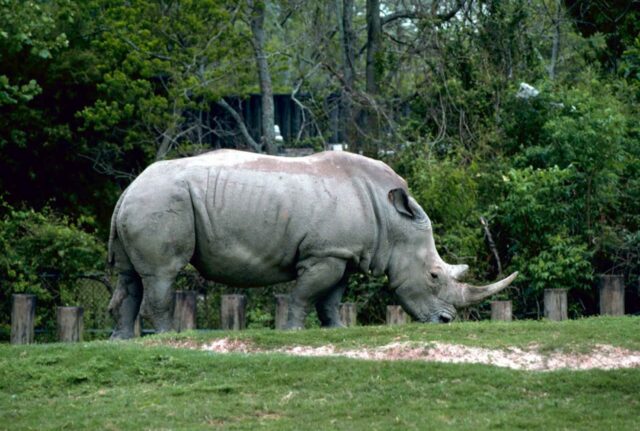
Five rhinoceros species survive today: white, black, greater one-horned, Javan and Sumatran rhinos. They differ greatly in habitat, feeding behavior, sociality and conservation status. The white rhino shown here is primarily a grazer with a broad square lip and can be more social than some other species.
Black rhinos are browsers with a more prehensile upper lip. Greater one-horned rhinos use grasslands, riverine habitats and wetlands and are capable swimmers. Javan and Sumatran rhinos live in forested Asian habitats and are exceptionally rare.
These differences shape symbolism. Grazing emphasizes steady grounded intake; browsing emphasizes selectivity; wallowing emphasizes maintenance and cooling; solitary movement emphasizes independence; temporary groups at resources show that even animals with solitary tendencies can tolerate social proximity when conditions support it.
The practical spiritual lesson of the Rhinoceros
The Rhinoceros asks whether your power is well informed.
- Let presence and consistency do work before resorting to force.
- Use more than one information channel when visibility is poor.
- Do not let others reduce your entire value to one visible trait.
- Recognize vulnerability even inside a strong identity.
- Build enough flexibility that stability does not become immobility.
The deepest Rhino symbolism is not aggression. It is weight: the ability to be difficult to displace, to alter an environment through presence and to defend a boundary. The wisdom lies in deciding where that weight should be placed before momentum makes the decision harder to reverse.
For the wider context, continue with Mammal Symbolism. The strongest interpretation keeps the living animal visible: biology supplies the pattern, documented history supplies cultural context and the spiritual layer remains clearly identified as interpretation.
References
Web References
- https://wildlife.cornell.edu/our-work/rhinos
- https://www.savetherhino.org/rhino-info/rhino-species/
- https://animaldiversity.org/accounts/Rhinocerotidae/
Image Reference
https://commons.wikimedia.org/wiki/File:White_rhinoceros_or_square_lipped_rhinoceros_animal_ceratotherium_simum.jpg