Click and download your
FREE Guided Meditation MP3!
Attract and Manifest
Love, Power, and Abundance
through Templum Dianae Guided Meditation!
Tarot cards meanings can feel like a secret language at first—beautiful, symbolic, and a little intimidating. If you’ve ever stared at a card and thought “Okay… but what does this actually mean for me?” you’re in the right place.
Welcome. This guide is built to make tarot clear, grounded, and practical—so you can move beyond random keywords and start reading with confidence, even if you’re starting out.
In this article you’ll discover:
Now keep reading—because once the structure clicks, tarot stops being confusing and starts becoming useful.
(Even If You’re Just Starting)
When you’re new to tarot, reading the cards can feel confusing — and reading for yourself can be even harder. You’re trying to remember dozens of tarot cards meanings, you notice symbols you don’t fully understand yet, and your mind keeps asking: “Am I interpreting this… or just guessing what I want to hear?” That’s normal. Tarot is a language, and at the beginning it can feel like learning to read all over again.
Here are three simple steps to start reading tarot in a way that feels easy and consistent:
And to read the cards even better, it helps to understand where tarot comes from — keep going, because the story of tarot is right below.
if you want know more about tarot card reading follow this guide about how to read tarot cards
Tarot is a centuries-long journey of mystery, change, and insight—especially when you feel stuck in repeating patterns, whether in relationships or money. At first, tarot can look like a code, but it can act like a lighthouse: helping you see your situation with more clarity.
Historically, tarot began in 15th-century Europe as playing cards (“triumph cards”), a pastime for the aristocracy. Only in the 18th century did thinkers and occultists start reading an esoteric meaning into the images. Antoine Court de Gébelin popularized the idea that tarot carried ancient, hidden wisdom, and over time new decks with stronger symbolism appeared (influencing modern tarot culture). In the 19th century, occult interest expanded, and in the 1960s–70s tarot was rediscovered as a tool for self-exploration. Today, many use it as a mirror for emotions, choices, and personal growth—guided by meaning, but led by intuition.
Today you can find countless oracle decks on the market—angels, animals, affirmations, moon cards, and more. But most modern “divination” decks still borrow their structure, symbolism, or reading style from traditional tarot, which has deep roots in Italian tarot history.
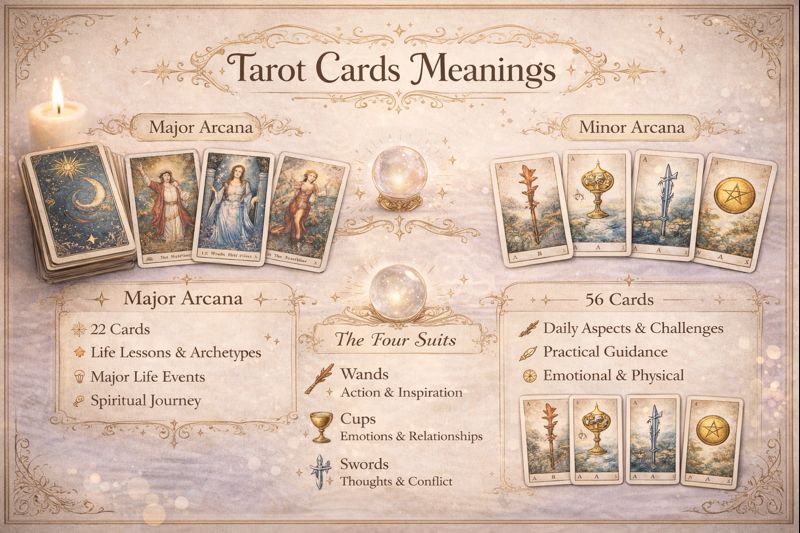
A classic tarot deck has 78 cards, divided into two main groups:
Major Arcana (also called the Trumps):
These are 22 cards that represent big life themes—turning points, lessons, inner transformation, and the kind of events that reshape your path.
Minor Arcana:
These are 56 cards focused on everyday reality: choices, relationships, work, challenges, emotions, and practical steps. The Minor Arcana is divided into four suits, each with its own “world” of meaning:
Once you understand this structure, tarot stops feeling like 78 random images—and starts feeling like one coherent system.
The Major Arcana are the 22 “Trumps” of tarot: powerful archetypes that describe life initiations, turning points, and inner transformation. In many Western esoteric traditions, these 22 cards are linked to Kabbalah through the Tree of Life: each card is mapped to one of the 22 Hebrew letters and the 22 paths that connect the sephirot. Read this way, the Major Arcana becomes more than symbolism—it becomes a spiritual map, showing how consciousness evolves through challenge, choice, and awakening.
follow this page to know more about Templum Dianae major arcana card meanings
beginnings, spontaneity, leap of faith — A fresh start calls you forward: trust the step you can’t fully see yet.
manifestation, skill, intention — You have the tools; focus your will and make the idea real.
intuition, mystery, inner knowing — The answer isn’t louder outside; it’s quieter inside.
abundance, creativity, nurture — What you nourish grows—love, beauty, comfort, and life.
structure, authority, boundaries — Stability comes from rules, plans, and firm limits.
tradition, guidance, learning — A trusted path or mentor helps you build on what’s proven.
choice, union, values — Love is a decision: choose what aligns with your truth.
drive, control, victory — Commit fully, take the reins, and move with purpose.
courage, patience, self-mastery — Real power is calm: you tame fear without force.
solitude, reflection, wisdom — Step back to see clearly; insight needs silence.
cycles, change, fate — The wheel turns—adapt, because life is shifting.
truth, balance, consequences — Clear choices bring clear outcomes; integrity matters.
surrender, pause, new perspective — Stop pushing and see the problem from another angle.
endings, release, rebirth — Something must close so something stronger can begin.
harmony, healing, integration — Balance the extremes and restore inner order.
attachment, temptation, illusion — Notice what owns you, then reclaim your freedom.
shock, rupture, revelation — What collapses was unstable; truth breaks through.
hope, renewal, healing — After the storm, you remember your direction and your light.
fear, subconscious, intuition — Walk through uncertainty and face what hides beneath.
joy, vitality, success — Clarity returns; confidence and warmth rise again.
awakening, calling, rebirth — Answer the inner call and rise into a new chapter.
completion, mastery, wholeness — A cycle closes; integrate the lesson and level up.
The Minor Arcana are the “daily-life” engine of tarot. While the Major Arcana speaks about big initiations and turning points, the Minor Arcana shows how life moves in practice: emotions, conversations, choices, work, conflicts, and small steps that silently shape your destiny.
They are traditionally linked to the four cardinal elements, each one expressing a different field of experience: Wands = Fire (drive, passion, action), Cups = Water (feelings, intuition, relationships), Swords = Air (mind, truth, conflict, decisions), and Pentacles = Earth (body, money, stability, results). This elemental map helps you read faster: before you even know the exact card, you already know the “world” it belongs to.
The Minor Arcana is also divided into numbers and figures. The numbered cards (Ace to Ten) describe a progression: an energy is born, develops, reaches tension, and eventually completes a cycle. The Ace is the pure origin of the suit—the raw seed of Fire, Water, Air, or Earth before it takes a specific shape. Then come the Court Cards (Page, Knight, Queen, King), which represent roles, personalities, and ways of expressing that element in real life.
follow this page to know more about Templum Dianae minor arcana card meanings
Fire energy: passion, desire, creativity, courage, and the push to act. Wands show momentum—what you want, what fuels you, and where you’re ready to take risks to grow.
explore meaning of tarot wands cards
Ace of Wands | 2 of Wands | 3 of Wands | 4 of Wands | 5 of Wands | 6 of Wands | 7 of Wands | 8 of Wands | 9 of Wands | 10 of Wands
Page of Wands | Knight of Wands | Queen of Wands | King of Wands
Water energy: emotions, love, intimacy, intuition, and healing. Cups reveal what you feel beneath the surface—your needs, attachments, and the emotional truth of a situation.
explore meaning of tarot cups cards
Ace of Cups | 2 of Cups | 3 of Cups | 4 of Cups | 5 of Cups | 6 of Cups | 7 of Cups | 8 of Cups | 9 of Cups | 10 of Cups
Page of Cups | Knight of Cups | Queen of Cups | King of Cups
Air energy: thoughts, communication, truth, conflict, and decisions. Swords cut through illusion—showing clarity, tension, boundaries, and the mental patterns shaping your choices.
explore meaning of tarot swords cards
Ace of Swords | 2 of Swords | 3 of Swords | 4 of Swords | 5 of Swords | 6 of Swords | 7 of Swords | 8 of Swords | 9 of Swords | 10 of Swords
Page of Swords | Knight of Swords | Queen of Swords | King of Swords
Earth energy: money, work, health, home, and long-term stability. Pentacles deal with the real world—results, resources, discipline, and what you’re building step by step.
explore meaning of tarot pentacles cards
Ace of Pentacles | 2 of Pentacles | 3 of Pentacles | 4 of Pentacles | 5 of Pentacles | 6 of Pentacles | 7 of Pentacles | 8 of Pentacles | 9 of Pentacles | 10 of Pentacles
Page of Pentacles | Knight of Pentacles | Queen of Pentacles | King of Pentacles
Ace (1) — Origin, seed, pure potential. The raw energy of the suit before it takes a specific form.
Two (2) — Choice, tension, balance. A split path, a decision, or the need to hold two forces at once.
Three (3) — Growth, expansion, collaboration. The energy starts moving outward and becoming real.
Four (4) — Stability, structure, consolidation. Building a base, creating safety, defining limits.
Five (5) — Conflict, disruption, challenge. Pressure tests the system; friction reveals what’s weak.
Six (6) — Adjustment, harmony, progress. Recovery after tension, a step toward balance or success.
Seven (7) — Strategy, tests, inner work. Doubt, evaluation, or the need for smarter effort.
Eight (8) — Movement, mastery, momentum. Things accelerate; repetition turns into skill and results.
Nine (9) — Intensity, near-completion, refinement. The last stretch: power builds, but so does pressure.
Ten (10) — Completion, outcome, overflow. The cycle reaches its peak—closure, harvest, or excess that demands change.
Court Cards Meaning
Now that you know the meanings of the cards, the next step is learning how to combine them in an order. In tarot, these structured layouts are called spreads. A spread is basically a map: each position gives the card a role, so the meaning becomes clearer and more specific.
Spreads can be simple or complex. A simple spread might use one card for guidance, or three cards for past–present–next step. Complex spreads can use many cards to explore deeper layers—like motivations, hidden influences, obstacles, timing, and possible outcomes.
This is where tarot stops being “a list of keywords” and starts becoming a structured conversation. The same card can shift its message depending on its position in the spread and the cards around it. The spread creates a reading with depth: not just what the card means, but what it means here, for this question, in this exact moment.
ow you know the foundations: how to read tarot, how the deck is structured, what the Major and Minor Arcana mean, and how spreads turn meanings into real readings. From here, the fastest way to deepen your skill is simple: study with solid tarot books and keep practicing.
Books give you what short articles and random keyword lists can’t: a complete system, consistent interpretations, and a reference you can return to whenever a reading gets confusing. If you want reliable material, the Templum Dianae tarot books—such as The Tarot Reading Bible—are designed to work both as a practical reference guide and as a deeper path of study.
You can discover more about Tarot Reading Bible there
Beyond the basic meanings, they also explore the esoteric layers many readers crave: Kabbalah correspondences, links with Akashic Records, and other advanced keys that connect tarot to a bigger spiritual framework—without losing the practical, real-life usefulness of the cards.
Templum Dianae Media, Tarot Reading Bible: A Complete Guide to the Art of Divination. (via Google Books).
Medium, “Beyond the Veil of Chance: Why Tarot is the Map of Our Unconscious“. (Accessed March 2026).
The British Museum, “History of Playing Cards and Tarot“. Collection Database.
Yale University Library, “The Cary-Yale Visconti-Sforza Tarot Deck“. Beinecke Rare Book & Manuscript Library.
Encyclopedia Britannica, “Tarot: Playing Cards and Divination“.
Wikipedia, “Tarot: Origins, Esotericism, and Cultural Impact“.