
What is meditation—really? Not the Instagram version, not the “just breathe and think positive” cliché, but the kind of practice that actually changes how you feel, decide, and move through life.
Welcome, wayfarer. In this guide you’ll see meditation as a living tool for feminine spirituality: a way to return to the body, sharpen intuition, and reconnect with that inner current of divine feminine energy—quiet, receptive, and fiercely wise. When you meditate with intention, you don’t escape reality. You learn to direct your mind and listen to what your soul has been trying to say under all the noise.
In this article you’ll discover:
- What meditation is (and what it’s not), so you stop guessing and start practicing with clarity
- How to meditate step by step, even if your mind never shuts up
- How meditation for feminine energy supports self-discovery, inner calm, and spiritual depth
- …and much, much more!
Keep reading and you’ll get a simple, practical meditation protocol—so you can feel more grounded, more focused, and more connected to your own feminine power.
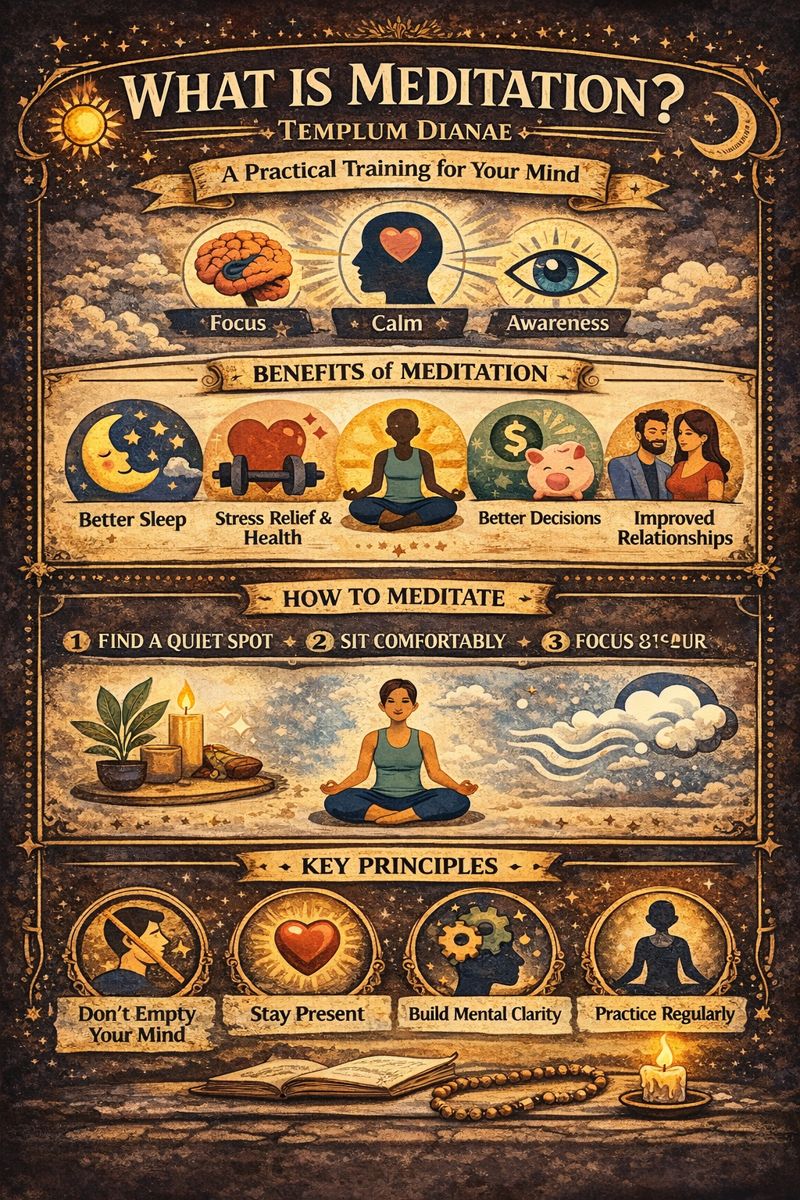
What Is Really Meditation
In the Templum Dianae vision, meditation is not “closing your eyes and trying to stop thinking.” That’s the watered-down version that makes people feel guilty the moment their mind does what minds do: produce thoughts. Real meditation is directive. It is mental training with a clear aim, where you learn to guide attention, regulate your inner state, and build the kind of mind that produces measurable outcomes in daily life.
So what is meditation, really? It’s a protocol that teaches you to empty the noise—the scattered, compulsive thinking, the emotional reactivity, the constant internal commentary—and then fill the mind on purpose with what you choose: a focus point, a goal, a vision, a new internal script, a state of calm authority. You’re not becoming passive. You’re becoming precise. You’re not trying to “transcend” your humanity. You’re training it.
And here’s the part most people get wrong: meditation is not meant to erase your personality or turn you into a bland, detached version of yourself. Templum Dianae does not use meditation to flatten desire, ambition, sensuality, or identity. We use it to remove distortion—fear-driven habits, toxic conditioning, self-sabotage, and mental chaos—so your real nature can operate cleanly. Your personality is not the enemy. The noise is.
Directive meditation is for people who want a mind that serves them: clearer decisions, stronger boundaries, more consistent action, and deeper self-trust. It’s inner power with direction—because peace without direction is just sleep, and spirituality without results is just performance.
What Is Meditation Good For?
Meditation isn’t just a wellness habit to “feel better for a moment.” In the Templum Dianae approach, meditation must create real, measurable change—otherwise it’s just another soothing ritual you do while your life stays the same. A proper practice trains attention, emotional regulation, and decision-making, and those skills inevitably show up in your results.
In relationships, meditation helps you see patterns instead of repeating them. You react less, communicate with more clarity, and set boundaries without guilt—because you’re no longer negotiating with anxiety or craving. In money management, a calmer, more directed mind reduces impulsive decisions, emotional spending, and self-sabotage. You become more consistent: planning, saving, investing, and acting with intention rather than mood.
Meditation can also support weight management, not through “magic,” but by improving self-control, stress regulation, and body awareness—so hunger and cravings stop running the show. And because the nervous system influences the entire body, a solid meditation practice often improves multiple aspects of health: sleep quality, recovery, inflammation-related stress, energy levels, and overall resilience. The point is simple: meditation should upgrade your inner operating system—and your outer life should prove it.
What Is Meditation Yoga?
Meditation yoga refers to the inner technologies of yoga: practices designed to steady attention, refine awareness, and train the mind to become calm, clear, and highly focused. In traditional yoga, meditation is not a random “relaxation moment.” It’s part of a structured path where breath, concentration, and inner observation work together to transform how you perceive yourself and reality.
The directive meditation approach of Templum Dianae was born from studying and applying these yogic methods—then translating them into a practical protocol for modern life. We keep the functional core: breath regulation, one-point focus, and the ability to witness thoughts without being dragged by them. But we also recognize a problem: many Western re-packagings of yoga added cultural filters that were never neutral. Moralistic pressure, guilt-based purity, and “be nice, be quiet, be empty” spirituality have often been used—subtly or openly—to confuse human beings, especially women, and make them more compliant.
Templum Dianae removes those distortions. We purify the limbs of yoga from biased, controlling narratives and return them to what they are meant to be: tools for inner mastery, not tools for social submission. Meditation should not erase your personality, your desire, or your ambition. It should remove mental noise, emotional reactivity, and self-sabotage so your real identity becomes stronger, not smaller.
Finally, we enhance the ancient framework with modern mindset research—attention training, habit loops, emotional regulation, and performance psychology—so the practice is not only spiritual, but also measurable in daily results.
if you want to explore more check this page : What Is Meditation in Yoga
What Is Meditation in Hinduism?
In Hinduism, meditation is a disciplined inner practice aimed at mastering the mind and recognizing a deeper level of reality beyond constant thoughts and emotions. Rather than being a single technique, it’s a spectrum of methods—often linked to yoga traditions—used to cultivate concentration, self-knowledge, and spiritual clarity. You’ll commonly see terms like dhyāna (meditative absorption) and samādhi (a more profound state of unified awareness) within classical yoga philosophy, where meditation is part of a structured path of inner training.
Many Hindu approaches use a chosen focus to stabilize attention: the breath, a sacred sound (mantra), a divine form (devotional visualization), or a philosophical inquiry into the nature of the self (ātman). The goal isn’t to “be blank,” but to reduce mental turbulence so awareness becomes steady and refined. Over time, meditation supports liberation from compulsive patterns—fear, attachment, and confusion—so a person can live with more inner freedom, clarity, and alignment with dharma (right living).
if you want to explore hindu meditation explore this page