
What is meditation in Hinduism—and how is it different from the modern “just relax” version people sell online? In the Hindu yogic view, meditation isn’t a trend. It’s a disciplined inner path meant to train attention, refine awareness, and bring you back to the deepest core of who you are.
Welcome, wayfarer. In this guide, we’ll explore Hindu meditation through the lens of feminine spirituality. At Templum Dianae, meditation is not about self-erasure—it’s about inner mastery. Used properly, it becomes a powerful tool to reconnect with the body, awaken intuition, and explore divine feminine energy with clarity, boundaries, and calm authority.
In this article you’ll discover:
- What meditation in Hinduism really means, and the key ideas behind it
- What meditation is in practical terms, so you can apply it without confusion
- How to meditate using simple principles inspired by Hindu yogic tradition
Keep reading and you’ll get a clear, grounded framework—so meditation stops being vague and starts becoming a real protocol for feminine self-discovery and inner power.
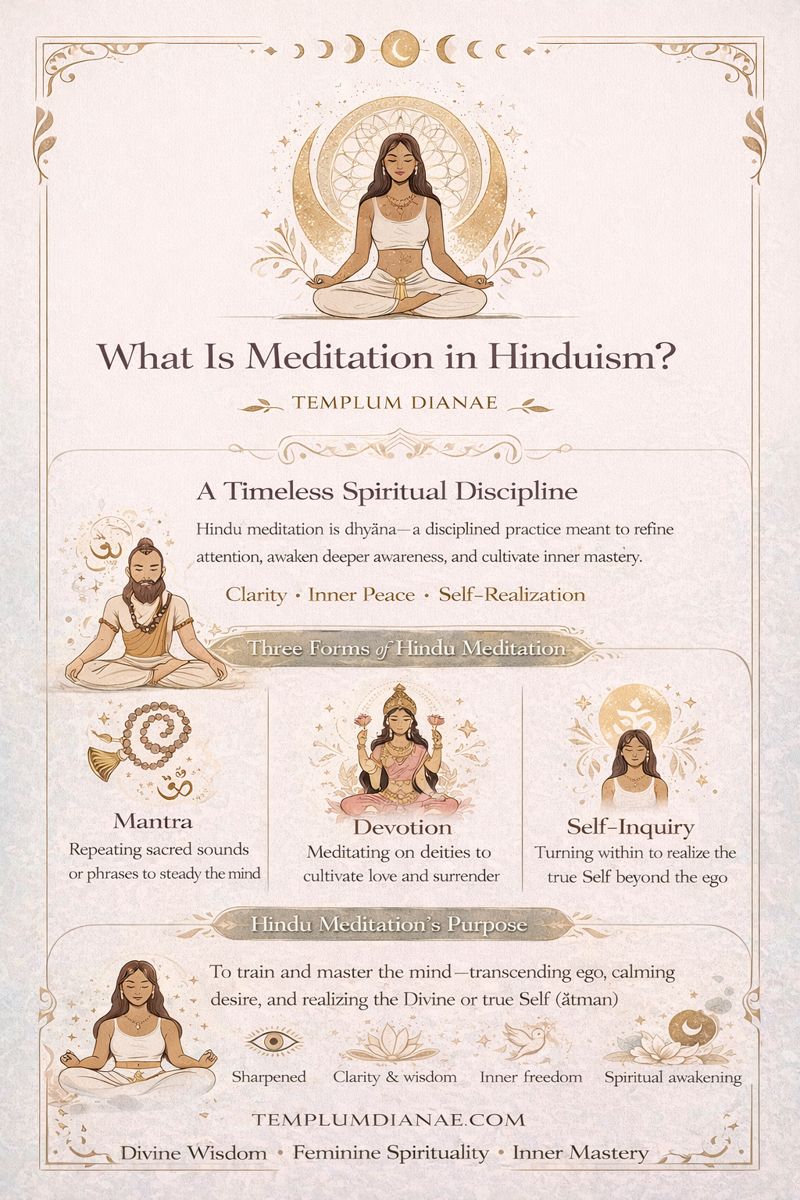
What Is Meditation in Hinduism?
Meditation in Hinduism is not a modern self-care trend and it is not a vague attempt to “think about nothing.” In many Hindu traditions, meditation is a disciplined inner practice designed to refine awareness, stabilize attention, and reveal a deeper layer of reality beneath mental noise. The word most commonly associated with meditation is dhyāna—a sustained, continuous flow of attention toward a chosen focus. It’s the moment when concentration stops being a struggle and becomes a steady stream.
Hindu meditation exists inside a larger spiritual aim. Depending on the school, that aim may be liberation from suffering, clarity about the Self, union with the Divine, or freedom from compulsive attachment. What stays consistent is the direction: the mind is trained so you are no longer owned by your thoughts, moods, cravings, or fears. Meditation is the craft of turning awareness from scattered to coherent, from reactive to sovereign.
At Templum Dianae, we respect this depth, but we also translate it into something you can actually use in daily life. Our philosophy is directive meditation: you don’t meditate to become empty or passive—you meditate to gain inner command. You learn to quiet the noise and then fill the mind with intention, so the practice produces real changes in boundaries, decisions, self-trust, and feminine energy.
Dhyāna and the Yogic Path: From Focus to Inner Absorption
In classical yoga philosophy, dhyāna is not the first step. It is preceded by dharana, the training of concentration, and it can mature into samādhi, the state of deep absorption. This sequence matters because it shows what Hindu meditation is really doing. It is not “relaxation.” It is the training of attention until awareness becomes stable enough to perceive clearly.
In this view, the mind is like a lens. When it is shaking, you see a distorted world. When it becomes steady, reality sharpens. Dhyāna is that steadiness—an unbroken current of attention. Some traditions describe this as absorption in a chosen object, mantra, deity, or inner principle. Others describe it as absorption in the nature of awareness itself.
Templum Dianae keeps the structure but changes the emphasis for modern women. We don’t teach meditation as self-erasure or personality destruction. We teach it as precision. The point is not to disappear. The point is to stop leaking energy into compulsive thinking and emotional spirals, so your real identity becomes stronger, not smaller. Feminine spirituality requires this because a woman’s inner world is often rich, intuitive, and sensitive—yet modern life pushes constant output and constant performance. Directive meditation gives you a stable inner axis: calm receptivity with sharp discernment.
Origins and Meaning: What Hindu Meditation Is Pointing Toward
Hindu meditation appears across many texts and lineages, from early contemplative reflections to systematic yogic teachings. Because Hinduism is not a single centralized religion, there isn’t one uniform method called “Hindu meditation.” There is a family of approaches built around the same core insight: the mind can be trained, and that training can transform your experience of self and world.
In some streams, meditation is tied to the relationship between ātman (the inner Self) and brahman (ultimate reality). In devotional paths, meditation is remembrance of the Divine through love, repetition, and inner intimacy. In discipline-based paths, meditation is mastery of attention and desire. The surface language differs, but the underlying mechanism is consistent: meditation interrupts automatic patterns and establishes a deeper center.
In Templum Dianae terms, this is the bridge between ancient spirituality and modern mindset. The ancients understood that repetition shapes consciousness. Modern psychology understands the same thing: what you repeatedly focus on becomes your mental default. That’s why we call it directive. You don’t sit there hoping the mind magically becomes pure. You train it. And as you train it, you begin to notice the hidden programs—your paradigms—rules you live by without realizing. Meditation exposes those paradigms so you can rewrite them.
Main Forms of Meditation in Hinduism
Mantra and Japa
Mantra meditation is one of the most widespread Hindu practices. A mantra can be a sacred sound, a divine name, or a phrase with spiritual meaning. Practiced as japa, the repetition creates a stable channel for attention. The mind naturally clings to repetition; mantra redirects that tendency into a purposeful inner rhythm. Over time, the repetition can calm agitation and cultivate a focused, devotional, or elevated state.
In directive meditation, mantra is not superstition. It is mental engineering. You are using repetition to concentrate attention, regulate emotion, and install a chosen internal state. This is especially effective for feminine spirituality because it grounds you in the body and the voice of intuition. When the mind is noisy, mantra gives it a single rope to hold.
Devotional Meditation
In bhakti traditions, meditation may focus on the presence, qualities, or form of a deity. This is not merely symbolic for many practitioners; it is relational. Devotional meditation reshapes the heart, turning fear and longing into a directed bond with the sacred. It often includes prayer, visualization, chanting, and inward surrender.
Templum Dianae makes one critical clarification: surrender should never mean submission to human manipulation. Healthy devotion strengthens inner integrity. It should make you more discerning, more grounded, and more capable of love with boundaries. If devotion trains guilt, silence, or self-betrayal, it has been distorted by power dynamics, not elevated by spirituality.
Self-Inquiry and Knowledge-Based Meditation
In knowledge-oriented approaches, meditation becomes inquiry into the Self. The practitioner investigates identity: what is awareness, and what is merely content within awareness? This practice can expose how the mind manufactures a constant “me-story.” When done correctly, it is not intellectual debate. It is direct observation that loosens attachment to thoughts and emotional narratives.
In the Templum Dianae framework, inquiry is powerful when paired with direction. If inquiry becomes endless thinking, it turns into another loop. The method must remain embodied: you observe, you return, you recognize, you choose. That is how insight becomes transformation.
How to Practice Hindu Meditation Today
To practice Hindu meditation without confusion, you need one thing: a clear objective. “Be spiritual” is not an objective. “Empty my mind” is often a trap. Choose a purpose that matches your season: calm authority, emotional regulation, devotion, focus, self-inquiry, or intuitive clarity.
Begin with consistency. Same time, same place, short sessions you can actually maintain. Let your breath settle. Then engage the method you chose—mantra repetition, devotional focus, breath-based concentration, or inquiry. Your job is not to win a perfect silent mind. Your job is to return. Each return is the real repetition that rewires you.
This is where Hindu meditation becomes a natural ally for feminine spirituality. A woman’s life often includes cyclical changes—emotionally, hormonally, relationally. Meditation provides a stable inner center through those waves. It doesn’t deny the cycles; it teaches you to ride them without being ruled by them. With directive meditation, you learn to receive information from your inner world without being drowned by it. You become soft without becoming weak. You become intuitive without becoming chaotic.
What Hindu Meditation Is Ultimately For
In its deepest sense, meditation in Hinduism aims at freedom. Freedom from compulsive craving. Freedom from fear-driven identity. Freedom from the mind’s constant need to control. Depending on the tradition, that freedom might be described as union with the Divine, knowledge of the Self, or liberation from suffering. But the lived experience is often the same: you stop being dragged by unconscious patterns.
Templum Dianae keeps that spiritual aim, but insists on a modern proof: your outer life should reflect your inner training. Meditation should improve the way you choose, the way you relate, the way you hold boundaries, and the way you direct your energy. Not by turning you into a blank person, but by restoring your true shape—clear, grounded, and sovereign.
So, what is meditation in Hinduism? It is a disciplined inner path that trains attention until awareness becomes steady enough to reveal what is real. And through the Templum Dianae lens, it becomes a feminine protocol: quiet the noise, fill the mind with intention, and let your life demonstrate the change.