
What Is Meditation in Yoga is not a trendy “relaxation hack.” It’s a disciplined inner technology—built to train attention, regulate the nervous system, and sharpen awareness until your mind becomes steady, clear, and useful.
Welcome, wayfarer. In this guide, you’ll see yogic meditation through the lens of feminine spirituality: not as self-erasure, but as embodied power. When practiced with intention, meditation becomes a doorway to your divine feminine—helping you listen to the body, reclaim intuition, and cultivate calm authority without losing your personality, your desire, or your ambition.
In this article you’ll discover:
- What meditation in yoga really is (and how it differs from the “empty your mind” myth)
- What meditation is in practical terms, so you can apply it as a repeatable protocol
- How to meditate step by step using yogic principles—without confusion or fluff
Keep reading and you’ll learn how to use yogic meditation as a focused inner practice—so you can feel more grounded, more clear, and more in command of your feminine energy.
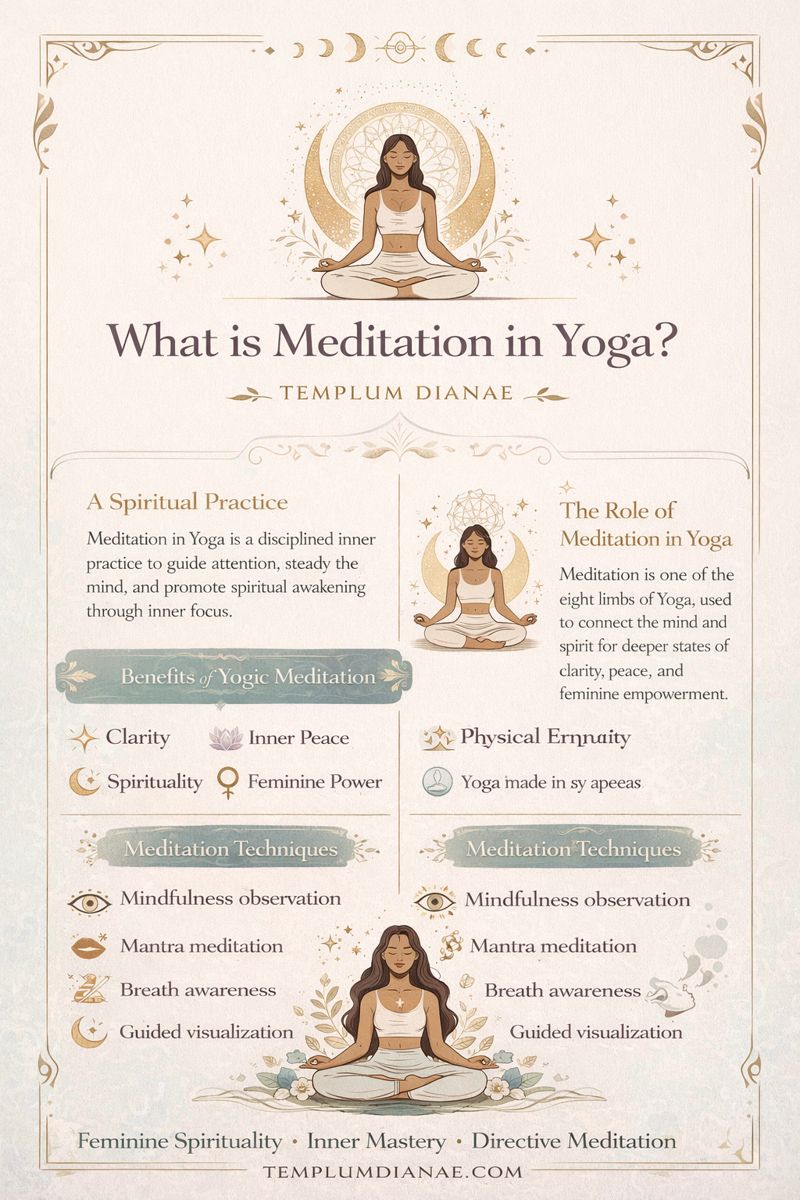
What Is Meditation in Yoga?
Meditation in Yoga is often introduced as “stilling the mind,” but that phrase can mislead you if you take it literally. In real yogic tradition, meditation is a trainable skill—a way to guide attention, refine awareness, and shape your inner state so your life stops being driven by noise.
Welcome, wayfarer. At Templum Dianae, we treat yogic meditation as a living tool for feminine spirituality: not a performance of purity, not self-erasure, and not a passive “empty your mind” ritual. Our approach is directive meditation—you learn to quiet the chaos and then fill the mind with intention, so the practice supports real outcomes: clarity, boundaries, focus, self-trust, and grounded feminine power.
Meditation as an integral part of Yoga practice
Yoga was never meant to be only physical postures. Asana builds strength, mobility, and stability, but meditation is what trains the inner axis—the mind that decides, the nervous system that reacts, the emotional body that holds memory. In classical yoga, meditation is the bridge between the external practice and the internal transformation: you move the body to prepare it, you regulate the breath to steady the system, and you meditate to direct consciousness.
In the Templum Dianae lens, this is where yoga becomes especially potent for women. Your practice stops being “one more thing to do” and becomes a space to return to yourself—to listen beneath the surface, to reclaim intuition, and to rebuild your inner authority without losing your personality, ambition, or desire.
The Role of Meditation in Yoga
In Patanjali’s Yoga Sutras, meditation (often described as Dhyana) is presented as a later limb of the yogic path, closely connected to deep absorption (Samadhi). In plain language: meditation is not the warm-up; it’s the doorway to the most refined states of yogic practice—where attention becomes steady enough to reveal what’s real beneath mental turbulence.
Templum Dianae keeps this spine intact, but modernizes the application: your meditation does not have to be abstract. You can practice in a way that still honors yogic depth while remaining goal-oriented—training attention, emotional regulation, and mindset so your daily life changes.
Understanding the relationship between meditation and the other limbs of Yoga
Meditation doesn’t sit “apart” from yoga—it weaves through it. Breathwork (pranayama) steadies the system. Asana makes the body stable enough to sit and focus. Ethical principles (often discussed as yamas and niyamas) become easier when you can actually observe impulses and choose a response rather than obeying reactivity
From a directive perspective, this matters because the mind learns by repetition. Every time you practice returning your attention, you’re training the same mechanism you need to make better decisions, hold boundaries, and stop leaking energy into people and situations that drain you.
How meditation complements and enhances the physical and philosophical aspects of Yoga
Here’s the hidden upgrade: meditation turns yoga from “exercise with spirituality vibes” into a full internal discipline. You don’t only stretch the body—you stretch your capacity to stay present. You don’t only learn philosophy—you build the inner silence needed to recognize when you’re lying to yourself.
For feminine spirituality, this is crucial. Many women are conditioned to override their own signals to stay “good,” “pleasant,” or “strong.” Meditation helps you detect the moment you abandon yourself—and choose differently.
The Benefits of Meditation in Yoga
Yogic meditation can support self-awareness, stress resilience, concentration, and emotional steadiness.
But in the Templum Dianae philosophy, the real benefit is simpler and sharper: meditation trains inner command.
You notice your patterns faster. You recover from triggers sooner. You stop negotiating with mental chaos. Over time, this changes what you tolerate, what you chase, how you speak, and how you choose. For women exploring divine feminine energy, meditation becomes a way to shift from performing femininity to embodying it—grounded, receptive, intuitive, and decisive.
And yes, there can be “wellness” effects too—better sleep, calmer nerves, more stable energy—but those are side effects of a system that is finally regulated. The main benefit is that the mind stops being a wild animal and becomes an ally.
Meditation Techniques in Yoga
Yoga includes many meditation approaches, and you’ll often see a few recurring categories
At Templum Dianae, we use them like instruments—chosen based on your objective.
Mindfulness-style observation
This is the practice of noticing thoughts, sensations, and emotions without instantly reacting. It builds the “witness” muscle. Done well, it doesn’t make you passive—it makes you precise.
Mantra meditation
Mantra uses sound or a phrase as a focal point. It’s powerful because repetition stabilizes attention and can reshape inner state. In directive meditation, mantra is not superstition—it’s a mental lever.
Visualization
Visualization trains the mind through image: light, symbols, inner scenes, archetypes. This is especially resonant for feminine spirituality, where symbolism often speaks faster than logic. Use it to install calm, courage, boundaries, or a chosen identity state.
Breath awareness
Breath is the simplest anchor. You’re not trying to control it at first; you’re learning to return to it. This is how you begin to interrupt spirals.
Loving-kindness and heart-based practices
Practices oriented toward compassion can soften inner cruelty and shame. But Templum Dianae adds one rule: compassion must include boundaries, or it becomes self-betrayal.
Transcendental-style mantra systems
Some lineages use personalized mantras and structured instruction. If you explore these, choose guidance carefully and keep your goal clear: you are training your mind, not outsourcing it.
Integrating Meditation into Your Yoga Practice
Start your session with stillness—two minutes is enough. Feel your feet, feel your breath, and set an intention. Then practice asana like a moving meditation: stay with breath and sensation, return when you drift, and treat each pose as attention training.
At the end, sit. Even five minutes. The body is open, the nervous system is primed, and the mind is more willing to focus.
Cultivating a Meditative Mindset in Daily Life
Meditation isn’t only what happens on the cushion. It’s what happens when you’re triggered and you pause instead of exploding. It’s what happens when you feel the pull to people-please and you choose a boundary instead.
Presence isn’t “being nice.” Presence is power. When you’re present, you see what’s actually happening. And when you see what’s happening, you can choose your move.
For feminine spirituality, this is everything: presence brings you back into the body—and the body is where intuition speaks.
Yoga principles like non-harm, truthfulness, and self-discipline become practical when you can observe yourself clearly. Templum Dianae reframes this: alignment isn’t moral perfection. It’s inner integrity—your actions match your values, your boundaries match your truth, and your life stops being a performance.
Exploring Meditation Resources and Guidance
If you want to deepen yogic meditation without getting lost in contradictory advice, choose a single framework and follow it long enough to see results. The Templum Dianae path is built around directive meditation + mindset training + feminine spirituality—so you don’t just “understand meditation,” you become the kind of woman whose mind obeys her.
Use your learning like a ladder: start with “what meditation is,” then “how to meditate,” then traditions like yoga meditation, then specialized goals like sleep and emotional mastery. And when you’re ready, add supportive tools—ritual, breathwork, symbolic work—without letting them replace the core practice: attention training.