wicca meaning becomes real when you stop looking for permission and start taking responsibility for what you send into the world. Wiccan practice trains you to notice cause and consequence in a sharper way. Your words matter. Your rituals matter. Your motives matter. That changes relationships because you stop feeding chaos with unconscious reactions. You become more deliberate with desire, more careful with promises, and less willing to create bonds that drain your peace. Wicca frames freedom together with accountability, and that combination gives you more control over love, conflict, and emotional balance.
It also affects abundance. Wicca is not built on random wishing but on alignment: intention, rhythm, ethics, and repeated action. Because it is Earth-focused and tied to cycles of season and moon, it teaches you to work with timing instead of against it. In practical terms, that can steady your mindset, reduce internal contradiction, and help you build prosperity with more coherence. Britannica describes Wicca as the largest modern Pagan religion, emerging publicly in England in the 1950s, while Wikipedia describes it as a modern, syncretic, Earth-focused religion shaped by Western esotericism.
- meaning of wiccan symbols and why signs like the pentacle and Triple Moon still carry force
- understanding wiccan beliefs through the Goddess, the God, ethics, ritual, and nature
- applying Wicca to love and money through responsibility, balance, and manifestation
- … and much, much more!
Keep reading if you want a beginner guide that gives you the theology, symbols, ethics, and daily foundations without flattening Wicca into vague “witchy” aesthetics.
“…in the vision of Templum Dianae, Wicca becomes a path where you learn to govern energy with conscience, create harmony instead of drama in relationships, and build abundance through disciplined alignment with nature and will…”
Wicca keywords
Upright: alignment, reverence, responsibility, harmony, manifestation
Reversed: imbalance, escapism, projection, misuse of will, spiritual confusion
Wicca Description and symbolism
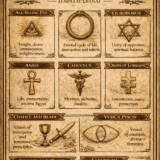
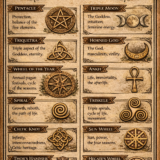
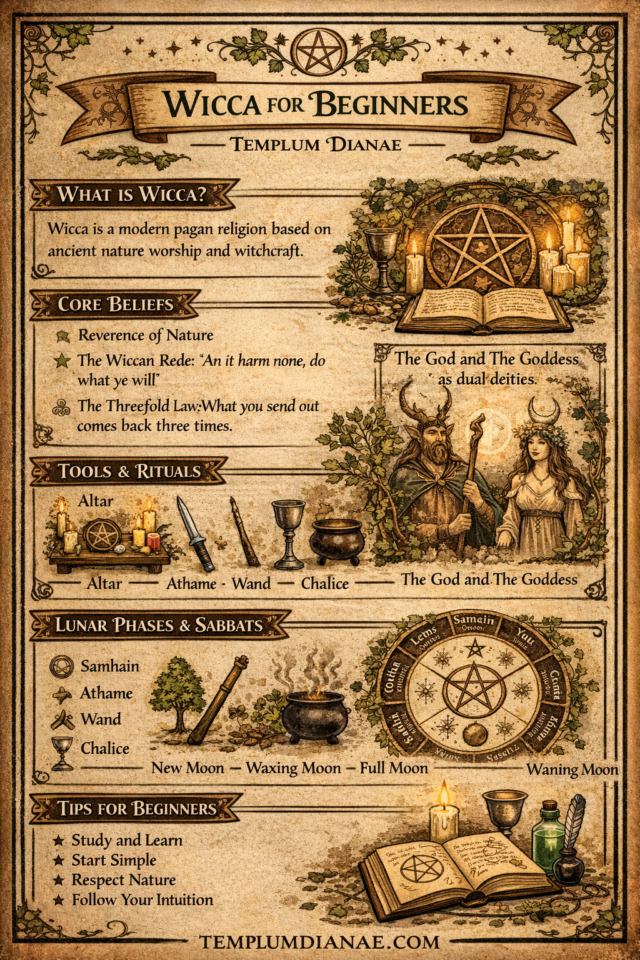
Wicca uses a compact symbolic language that becomes clearer the longer you practice it. The pentacle is one of the most recognizable signs. Britannica notes that, in Wiccan use, the five points of the pentagram often represent air, fire, water, earth, and spirit; it may also symbolize the Triple Goddess and the Horned God. When enclosed in a circle, it becomes a pentacle, a sign of order, protection, and the interrelation of forces rather than a symbol of chaos.
The Triple Moon is another central icon in modern Wiccan imagery. In Wiccan theology, the Goddess is often understood in a triple form, and Wikipedia describes the tradition as typically duotheistic, venerating the Triple Goddess and the Horned God. The waxing, full, and waning moons therefore become more than decoration; they represent phases of life, power, fertility, decline, mystery, and renewal.
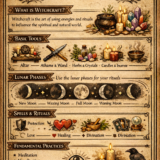
On the altar, the core tools are equally symbolic. Wikipedia’s overview of magical tools in Wicca describes the pentacle, athame, wand, and chalice as principal implements, commonly linked to earth, air or fire depending on tradition, and water. The athame directs will and defines sacred boundary. The wand projects intention. The chalice receives and contains. The altar itself becomes a map of a Wiccan cosmos in miniature: elements, deity, cycle, and deliberate action held in one place.
Wicca meaning and core beliefs
Wicca is generally understood as a modern Pagan religion rather than a survival of an untouched ancient cult. Britannica places its public emergence in England in the 1950s, and Wikipedia notes that Gerald Gardner introduced it publicly in 1954 after it had developed in the first half of the 20th century out of Western esotericism, occultism, and modern reinterpretations of pre-Christian themes. That does not make it shallow or invented in a trivial sense. It means Wicca is a modern religious synthesis with its own theology, ritual life, and devotional structure.
At the center of that theology is usually a Goddess and a God. Wikipedia describes Wicca as typically duotheistic, with the deities traditionally conceived as the Triple Goddess and the Horned God. The Goddess is often approached in cyclical forms linked to lunar phases and life stages, while the God is often understood through wildness, fertility, nature, and seasonal vitality. This is not always rigidly literal; some Wiccans treat the deities as distinct beings, others as aspects of a deeper divine reality expressed through many names and forms.
The spiritual atmosphere of Wicca is strongly nature-centered. Britannica describes it as a modern Pagan religion inspired largely by pre-Christian Europe, while Wikipedia calls it Earth-focused and notes its ritual life around solar Sabbats and lunar Esbats. That gives Wicca a theology of immanence in practice: the sacred is encountered in season, moon, element, body, land, and recurring natural pattern rather than only in a distant transcendence. For a beginner, that is the heart of Wicca. The world is not spiritually empty. It is alive, patterned, and responsive, and the practitioner is responsible for how they enter into that living web.
Wicca love and relationships meaning
commitment, balance, devotion
In relationships, Wicca emphasizes harmony through responsibility rather than control through force. That matters because the Wiccan path does not separate intention from consequence. A bond is treated as energetic as well as practical, which is why modern Pagan and Wiccan communities often use handfasting as a form of wedding or commitment rite. Historically the term is older than Wicca, but Wikipedia notes that it was adopted into modern Paganism and Wicca for wedding ceremonies from at least the late 1960s. In practice, Wiccan love work is healthiest when it builds loyalty, clarity, and reverence instead of obsession.
Wicca careers and abundance meaning
prosperity, discipline, flow
In work and material life, Wicca supports abundance through alignment rather than raw appetite. A nature-based religion trains you to respect rhythm, timing, and consequence. That can make you steadier with money, more patient with growth, and less likely to sabotage your own efforts through contradiction. Because many Wiccans treat magic as a force that works with will and natural law rather than outside it, prosperity becomes something you cultivate through focused intention, ethical conduct, and repeated action, not through fantasy alone.
Wicca and tarot and astrology
Tarot and astrology are not mandatory in Wicca, but they overlap heavily in modern practice because both systems help practitioners read pattern, timing, and symbolic meaning. Wicca grew out of a stream of Western esotericism, and Wikipedia explicitly places it within that broader esoteric current. That is one reason many Wiccans feel comfortable using divinatory or astrological tools alongside seasonal ritual and spellcraft.
For a beginner, the distinction is useful. Tarot can help identify the current pattern. Astrology can help frame timing and temperament. Wicca then provides the devotional and ritual structure through which a person responds. This makes the overlap practical rather than abstract. You observe, interpret, and then act with clearer intention inside a sacred framework that already values cycles, correspondences, and altered states of awareness.
Wicca and dreaming interpretation
Dreams matter in Wiccan practice because they sit at the threshold between symbol and encounter. Wikipedia’s discussion of Wiccan views of divinity notes that the gods can manifest in personal form through dreams, physical manifestations, or through priestesses and priests. That does not mean every dream is revelation. It does mean sleep can become a valid space for reflection, contact, or spiritual teaching within a Wiccan framework.
For beginners, dream work is most useful when approached with restraint. Record repeated symbols, emotional tone, and the timing of vivid dreams around ritual, Esbats, or difficult life transitions. Wicca is already a religion of cycle and attention, so dreaming fits naturally into practice. The goal is not to force messages from every image but to learn which patterns return with weight and which are only mental residue.
Wicca and shadow work
Wicca has a bright public image of moonlight, herbs, and beauty, but its structure also includes darkness, descent, and endings. The Wheel of the Year does not celebrate endless increase. It honors waxing and waning, fertility and harvest, death and return. That makes Wicca naturally compatible with shadow work, because the religion already treats darkness as part of sacred rhythm rather than a failure of it.
For a beginner, shadow work in a Wiccan context means noticing where fear, jealousy, spiritual vanity, or the hunger to control others enters your practice. The dark half of the year can become a mirror for the dark half of the self. Wicca does not ask you to pretend you are pure. It asks you to practice with awareness, so that will is guided by ethics and reverence rather than compulsion. That is where inner maturity begins.
Wicca and the law of attraction
Wicca and manifestation overlap, but Wicca gives manifestation a harder backbone. The popular “law of attraction” often focuses on desire alone. Wicca adds ethics, ritual, and return. Wikipedia describes the Law of Threefold Return as a common element in Wiccan morality, holding that benevolent or malevolent action returns with triple force, while the Rede frames freedom together with the duty to minimize harm.
That changes manifestation work. You do not simply ask what you want. You ask what you are strengthening in yourself by seeking it. You ask whether the method is clean. You ask whether the result can be held without violating your own principles. For beginners, this is a healthier way to think about love, money, and spiritual power. It turns attraction into aligned creation rather than desperate grasping.
Wicca and historical references
Wicca does not come from an unbroken ancient priesthood, even though it draws heavily on older pagan imagery and mythic material. Britannica states that Wicca emerged publicly in England during the 1950s, and its summary page notes that historians do not accept the idea that modern Wicca is simply the underground survival of a pre-Christian European religion. Instead, modern Wicca is usually dated to Gerald Gardner and, importantly, Doreen Valiente, who helped shape its liturgical development after the repeal of the last Witchcraft Act in England in 1951.
Wikipedia adds that Wicca developed in England in the first half of the 20th century and was introduced publicly in 1954 by Gardner. That makes Wicca modern in origin, even when ancient roots are present as inspiration, vocabulary, symbolism, and devotional atmosphere. For a beginner, that is actually clarifying. It lets you respect Wicca for what it is: a modern religion with real history, not a vague claim of timelessness.
Wicca and ethics
Wiccan ethics are often summarized through two famous ideas: the Wiccan Rede and the Threefold Law. Wikipedia describes the Rede as the key moral statement in Wicca and related witchcraft-based faiths, usually remembered in the form “An ye harm none, do what ye will.” It also notes that “rede” means advice or counsel, which is important because the saying is usually understood as guidance rather than a rigid commandment.
The Threefold Law adds a second layer of responsibility. Wikipedia explains it as the idea that whatever benevolent or malevolent actions a person performs will return with triple force, or equally across body, mind, and spirit. Not every Wiccan interprets this literally, but it has had enormous influence on how beginners understand magical responsibility. In simple terms, Wiccan ethics do not treat magic as morally neutral technique. They treat action as relational. What you do changes you as well as the world around you.
Wicca and the wheel of the year
The Wheel of the Year is the ritual calendar through which many Wiccans experience sacred time. Wikipedia explains that Wiccan celebrations encompass solar festivals known as Sabbats and lunar observances known as Esbats, and its longer overview notes that most Wiccans celebrate a cycle of eight Sabbats. These mark turning points in the agricultural and seasonal year, including solstices, equinoxes, and cross-quarter festivals.
For a beginner, the Wheel is one of the easiest ways into Wicca because it trains the body and mind to live ritually through season rather than abstraction. You stop treating the year as flat time. You begin noticing emergence, fullness, harvest, decline, stillness, and return. The result is not just better ritual timing. It is a different relationship with time itself, one that makes the religion feel lived rather than merely believed.
Wicca and moon phases for beginners
Moon work is central enough in Wicca that Wikipedia distinguishes the lunar observances, Esbats, from the solar Sabbats of the Wheel of the Year. The Moon is commonly linked with the Goddess, and the Triple Moon symbol expresses waxing, fullness, and waning as spiritually meaningful phases rather than mere astronomical facts.
For beginners, this makes lunar practice a simple starting structure. Waxing can support growth, courage, and attraction. The full moon often becomes a time for blessing, charging, or heightened awareness. Waning supports release, cleansing, and letting go. The point is not superstition about every phase. The point is rhythm. Wicca teaches you to act with cycles instead of demanding the same energetic work from every moment.
Wicca and elemental magic basics
Elemental symbolism is basic to much of Wiccan ritual. Wikipedia notes that many traditions hold to five classical elements: air, fire, water, earth, and aether or spirit. It also explains that, in traditional Gardnerian correspondences, the elements are associated with directions and are invoked in ritual work, especially in the consecration of the magic circle.
This matters for beginners because the elements are not just decorations on an altar. They give you a language for experience. Earth stabilizes. Air clarifies. Fire energizes. Water softens and connects. Spirit unifies. When you learn basic Wiccan ritual, you are really learning how to enter a balanced field where these forces are recognized, invited, and held in right relation. That is one reason the pentacle and the altar tools remain so central: they make elemental theology visible.
Wicca and herbalism foundations
Herbalism is not the whole of Wicca, but it sits naturally inside it because Wicca belongs to a wider field of neopagan witchcraft that often includes nature worship, divination, magic, and herbalism. Wikipedia’s overview of neopagan witchcraft explicitly notes that such traditions may incorporate herbalism, and that Wicca is the largest and most influential of these movements.
For beginners, the clean lesson is respect. Plants can be symbolic, culinary, medicinal, or ritual, and those uses are not identical. Wiccan practice often approaches herbs through blessing, correspondence, and seasonal relationship, but that should not erase real-world safety. A mature beginner starts with knowledge before romanticism. Learn the plant, its history, its risks, and its place in ritual. Wicca is strongest when reverence for nature includes practical intelligence.
Wicca challenges and misconceptions
One of the oldest misconceptions about Wicca is that it is simply “black magic” with a new name. That is historically inaccurate. Britannica and Wikipedia both describe Wicca as a modern Pagan religion, and Wikipedia’s discussion of its public reception notes that some Christians and sections of the media have inaccurately portrayed it as a form of Satanism, a characterization Wiccans reject. That confusion persists because the religion uses the vocabulary of witchcraft, ritual, and magic, which outsiders often read through older fears rather than through Wicca’s actual theology and ethics.
A second challenge is internal rather than external. Beginners often hear the Rede and the Threefold Law as slogans without understanding their weight. Wiccan ethics do not make practice “safe” in a childish sense. They make it responsible. If you try to use ritual for coercion, revenge, manipulation, or obsessive attachment, you are already stepping outside the balance the path is trying to cultivate. The problem is not that lightning will strike you. The problem is that your own character and spiritual field are being shaped by what you repeat.
The most common beginner mistakes are simpler than people expect. They confuse collecting tools with building practice. They imitate aesthetics without understanding theology. They treat every coincidence as a sign. They borrow from traditions without context. They chase intense experiences instead of learning rhythm, recordkeeping, and ethical clarity. Wicca becomes much more solid when approached as a religion and discipline, not as a mood.
Wicca FAQ
Wicca what is the true wicca meaning for beginners?
For beginners, Wicca means a modern Pagan religion centered on sacred relationship with nature, ritual practice, ethical responsibility, and devotion to the Goddess and the God. It is not just a style of magic; it is a religious path with theology, rites, and a ritual calendar.
Wicca is Wicca a real religion and how does it work?
Yes. Britannica describes Wicca as the largest modern Pagan or Neo-Pagan religion, and Wikipedia classifies it as a new religious movement. It works as a religion through ritual, theology, seasonal observance, ethical teaching, and community structures such as covens, even though many practitioners today are solitary.
Wicca how do I become a Wiccan at home?
A beginner can start at home by learning the core theology, observing moon phases and Sabbats, creating a simple altar, keeping notes, and practicing basic meditation or ritual with ethical clarity. Formal initiation exists in some traditions, but Britannica notes that many Wiccans now practice solitarily rather than only in covens.
Wicca what are the most common wicca symbols and meanings?
The pentacle, Triple Moon, athame, wand, and chalice are among the most common. The pentacle often represents the five elements, while the Triple Moon is associated with the Goddess in her cyclical forms. The tools are central to altar symbolism and ritual action.
Wicca can Wicca help with finding a soulmate?
Wicca can support clarity, intention, self-knowledge, and better energetic boundaries, which can improve how you approach partnership. In a healthier sense, it helps you become a more conscious participant in love. It should not be reduced to a system for forcing a specific person into attachment. Wiccan ethics push against that kind of coercive approach.
Wicca what is the difference between Wicca and witchcraft?
Witchcraft is a broader term that can refer to many practices, beliefs, or accusations across cultures. Wicca is a specific modern Pagan religion, even though many Wiccans identify as witches and practice magic. In other words, all Wicca is not all witchcraft, and not all witchcraft is Wicca.
Wicca do I need to join a coven or can I be a solitary Wiccan?
You can be solitary. Britannica states that while early public Wicca was strongly associated with initiatory covens, by the early 21st century most followers were instead operating solitarily. That means a coven is one valid path, not the only one.
Wicca is Wicca dangerous or does it involve evil?
Wicca is not defined by evil, and it is not Satanism. That stereotype has been repeatedly applied from outside the religion and is rejected by Wiccans. The real danger for a beginner is not hidden evil but poor judgment: unethical magic, obsession, or confusing fantasy with discipline.
Wicca what is the Wiccan Rede “An’ it harm none”?
It is the best-known ethical maxim in Wicca. Wikipedia describes it as the key moral statement of the religion and explains that “rede” means advice or counsel. It is usually understood as permission to act, paired with the duty to consider consequences and minimize harm.
Wicca how do I set up my first Wiccan altar?
A first altar does not need to be expensive. The basic symbolic pattern usually centers on a pentacle and the core ritual tools, often arranged in relation to elemental meanings. Start with a clean surface, one or two meaningful symbols, and a structure you can maintain consistently rather than a crowded display with no devotional depth.