witchcraft meaning begins the moment you stop treating power as fantasy and start treating it as discipline. Practice teaches you to notice currents before they become consequences. You read desire faster. You see manipulation earlier. You hold your ground with more calm and less confusion. In relationships, that matters because most damage begins long before the obvious betrayal. Witchcraft trains attention, boundary, timing, and intention. Those four things change how you love, how you choose, and how easily other people can pull you off center.
It also changes how you approach abundance. Real practice makes you less scattered. You waste less force on obsession, resentment, and wishful thinking. You learn to direct emotion instead of drowning in it, and to build symbolic actions that reinforce focus, courage, and follow-through. Historically, the word witchcraft was often used for harmful occult action, but modern esoteric practice also includes protective, healing, devotional, and self-transformative uses. Britannica notes both the older association with maleficium and the broader modern use, while Wikipedia records how the term was later reclaimed within some modern pagan movements.
- witchcraft symbols meaning and why ritual tools still shape the mind so strongly
- how to start witchcraft with a grounded beginner practice instead of random imitation
- witchcraft for love and money through focus, timing, magnetism, and ethical intention
- … and much, much more!
Read further if you want a serious beginner’s guide that separates fear, folklore, and fantasy from usable spiritual practice.
“…in the vision of Templum Dianae, witchcraft meaning becomes clear when you learn to govern your desire, protect your energy, and use ritual intelligence to choose better love, cleaner boundaries, and stronger abundance…”
Witchcraft keywords
Upright: intuition, sovereignty, protection, magnetism, transformation
Reversed: manipulation, fear, obsession, leakage, delusion
Witchcraft description and symbolism
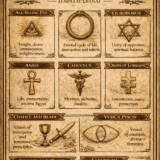
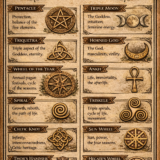
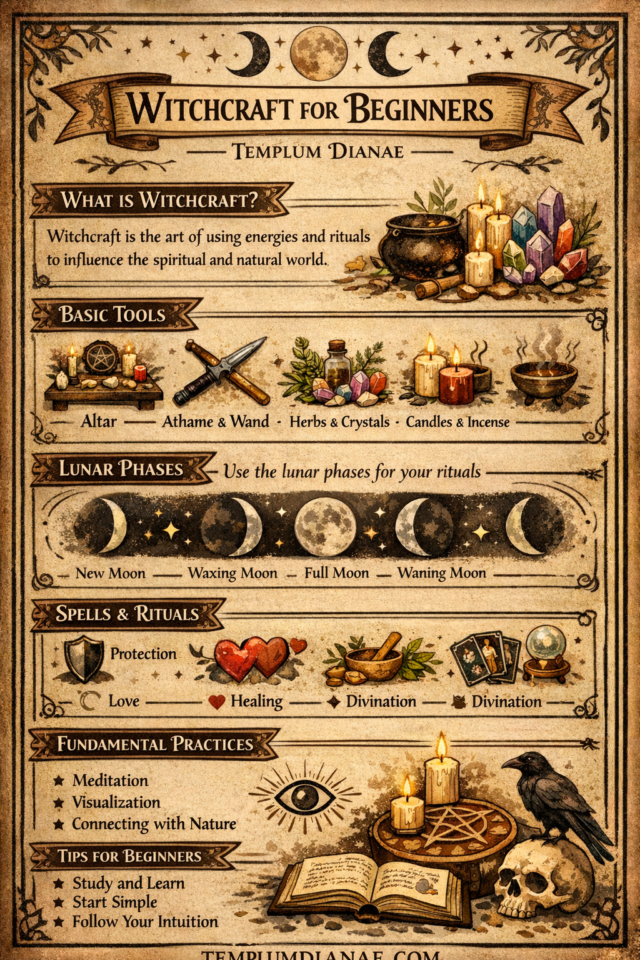
Witchcraft is wrapped in a visual language that beginners notice before they understand: the athame, the wand, the pentacle, the chalice, the candle, the cord, the mirror, the moon. In modern Wiccan ritual, the pentacle is commonly placed on the altar and is often read as a sign of the elements and directions. The athame functions as a ritual blade used to direct force rather than for ordinary cutting, while the wand is associated with projection, summoning, and focused intention. In many Wiccan tool systems, these ritual objects are linked to elemental correspondences, though the exact associations can vary by tradition.
For a beginner, the most useful way to read these tools is symbolically. The athame represents directed will, the ability to cut through confusion and define a boundary. The wand represents extension, influence, and the conscious sending of intention. The pentacle represents grounding, embodiment, order, and manifestation in the material plane. The chalice suggests receptivity, memory, and the inner vessel. None of these tools creates wisdom on its own. They externalize inner acts.
Even the word witchcraft carries that sense of practiced skill. Wikipedia notes that the term goes back to Old English wiccecræft, literally combining “witch” and “craft.” That etymology matters because it frames witchcraft not as random chaos but as a learned operation, a craft shaped by repetition, method, and symbolic literacy.
Witchcraft meaning and philosophy
At its core, witchcraft is the disciplined use of intention through symbol, timing, repetition, and altered awareness. Historically, the term was often applied to harmful magic, especially magic believed to injure people, livestock, crops, or fortune. Britannica still gives that older definition pride of place, describing witchcraft as harm brought upon others through occult or supernatural means, while also noting that the term broadened over time and can include healing, divination, and counter-magic in some contexts.
For a beginner entering modern esoteric practice, it helps to think of witchcraft as a craft of the wise: not “wise” in the sense of perfection, but in the sense of trained perception. You learn to notice what feeds you, what weakens you, what binds you, and what repeats. A spell then becomes more than a wish. It becomes intention given form. A ritual becomes more than theater. It becomes a way of aligning mind, body, memory, and desire so action stops leaking in ten directions at once.
Philosophically, witchcraft asks a hard question: what part of your life is truly fate, and what part is pattern reinforced by fear, appetite, habit, and inherited belief? Serious practice does not flatter the ego. It makes responsibility heavier. It asks you to choose with more awareness, speak with more precision, and stop calling compulsion “intuition.” In that sense, witchcraft is not escape from reality. It is a method for engaging reality with more symbolic intelligence and more inner command.
Witchcraft love and relationships meaning
magnetism, boundaries, discernment
In love, witchcraft teaches you to read the unseen structure of a bond. Attraction is not always alignment. Intensity is not always devotion. A beginner who approaches witchcraft seriously learns to protect their field, slow down projection, and see where attachment turns into obsession. The healthiest use of the Craft in relationships is not domination. It is discernment. It helps you recognize seduction, loyalty, psychic entanglement, emotional leakage, and the difference between a bond that nourishes you and one that feeds on your instability.
Witchcraft careers and abundance meaning
focus, momentum, manifestation
In work and abundance, witchcraft strengthens directed attention. That is where results begin. A scattered person may desire wealth, but desire without concentration burns out quickly. Beginner practice helps you build rhythm: clear intention, repeated action, symbolic reinforcement, and cleaner emotional management. In plain terms, you become harder to derail. Abundance work in witchcraft is strongest when it is not desperate. It works best when you combine spiritual focus with real decisions, timing, consistency, and an environment that supports what you claim to want.
Witchcraft and tarot and astrology
Tarot and astrology often function as reading systems around witchcraft rather than replacements for it. Tarot reads the pattern in motion. Astrology reads timing, temperament, and recurring cycles. Witchcraft becomes the operative layer: cleansing, protection, attraction, consecration, boundary work, devotion, or release.
For beginners, this matters because divination without action becomes passive. You can keep pulling cards forever and still never change the pattern. Tarot tells you where the tension is. Astrology tells you when the current is stronger. Witchcraft gives you a ritual response. In modern pagan and Wiccan settings, these systems are often blended into one broader esoteric framework, drawing from Western esotericism, ritual symbolism, and occult correspondences.
Witchcraft and dreaming interpretation
Dreaming is one of the oldest doors into witchcraft because dreams reveal what the waking mind edits out. A house in a dream can point to the psyche. A locked room can point to repression. Water may suggest emotion, memory, or psychic overflow. Repeated dreams often show unfinished inner work long before your daily life is honest enough to name it.
For a beginner, dream interpretation is useful when handled with restraint. Not every dream is prophecy. Many are symbolic rehearsals of fear, longing, guilt, desire, or transformation. The value lies in pattern recognition. Keep track of recurring images, emotional tone, and how your body feels upon waking. Over time, dreaming becomes one of the simplest ways to notice what your inner world is trying to communicate before it becomes a louder problem in waking life.
Witchcraft and shadow work
Shadow work is where witchcraft stops being aesthetic and becomes real. Ritual magnifies what is already present. If the practitioner is driven by envy, revenge, compulsion, or fear of abandonment, the work will amplify those forces too. This is why beginners who skip inner examination often become chaotic very quickly. The tools are not the danger. Unexamined motive is.
In practice, shadow work means noticing where you want control because you fear rejection, where you call something “spiritual guidance” because you do not want to face pain, and where you confuse intensity with truth. Witchcraft can support deep transformation, but only if you allow it to expose what your persona tries to hide. Otherwise the Craft becomes performance, and performance always collapses under pressure.
Witchcraft and the law of attraction
The law of attraction becomes more serious when filtered through witchcraft. It stops being “think positive and wait” and becomes “clarify, direct, reinforce, remove contradiction.” Attraction without structure often produces fantasy. Witchcraft adds structure through symbols, repetition, consecrated space, written intention, candle work, cleansing, and disciplined emotional tone.
For a beginner, this means you do not start by demanding impossible results. You start by learning how to hold a clear intention without immediately poisoning it with panic, obsession, or self-sabotage. Attraction work becomes stronger when it is paired with protection, banishing, and self-honesty. Sometimes the first spell for abundance is not a money ritual. It is the removal of the habits and attachments that keep you unavailable for growth.
Witchcraft and historical references
From the Middle Ages into the early modern period, witchcraft was commonly treated in Europe as a real source of harm, and accusations could lead to ostracism, punishment, torture, or death. Britannica identifies the major European and colonial witch trials as early modern phenomena, especially from the 15th to the 17th centuries, while Wikipedia notes that early modern witch-hunts led to tens of thousands of executions.
That historical record matters because modern beginners often inherit two distorted images at once: the satanic monster invented by persecutors, and the completely sanitized aesthetic icon created by modern pop culture. Neither is enough. During the Enlightenment, legal belief in witchcraft weakened across Europe, yet the fear of malevolent magic did not disappear everywhere. At the same time, some modern pagan movements reclaimed the term in the 20th century, especially through Wicca and related paths.
Witchcraft and ethics
A great deal of beginner ethics in modern witchcraft is filtered through Wicca, though witchcraft and Wicca are not the same thing. Wikipedia and Britannica both describe Wicca as a modern pagan religion that developed in England in the first half of the 20th century and became publicly visible through Gerald Gardner.
Two ethical ideas are especially influential. The first is the Wiccan Rede, commonly known in the form “An ye harm none, do what ye will,” which Wikipedia describes as a key moral statement in Wicca and certain related witchcraft-based faiths. The second is the Threefold Law, the idea that what one sends into the world returns amplified; Wikipedia also notes that this is not a universal belief among all Wiccans.
For beginners, the practical lesson is simple: ethics are not decoration. Before any spell, ask what this work strengthens in you. Clarity, courage, healing, and sovereignty lead somewhere different from coercion, obsession, and revenge.
Witchcraft and types of traditions
Modern witchcraft is not one single stream. Even within Wicca, traditions vary, lineages differ, and many practitioners work solitarily rather than in formal covens. Wikipedia describes Wicca as decentralized, with multiple traditions and disagreements over where its boundaries begin and end.
That is why beginner labels such as Green Witch, Kitchen Witch, Hedge Witch, eclectic witch, or folk witch are best treated as styles of emphasis rather than rigid historical castes. Green practice leans toward plants, land, and nature symbolism. Kitchen practice centers the home, the hearth, and everyday acts of blessing. Hedge practice often emphasizes liminality, spirit journeying, and threshold work. Eclectic practice borrows across systems. The useful question is not which label sounds impressive. It is which rhythm of practice you can sustain honestly.
Witchcraft and moon phases for beginners
Moon phases give beginners a simple structure. Waxing moon work is commonly used for growth, attraction, courage, and increase. Full moon work heightens visibility, intuition, charging, and revelation. Waning moon work is better for release, banishing, severing, and cleansing. The dark moon is often reserved for rest, silence, mourning, or deep inner work.
This structure works because it teaches rhythm. Instead of trying to do everything at once, you learn timing. That alone makes practice calmer and more coherent. Start with observation before ritual. Watch how your mood, dream life, and concentration shift across the lunar cycle. Then add one small act per phase: a candle, a written intention, a cleansing bath, a prayer, or a release rite. Simplicity builds accuracy.
Witchcraft and candle magic basics
Candle magic is one of the best beginner gateways because it is simple, visible, and easy to repeat. You choose a clear intention, a candle color if you use color symbolism, a phrase or petition, and a short ritual sequence. The candle becomes a fixed point for attention. Its value is not in theatrical complexity. Its value is concentration.
A good beginner method is small and specific. Cleanse the space. State the intention plainly. Dress or inscribe the candle only if you want to. Sit with the flame and hold the outcome in language that is clean, restrained, and grounded in reality. Then close the work properly. Do not treat candle magic like gambling. Treat it like disciplined symbolic training. Repetition teaches more than intensity.
Witchcraft and herbalism foundations
Herbalism enters witchcraft through scent, correspondence, memory, and embodied ritual. For beginners, the first lesson is respect. Plants are not aesthetic props. They have physical properties, cultural histories, and, in many traditions, spiritual associations. Learn the difference between medicinal use, symbolic use, and simple household use. Do not ingest herbs casually because a spell book sounded romantic.
A beginner foundation can be built with a few safe and familiar herbs: rosemary for remembrance and cleansing, basil for blessing and prosperity, lavender for calm, mint for freshness and alertness, chamomile for softness and ease. Use them in sachets, baths, teas only when safe and appropriate, altar offerings, smoke-free bowl blends, or charm bags. Start small. The point is not volume. It is relationship.
Witchcraft challenges and misconceptions
The biggest misconception about witchcraft is that it is either pure evil or harmless cosplay. Historically, accusations of witchcraft were often tied to fear, scapegoating, religious panic, and social control, especially in the early modern trials. At the same time, not every modern use of the word is historical continuation; some contemporary practitioners reclaim it inside modern pagan or esoteric religions such as Wicca.
For beginners, the more immediate danger is not demonic fantasy. It is confusion. People rush into spell work without ethics, symbolic literacy, or emotional stability. They try to control other people, chase signs obsessively, mistake coincidence for prophecy, or use ritual to avoid direct action. This creates distorted practice fast. Love work becomes fixation. Protection work becomes paranoia. Abundance work becomes desperation dressed in candles.
Another mistake is overvaluing tools. Expensive altar pieces do not create depth. Many strong practitioners began with a notebook, a candle, a bowl of water, and consistent attention. The Craft weakens when performance takes over. It also weakens when beginners borrow from traditions they have not studied, especially ancestral, folk, or closed systems they do not understand.
The clean beginner path is slower and more demanding. Learn symbolism. Keep notes. Test your impressions. Watch results honestly. Build ethics before intensity. That is how practice stops being fantasy and starts becoming craft.
Witchcraft FAQ
Witchcraft what is the true witchcraft meaning for beginners?
For beginners, witchcraft means a disciplined practice of intention, symbolism, timing, and spiritual attention. Historically the term often referred to harmful magic, but in modern practice it can also refer to protective, devotional, healing, and self-transformative work.
Witchcraft is it real and how does it work?
Historically, belief in witchcraft has existed across many societies. How it “works” depends on the framework: religious, magical, psychological, symbolic, or anthropological. A practical beginner answer is that ritual works by shaping focus, meaning, emotion, memory, and action; claims about literal supernatural causation differ by tradition and belief.
Witchcraft how do I start practicing at home?
Start with a clean, simple practice: a journal, a small altar or dedicated surface, basic cleansing, dream notes, one candle ritual, and regular reflection. Learn protection and grounding before complicated spell work. Consistency matters more than drama.
Witchcraft what are the most common witchcraft symbols and meanings?
Common beginner symbols include the pentacle for grounding and elemental order, the athame for directed will and boundary, the wand for projection and intention, the chalice for receptivity, and the candle for focused manifestation. In Wiccan practice, the pentacle is widely used on the altar and the elemental meanings of tools are important, though exact correspondences can vary.
Witchcraft can it help with finding a soulmate?
It can help you clarify desire, remove self-sabotage, strengthen magnetism, and improve discernment. What it should not become is a fixation on forcing one specific person. The strongest love work begins by making you more lucid, not more desperate.
Witchcraft what is the difference between Wicca and witchcraft?
Witchcraft is a broader category of magical practice and belief. Wicca is a specific modern pagan religion that emerged in 20th-century England and incorporates ritual, theology, ethics, and often witch identity. They overlap, but they are not identical.
Witchcraft do I need expensive tools to be a witch?
No. Tools can help focus the mind, but they are supports, not substitutes for practice. Many beginners do better with a very small setup because it forces precision and discipline.
Witchcraft is it dangerous or evil?
Historically, many cultures feared witchcraft as malevolent magic, and that fear fueled persecutions. Modern practice is not automatically evil, but it can become unhealthy when driven by coercion, obsession, paranoia, or unethical intent. The moral risk is real when the practitioner refuses self-examination.
Witchcraft how do I write my own spells?
Start with one clear intention. Use plain language. Keep the outcome specific and ethical. Choose a symbolic action that matches the goal, such as lighting, cleansing, binding, releasing, blessing, or charging. Record the result. Refine after repetition.
Witchcraft what is a Book of Shadows and do I need one?
A Book of Shadows is closely associated with Wicca and traditionally contains ritual texts and magical instructions; in modern solitary practice it is often treated more like a personal working journal. You do not need one to begin, but keeping records is one of the fastest ways to mature as a practitioner.
#Witchcraft references and further reading
Historical and cultural overview: Witchcraft on Wikipedia
Encyclopedic reference: Witchcraft on Britannica