The Anteater spiritual meaning is associated with specialization, patience, sensory focus and quiet strength. The giant anteater is one of the clearest examples of a mammal shaped around a specific ecological task: it has no teeth, a long narrow snout, an exceptionally long sticky tongue, powerful forelimbs and large claws used to open ant and termite nests. It usually avoids conflict, yet those same claws can become formidable defensive tools when escape is not possible. Symbolically, the Anteater combines gentleness with capability and patience with highly specialized action.
This guide keeps three layers separate: the animal’s real behavior, documented cultural material, and modern spiritual interpretation. That distinction prevents a recent symbolic idea from being presented as ancient tradition and keeps the animal itself at the center of the meaning.
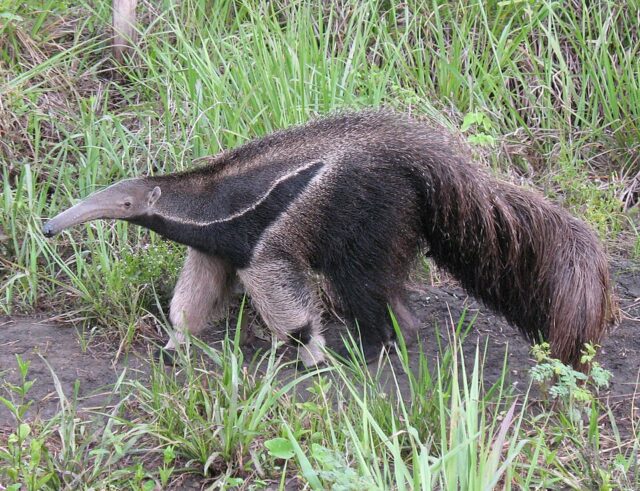
Anteater spiritual meaning: quick guide
| Core meanings | Specialization, patience, sensory focus, self-sufficiency, deliberate effort and nonaggressive strength |
| Shadow meanings | Over-specialization, isolation, ignoring alternatives and appearing passive until pressure becomes extreme |
| Spirit animal lesson | Know what you are built to do, and use strength selectively rather than constantly |
| Best way to read an encounter | Start with behavior and context, then use symbolism as reflection rather than prediction |
What does a Anteater symbolize?
Giant anteaters rely heavily on smell to locate ant and termite colonies. They open a nest, feed rapidly with the tongue and often move on rather than destroying the entire colony. This creates a symbolic pattern of selective extraction: take what is needed, do not remain in one place longer than necessary, and keep moving across a broader landscape.
The animal’s anatomy is an extreme lesson in specialization. Powerful digging claws, a long tongue and elongated skull all serve a focused feeding strategy. Spiritually, this can represent mastery built around a clear niche. The advantage of specialization is efficiency; the risk is dependence on a limited set of conditions. The symbol therefore asks both “What are you uniquely suited to do?” and “Where has specialization narrowed your options too far?”
The Anteater’s apparently slow gait can also mislead. Smithsonian sources note that giant anteaters can move quickly when necessary and can defend themselves using their foreclaws. The spiritual meaning is not passivity. It is conserving force until force is actually required.
Anteater as spirit animal, totem and power animal
As a modern spirit animal, Anteater can symbolize a period of narrowing attention toward what truly nourishes a goal. It favors less scattering, better sensory discrimination and repeated attention to a defined niche. This can be relevant to study, craft, business specialization or healing practices where progress comes from doing a small number of things very well.
As a power-animal image, Anteater represents selective strength. It does not display weapons continuously; the claws used for feeding become defensive only when necessary. That makes the animal useful symbolically for people learning to set boundaries without becoming aggressive.
People drawn to Anteater symbolism may value independence, concentration and unconventional methods. The shadow is becoming so self-contained or specialized that collaboration and new possibilities disappear. A balanced Anteater knows its niche without confusing a niche with the whole world.
The terms spirit animal, totem and power animal are frequently blended together in contemporary spirituality, but they are not historically identical. “Totem” belongs to culturally specific Indigenous systems and should not be treated as a universal synonym for a personal animal symbol. Here the Anteater is discussed primarily as a modern symbolic and reflective figure. For the terminology itself, see Spirit Animals, Totems & Power Animals.
What does it mean when you see a Anteater?
A giant Anteater walking across grassland or forest edge can symbolize deliberate movement and independence. An animal feeding emphasizes focus and extracting value from small, repeated sources. One rearing defensively is a much stronger boundary image: avoid confrontation where possible, but do not mistake avoidance for helplessness.
Direct encounters should always respect distance. Giant anteaters are wild animals with large claws, and conservation concerns in parts of their range include habitat loss, fire and road collisions. A meaningful encounter is not an invitation to approach.
In dreams, an Anteater may represent searching for what is hidden beneath a surface, focusing on small details or finding sustenance where others see almost nothing. An Anteater that cannot find food may symbolize over-specialization. One defending itself can represent a boundary that has reached the point where passive endurance is no longer enough.
An encounter does not prove that a supernatural message has been sent. The useful approach is to ask first what the animal is actually doing and why it may be present, then notice whether the encounter mirrors a real question in your life. Context gives symbolism precision.
Anteater in folklore, culture and modern symbolism
Anteaters are native to the Americas and appear in the cultural landscapes of many distinct peoples, but there is no single Indigenous “Anteater meaning” that can responsibly be generalized across Central and South America. Specific stories belong to specific languages, communities and sources.
Modern symbolism often grows more directly from the animal’s striking anatomy and behavior: the long snout, remarkable tongue, slow-looking movement and powerful claws. Conservation work has also changed contemporary cultural perception by emphasizing the species’ vulnerability to roads, habitat change and fire. These are modern ecological realities, not ancient omens, but they legitimately shape what the Anteater represents today.
Species and behaviors: how the symbolism changes
“Anteater” includes several species. The giant anteater is terrestrial and the largest. Tamanduas are smaller and more capable climbers, while silky anteaters are small, arboreal animals with a different scale of movement and habitat. A symbolic interpretation should therefore avoid treating every Anteater as a miniature version of the giant species.
Giant Anteater behavior emphasizes solitary foraging, smell and large-scale movement. Tamandua imagery can add flexibility between ground and trees. Silky anteaters can emphasize concealment and delicate arboreal specialization. Feeding suggests focused extraction; defensive rearing suggests boundaries; a mother carrying a young on her back can symbolize protection and continuity.
The practical lesson of the Anteater
The Anteater asks where specialization is an advantage and where it has become a limitation.
- Identify the small set of activities that actually feed the larger goal.
- Stop displaying force where careful sensory attention would work better.
- Protect boundaries decisively if avoidance has already failed.
- Keep enough flexibility that a changing environment does not erase your options.
Its spiritual lesson is quiet competence. You do not need every possible tool. You need the right tools, used with enough patience and accuracy to solve the problem they were built for.
For the wider animal cluster, continue with Mammal Symbolism. Animal symbolism works best when it deepens observation rather than replacing it: the real animal supplies the pattern, documented culture supplies historical context, and the modern spiritual reading becomes a tool for reflection.
References
Web References
- https://nationalzoo.si.edu/animals/giant-anteater
- https://www.vet.cornell.edu/about-us/news/20241028/student-blog-advancing-giant-anteater-conservation-brazil
- https://animaldiversity.org/accounts/Myrmecophaga_tridactyla/
Image Reference
https://commons.wikimedia.org/wiki/File:Myrmecophaga_tridactyla,_Pantanal_region,_Brazil_(cropped).jpg