Meaning of Major Arcana is the key that turns tarot from random images into a true spiritual map. If you’ve ever pulled a Major Arcana card and felt it hit “deeper” than usual, it’s because these 22 archetypes speak about life lessons, turning points, and inner transformation.
Welcome. In this guide you’ll learn how to understand the Major Arcana with more clarity—so you stop relying on vague keywords and start seeing what the cards are really trying to show you, through their symbols, patterns, and hidden structure.
In this article you’ll discover:
- How to read tarot cards with a simple method
- The meaning of the Major Arcana cards and what makes them different
- The meaning of the symbols in Major Arcana (and why they matter)
- … and much much more!
Keep reading—because once you understand the Major Arcana, tarot becomes less confusing and far more powerful.

What Are the Major Arcana?
The Major Arcana are the heart of the tarot deck. They are 22 symbolic cards that represent universal human archetypes—inner forces and life passages that almost everyone meets at some point: beginnings, choices, love, power, crisis, justice, change, endings, and rebirth.
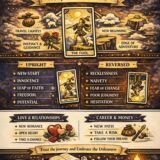
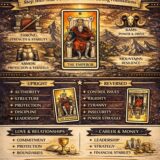
Each Major Arcana card has a core meaning, but it can shift depending on the question, the spread position, and the surrounding cards. For example, The Fool often points to innocence, spontaneity, and a new adventure—while The Emperor speaks of structure, authority, discipline, and taking control of your life.
Historically, the Major Arcana became strongly associated with divination and esoteric study from the 18th century onward, and they remain the most recognized tarot images today. Many readers use them not only for prediction, but as a tool for self-knowledge and personal growth: a mirror that reveals what’s changing inside you, what lesson you’re facing, and what kind of transformation is trying to emerge.
major arcana and numerology
Among all tarot cards, the Major Arcana are the most symbolically dense. Their imagery echoes multiple esoteric traditions: references to the liberal arts and medieval initiatic schools, currents of Hermeticism linked to the teachings attributed to Hermes Trismegistus, and—according to many researchers—possible bridges with astrology and alchemy.
One of the strongest connections is with Jewish Kabbalah and numerology. This is why Major Arcana cards are not only numbered: in many occult systems they are also associated with a Hebrew letter, signaling a deeper map behind the images.
At the center of this map is the Tree of Life (the Sephirotic Tree), a symbolic diagram made of ten sefirot arranged on three vertical pillars—left, right, and a central pillar that extends above and below the others. These ten spheres are linked by twenty-two paths (horizontal, vertical, and diagonal). In Kabbalistic tradition, each path corresponds to one of the twenty-two Hebrew letters.
Because of this structure, tarot has often been used as a practical gateway for studying Kabbalah and numerology—a visual language that turns abstract principles into living archetypes.
Major Arcana Tarot Card Meanings
The Major Arcana carry a deep esoteric meaning that goes beyond reading each card as an isolated message. Each card represents a universal archetype—a symbolic force that mirrors a stage of human experience and a passage of existence.
In a broad spiritual framework, the Major Arcana can be seen as three main groups: seven archetypes of personality, seven archetypes of the soul, and seven archetypes of the spirit.
The archetypes of personality reflect human nature and the challenges we must face to grow: identity, ego, choices, boundaries, and how we relate to other people and to the world around us.
The archetypes of the soul describe the inner journey: the search for meaning and truth, the emotional landscape, desire and fear, and the hidden forces that push us toward deeper answers.
Finally, the archetypes of the spirit point to awakening and transformation: connection with the divine, expanded consciousness, and the ability to change oneself—and therefore change one’s reality.
Seen this way, the Major Arcana become a path of development, guiding you through the integration of personality, soul, and spirit.
If you want to explore more about Templum Dianae meditation for woman energy—with deeper guidance, practical protocols, and feminine spiritual tools—follow this page
List of the 22 Major Arcana
The Fool
Upright: innocence, new beginnings, free spirit
Reversed: recklessness, being taken advantage of, lack of awareness
Read the full meaning of The Fool
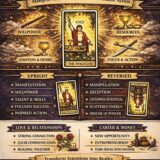
The Magician
Upright: willpower, desire, creation, manifestation
Reversed: deception, illusions, out of touch with reality
Read the full meaning of The Magician
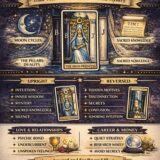
The High Priestess
Upright: intuition, subconscious, inner voice
Reversed: lack of grounding, lost inner voice, repressed feelings
Read the full meaning of The High Priestess
The Empress
Upright: motherhood, fertility, nature
Reversed: dependence, smothering, emptiness, intrusive behavior
Read the full meaning of The Empress
The Emperor
Upright: authority, structure, control, fatherhood
Reversed: tyranny, rigidity, coldness
Read the full meaning of The Emperor
The Hierophant
Upright: tradition, conformity, morality, ethics
Reversed: rebellion, subversion, new approaches
Read the full meaning of The Hierophant
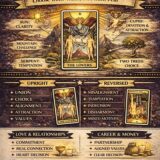
The Lovers
Upright: connection, duality, union
Reversed: imbalance, one-sidedness, disharmony
Read the full meaning of The Lovers
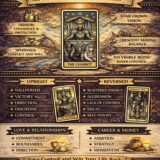
The Chariot
Upright: direction, control, willpower
Reversed: lack of control, lack of direction, aggression
Read the full meaning of The Chariot
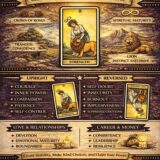
Strength
Upright: inner strength, courage, compassion, focus
Reversed: self-doubt, weakness, insecurity
Read the full meaning of Strength
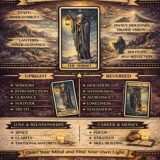
The Hermit
Upright: contemplation, search for truth, inner guidance
Reversed: loneliness, isolation, losing your way
Read the full meaning of The Hermit
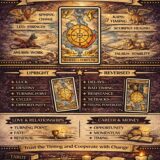
Wheel of Fortune
Upright: change, cycles, inevitable fate
Reversed: no control, clinging to control, bad luck
Read the full meaning of Wheel of Fortune
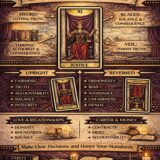
Justice
Upright: cause and effect, clarity, truth
Reversed: dishonesty, irresponsibility, injustice
Read the full meaning of Justice
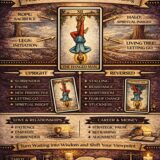
The Hanged Man
Upright: sacrifice, release, martyrdom
Reversed: stalling, pointless sacrifice, fear of sacrifice
Read the full meaning of The Hanged Man
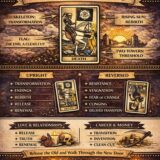
Death
Upright: end of a cycle, beginnings, change, transformation
Reversed: fear of change, clinging, stagnation, decay
Read the full meaning of Death
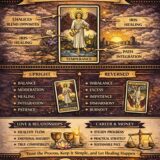
Temperance
Upright: moderation, patience, finding meaning
Reversed: extremes, excess, lack of balance
Read the full meaning of Temperance
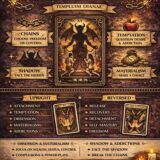
The Devil
Upright: addiction, materialism, playfulness
Reversed: freedom, liberation, taking back control
Read the full meaning of The Devil
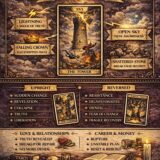
The Tower
Upright: sudden upheaval, shattered pride, disaster
Reversed: avoided disaster, delayed disaster, fear of suffering
Read the full meaning of The Tower
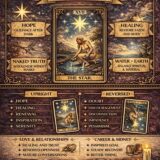
The Star
Upright: hope, faith, renewal
Reversed: loss of faith, discouragement, insecurity
Read the full meaning of The Star
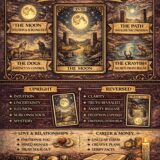
The Moon
Upright: subconscious, illusions, intuition
Reversed: confusion, fear, misinterpretation
Read the full meaning of The Moon
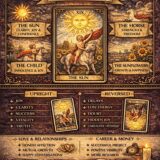
The Sun
Upright: joy, success, celebration, positivity
Reversed: negativity, depression, sadness
Read the full meaning of The Sun
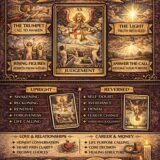
Judgement
Upright: reflection, reckoning, awakening
Reversed: lack of self-awareness, doubt, self-disgust
Read the full meaning of Judgement
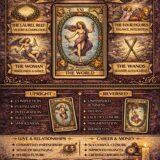
The World
Upright: fulfillment, harmony, completion
Reversed: incompletion, no closure
Read the full meaning of The World
Books About the Major Arcana
If you want to go beyond short keywords and truly understand the meaning of each Major Arcana card, the fastest path is a solid reference book. The Tarot Reading Bible by Templum Dianae breaks down every Major Arcana in detail—core meanings, symbolism, practical interpretation tips, and deeper esoteric layers you can study over time. If you want a complete guide you can keep next to your deck and return to whenever a card feels unclear, follow this link here
References
Templum Dianae Media, Tarot Reading Bible: A Complete Guide to the Art of Divination. (via Google Books).
Medium, “Beyond the Veil of Chance: Why Tarot is the Map of Our Unconscious“. (Accessed March 2026).
The British Museum, “History of Playing Cards and Tarot“. Collection Database.
Yale University Library, “The Cary-Yale Visconti-Sforza Tarot Deck“. Beinecke Rare Book & Manuscript Library.
Encyclopedia Britannica, “Tarot: Playing Cards and Divination“.
Wikipedia, “Tarot: Origins, Esotericism, and Cultural Impact“.